
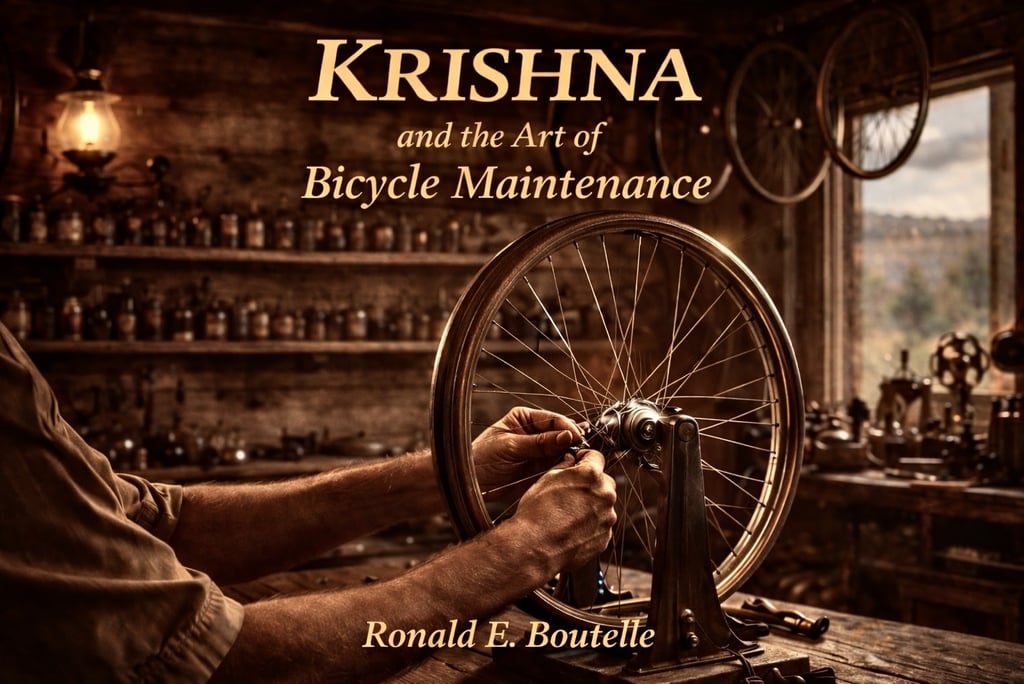
Krishna and the Art of Bicycle Maintenance

- Table of Contents -
The Third Light
The great sage Narada Muni is glorified throughout the Vedic scriptures as an empowered servant of the Supreme Personality of Godhead. His mission is to spread devotional service, and by the Lord’s grace, he is free to travel between the material and spiritual worlds.
One day, Narada came upon a brahmin deeply engaged in his morning rituals. This priest took great pride in his ability to recite the Vedas from memory, and in the austerities he performed.
Seeing Narada approach, he asked where he was going.
“I am on my way to see Lord Krishna,” Narada replied.
At once the brahmin said, “Then please do me a favor. Tell the Lord of my accomplishments, my knowledge, my austerities—and ask Him when I shall return to the spiritual world.”
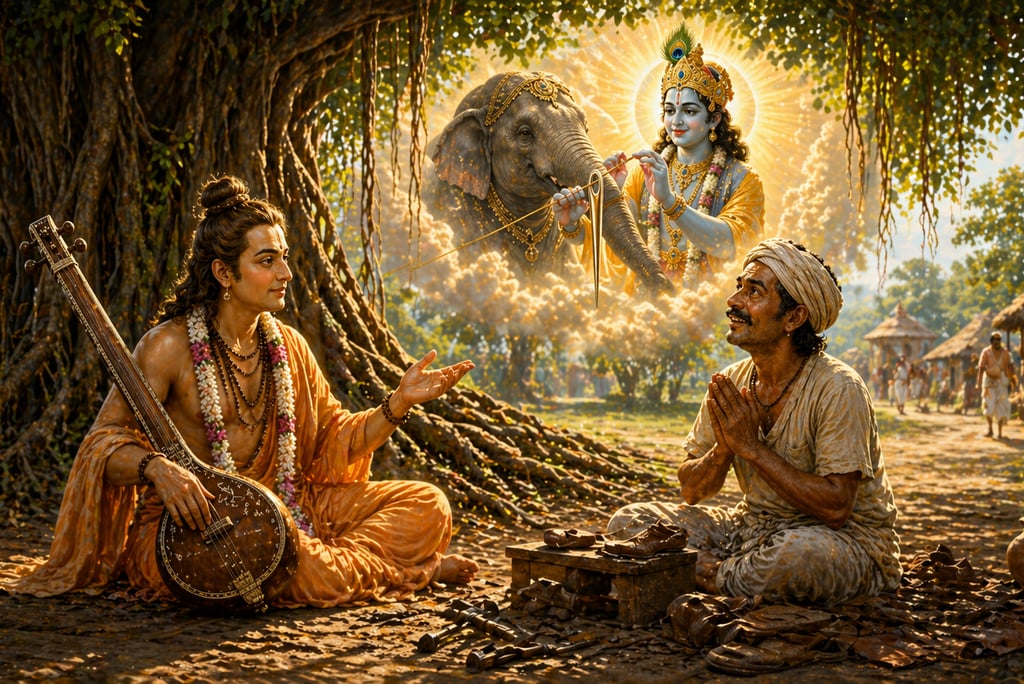
Narada agreed and continued on his journey. Not long after, he came upon a humble cobbler sitting beneath a banyan tree, repairing shoes. When the cobbler learned that Narada was going to see Lord Krishna, he, too, made a request: “Please ask the Lord when I will be able to return to Him.”
Narada kindly agreed and when Narada reached the spiritual world and sat before Lord Krishna, he presented both requests.
The Lord replied: “As for the cobbler, after this life he will come directly to Me. But the brahmin—he must remain for many more births. I do not know when he will return.”
Narada was surprised. “My Lord, this puzzles me.”
“You will understand,” Krishna said. “When they ask what I was doing, tell them I was threading an elephant through the eye of a needle.”
Narada returned first to the brahmin and delivered the Lord’s message. Hearing that he would remain bound in the material world, the brahmin became furious.
“I don’t believe you were with God at all!” he snapped. “If you saw Him, tell me—what was He doing?”
Narada repeated the Lord’s words. “The Lord was threading an elephant through the eye of a needle.”
The Brahmin immediately scoffed. “Impossible! No intelligent person could believe such nonsense. Leave me alone.”
Seeing his lack of faith, Narada departed.
Later, Narada returned to the cobbler and gave him the Lord’s reply. The cobbler’s face lit up with joy.
“This will be my last birth?” he said, overwhelmed. “My Lord is so kind!” Then he asked softly, “Please tell me… what was He doing when you saw Him?”
Narada replied, “He was threading an elephant through the eye of a needle.”
At once, the cobbler folded his hands, his eyes filling with tears. “My Lord is so great,” he said. “He can do anything.”
Narada, curious, asked, “Do you truly believe this?”
The cobbler gestured toward the ground beneath the banyan tree.
“Just look here,” he said. “There are countless seeds and inside each one is a tree as large as this. If the Lord can place such a vast tree within a tiny seed, then threading an elephant through the eye of a needle is nothing for Him.”
Narada was deeply moved. He had given both men the same message—yet their responses revealed everything. The brahmin had knowledge, but no faith. The cobbler had simple faith—and because of that, he was ready to meet his Lord.
Doubt: There may not be a more dangerous force in the human mind—especially when it comes to our relationship with God.
Doubt creates distance. It weakens trust. And if left unchecked, it can quietly lead us away from the very truth we are trying to find.
In the book Through the Eyes of Jesus, Jesus is quoted as saying: "When you doubt, you place a barrier between you and Me.”
The dictionary defines doubt as:
uncertainty
hesitation
lack of trust
And in spiritual life, that definition becomes very real, because if doubt succeeds in undermining our faith in God, the consequences are profound.
I know this struggle personally. Doubt has not been an abstract concept in my life—it has been an opponent. At times, a fierce one.
Faith seems to develop in two places: First in the mind…and then in the heart. We hear the Word of God, and it enters the mind. There it is examined, questioned, and tested. Only after that does it settle deeper within us—if we allow it. Within the mind is where doubt often does its work.
I did not grow up in a religious environment. I had no strong foundation, no clear guidance. For many years, I relied on my own instincts, trying to make sense of a world that often felt confusing and uncertain. I spent long stretches of my life searching—trying to understand what truly mattered. Then, one day—deep in the Adirondack Mountains, near a small cabin—I came to a realization: I needed help.
Searching for truth alone is not easy, and by what I can only describe as Providence, I was led to Lord Krishna. I made a decision to place my faith in Him, but at that very moment…doubt appeared as well.
The greater I began to understand God’s greatness, the greater the questions seemed to become. It felt as though the magnitude of my doubts was rising alongside the magnitude of what I was discovering.


---🔧---
A woman living in Nevada was severely crippled. She could not walk. She could not even wear shoes. Her body had become so twisted that she had to be carried in a sling.
After years of suffering, her condition only worsened. Finally, her doctor concluded that only a major operation could offer any hope.
On the day the ambulance arrived to take her to the hospital, she made an unusual request. She wanted her slippers. For nearly twenty years she had not been able to wear them—nor was there any expectation that she ever would again. Still, she insisted.
Turning to her husband, she said with complete certainty, “Jesus is going to heal me. When I get to the hospital, I’ll need these. The floors will be cold… and I’m going to walk.”
That night, while the hospital slept, she prayed. At around two o’clock in the morning, the nurse on duty heard sudden, sharp cracking sounds echoing down the hallway. Alarmed, she rushed to investigate.
What she found was astonishing. The woman—who had arrived unable to walk—was now standing… wearing her slippers. Calmly, she said that Jesus had just healed her.
Those sounds the nurse had heard were later described as her twisted bones snapping straight. By morning, she was walking the halls, telling everyone she met about the mercy of her Lord. She had never lost her faith.
I don’t know if this story is true. I heard it on a Christian radio station and it stayed with me. What struck me most was not just the account itself, but the kind of faith it represents—a faith so strong that it refuses to yield, even in the face of overwhelming odds. Whether every detail happened exactly as described or not, the message is unmistakable: Faith, when it is real, does not hesitate. It does not bargain. It does not retreat. It believes.


One kind of envy that I openly admit to is this: I envy those who possess unshakable faith in God. This is the kind of faith I want—the kind that stands firm and challenges all doubt. Wouldn’t it be wonderful to be such a person?
We can all appreciate that God is capable of the unthinkable—or what we call the impossible. This is what makes Him so incredible. Yet, this very truth can also present a problem. God is so great, so inconceivable, that His actions often lie far beyond our ability to understand.
It has been said that the mind is like a computer—always calculating. In many ways, this is true. But like any machine, it has its limits.
Imagine handing a calculator to someone, unfamiliar with how it works, and then asking them to add enormous numbers—thirty-five billion plus sixty-two million, and then larger still. At some point, the machine would fail to process the input. It would freeze, not because it is broken, but because it has reached the limits of what it was designed to handle.
If this continued, the person might conclude that the calculator itself was useless—losing faith in it entirely.
But the problem was never the calculator.
This is much like the human mind. It, too, has limits. When we try to fit the Infinite within it, God simply will not “compute.” And in that gap—between what is real and what we can comprehend—doubt quietly takes hold.
This has been my struggle. Trying to contain the Infinite within the confines of my own understanding has never worked. Clearly, something greater is required—something capable of embracing what the mind cannot.
That something is faith.
If we could possess even a fraction of the simple faith of the cobbler, our lives would overflow with joy. Just as the brahmin and the cobbler were each confronted with their own “elephant,” so too are we.
Some aspects of God are easy to accept. Others stretch us beyond what we can comprehend. Yet both are real.
These are our “elephant stories.” And if we can learn to embrace them—not just the understandable, but the inconceivable as well—then something remarkable begins to happen.
Instead of doubt, we find wonder. Instead of resistance, we find trust. And instead of confusion, we find joy.
---🔧---
At times, even protected by thick shields made of iron and hardened leather, elephants have been trained to perform a wide range of tasks. Among their most formidable roles was their use in ancient warfare—serving as the first “armored tanks” on the battlefield.
For example, during the Battle of the Hydaspes (326 B.C.), the Indian army, commanded by Porus, charged Alexander the Great with over two hundred elephants in full battle dress.
Elephants have also been trained for labor—dragging massive logs from deep, long-forgotten forests. These seven-thousand pound “living bulldozers” can easily pull four thousand pounds, and even more for short distances.
The strength of a single elephant surpasses that of sixty strong men. And when several work together, their combined power is nothing short of astonishing.
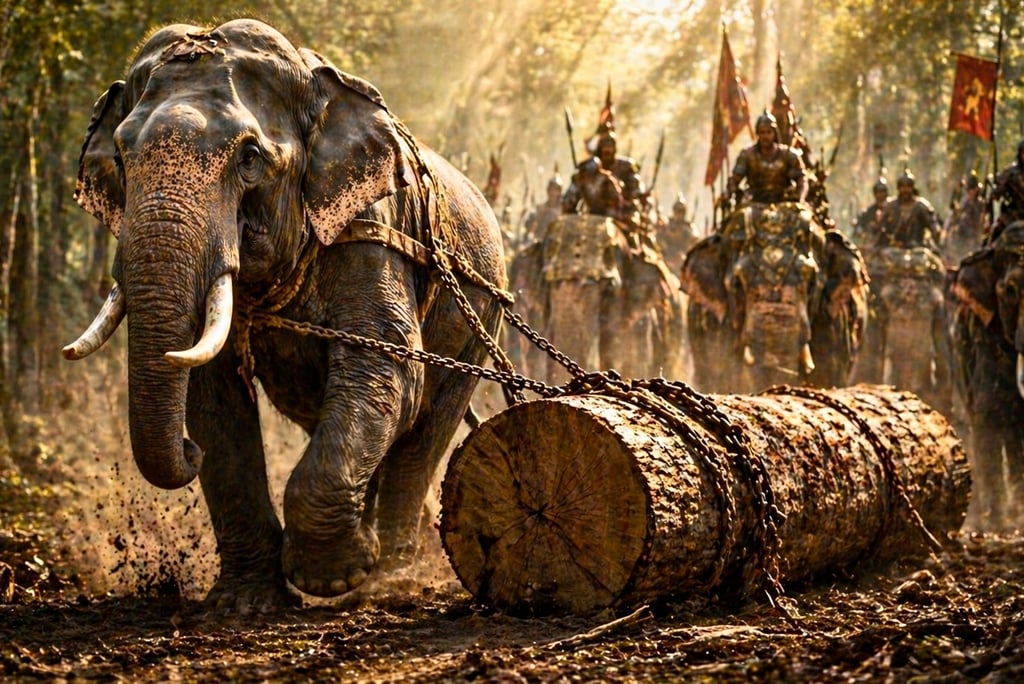
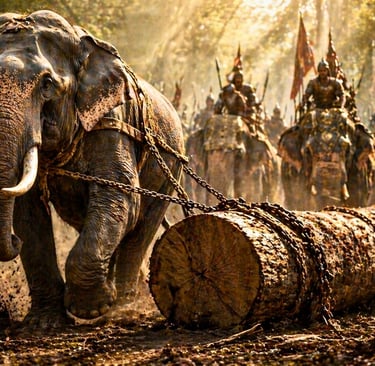
Indeed, elephants have been called upon to pull just about everything imaginable. But on one particular morning, over five hundred years ago, even their combined might was rendered powerless—greatly disappointing a famous king who had urgently ordered their use during an ancient festival. What follows is an eyewitness account:
“Outside the garden, when it was time to pull Lord Jagannatha’s cart, all the workers tried to pull it, but it would not move forward.”
(Note: This attempt to move Lord Jagannatha’s cart (jog-a-nath) took place at the beginning of a famous religious parade held annually in Puri, India.)
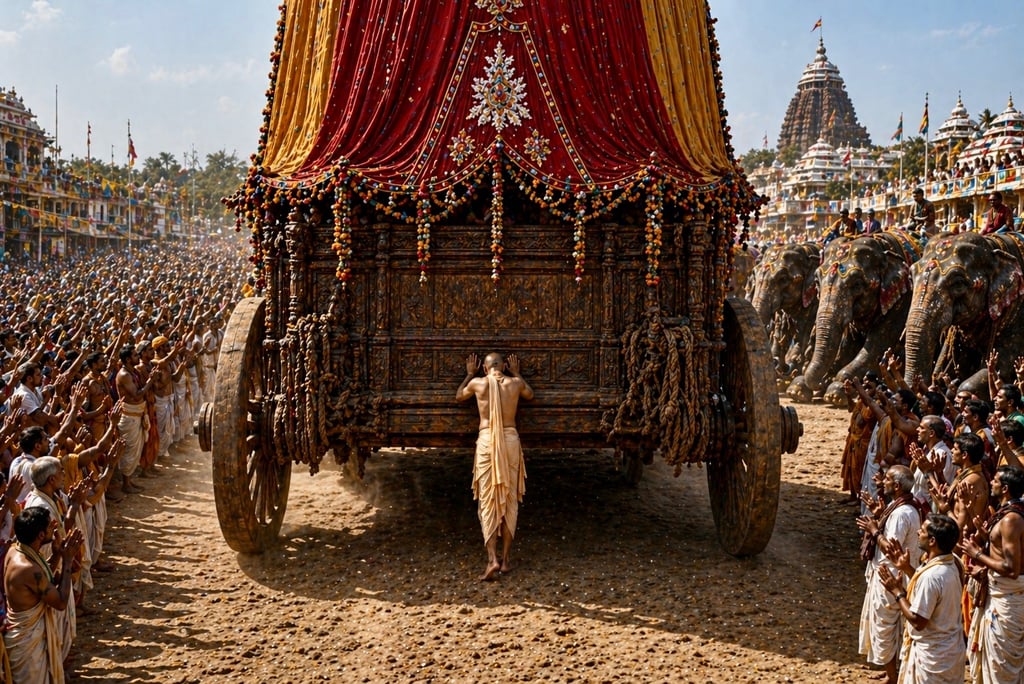
Large wooden deities of Lord Jagannatha, Lady Subhadra (soob-ha-DRA), and Lord Balarama (ball-a-ROM) are placed upon massive carts and taken on a grand procession lasting many hours. They are recognized as divine manifestations of Lord Krishna, His sister, and His divine brother in sacred form. Even today, they are worshiped in many Krishna temples throughout the world.
Built from enormous timbers and towering nearly forty-five feet high, these carts weigh many tons. As the festival begins, thousands of pilgrims—from across Orissa and beyond—gather to help pull the Lord’s cart by grasping the long ropes attached to it.
However, on this particular morning, when it was time for the lead cart to move, something extraordinary occurred. Despite all efforts, its enormous wheels refused to turn.
“When everyone saw that they could not budge the cart, they abandoned their attempt. Then the king, Maharaja Prataparudra (ma-HA-RAJ—pra-TA-pa-roo-dra), arrived in great anxiety, accompanied by his officers and associates. The king then arranged for powerful wrestlers to pull the cart, and even he himself joined in—but still, the cart would not move.
“Becoming even more eager, the king ordered strong elephants to be brought and harnessed to the cart. The elephants pulled with all their strength, yet the cart remained fixed—immovable, not budging an inch.
“As soon as Lord Chaitanya heard this, He came with His personal associates. They stood and watched as the elephants strained. The animals, beaten by their trainers cried out in distress—but still the cart did not move. The assembled crowd lamented, ‘Alas!’
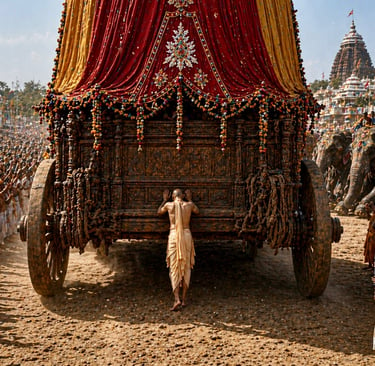
“At that moment, Lord Chaitanya ordered that all the elephants be released. He placed the ropes into the hands of His devotees and then went behind the cart. Pressing His head against it, He began to push.
“Immediately, the cart began to move—rolling forward with a great rattling sound.
“Indeed, it moved effortlessly. The devotees simply held the ropes—they did not need to pull. As the cart advanced, the crowd erupted in joy, chanting, ‘All glories! All glories! All glories to Lord Jagannatha!’ Nothing else could be heard.” (Bhaktivedanta Swami Prabhupada, Chaitanya-charitamrita, Madhya-lila 14.47–57)
Even the combined strength of men and elephants could not move the cart. Yet, with a simple touch from the Lord, what was impossible became effortless.
This is the nature of God—beyond all calculation, beyond all limitation.
Shortly after the miraculous way in which Lord Chaitanya moved the enormous cart, Shri Chaitanya Mahaprabhu—at just twenty-nine years of age—set out on foot from Puri to Vrindavan, a journey of nearly one thousand miles.
During this long and arduous pilgrimage, He traveled through the dense and foreboding forests of Jarikhanda (JAW-ree-kan-da), accompanied by Balabhadra Bhattacharya (ball-a-bud-ra— but-a-CHAR-ya), a highly respected priest. Based on Balabhadra’s firsthand account, what took place in that jungle defies all ordinary understanding:
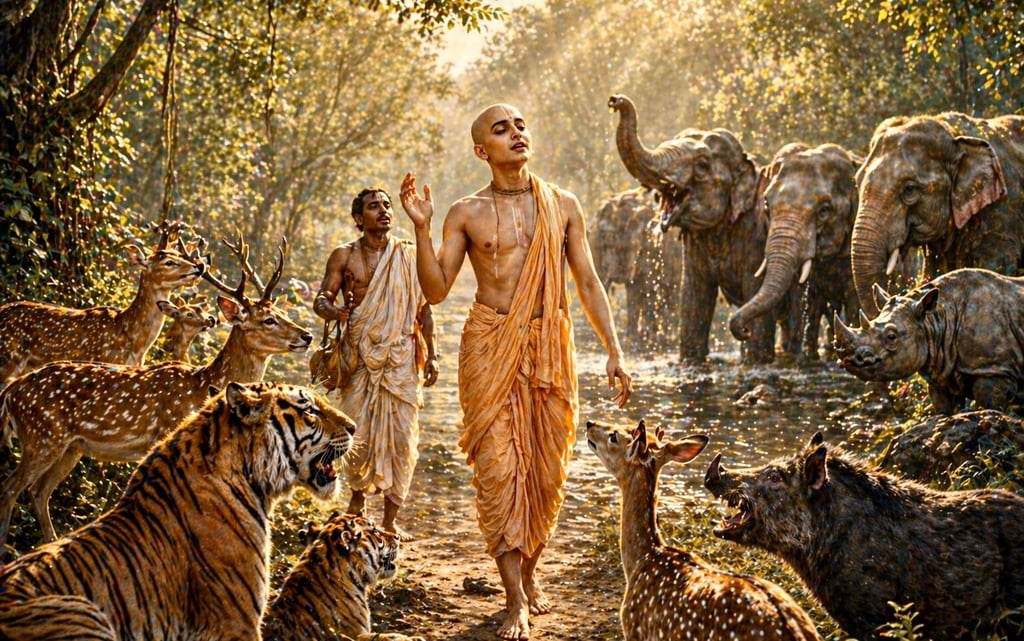
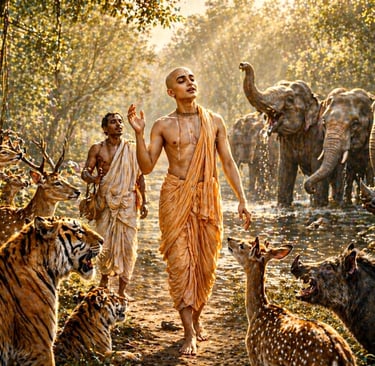
As Lord Chaitanya moved through the forest, absorbed in chanting the Holy Names of Lord Krishna, the wild animals—tigers, elephants, rhinoceroses, and boars—naturally gave way. Though Balabhadra was struck with fear at the sight of these dangerous creatures, by the Lord’s influence they became peaceful, standing calmly to either side as He passed.
On one occasion, a tiger lay directly in the path. Unaware of any danger, Lord Chaitanya gently touched it with His foot and said, “Chant the Holy Name of Krishna.” Instantly, the tiger rose and began to chant, “Krishna, Krishna,” dancing in ecstasy.
On another day, while the Lord was bathing in a river, a herd of elephants approached to drink. Seeing them, He playfully splashed water upon them and requested that they chant the Holy Name. Touched by that water, the elephants began to chant, “Krishna, Krishna,” lifting their trunks, swaying, and even falling to the ground in spiritual ecstasy. Witnessing this, Balabhadra was overcome with astonishment.
At times, Lord Chaitanya would chant loudly as He walked. Hearing His sweet voice, gentle deer approached Him from all directions, following Him closely on both sides. With great affection, He patted them and recited a verse describing the beauty of Lord Krishna:
“Blessed are these deer, for they have approached the son of Maharaja Nanda, who is beautifully dressed and playing upon His flute. Both the does and the bucks worship Him with loving glances.” (Shrimad-Bhagavatam 10.21.11)
Then something even more extraordinary occurred.
Groups of tigers emerged from the forest and joined the deer, following alongside the Lord. Seeing this, Lord Chaitanya was reminded of the land of Vrindavan, where natural enemies live together in harmony. He then recited another verse:
“Vrindavan is the transcendental abode of the Lord, where there is no hunger, anger, or thirst. Even those who are naturally enemies live together there in perfect friendship.” (Shrimad-Bhagavatam 10.13.60)
As the Lord called out, “Chant Krishna! Krishna!” the animals responded. Tigers and deer alike began to chant and move together in joy. Some leapt, some stood still in wonder, and some even approached one another without fear.
In that sacred moment, the impossible became reality—natural enemies embraced, touching one another gently, as if bound by a higher affection.
Seeing this astonishing transformation, Lord Chaitanya smiled. Then, leaving the animals behind, He continued on His journey toward Vrindavan. (Chaitanya-charitamrita, Madhya-lila 17.25–43)
Sadly, my dilemma has always been this: ...even when I read an eyewitness account or an historical record, I am not always able to accept it as truth. The irony is that some of the most unbelievable things I am asked to accept are found in the very books I most want to believe—the Holy Scriptures. What a curious predicament to be in.
Most of us are familiar with these kinds of accounts. In the Holy Bible:
Noah is said to have lived to be 950 years old (Genesis 9:29).
Moses held out his rod, and the Red Sea was parted (Exodus 14:21).
Jonah was swallowed by a great fish, remained inside for three days, and was then cast safely back onto dry land (Jonah 1–2).
These are just a few examples. And yet, as astonishing as they are, many people absolutely accept them—largely because they have grown up hearing them. But the real difficulty comes when we are asked to consider something unfamiliar, especially from another tradition—such as stories found in the Shrimad-Bhagavatam and other Vedic scriptures.
And yet, if we look closely, there are striking similarities.
Both Christianity and the Gaudiya (gow-dee-ya) tradition assert that their Scriptures are worthy of worship: Jesus walked on water; He appeared to His disciples after His crucifixion; as a child, Lord Krishna was carried into the sky by a demon in the form of a whirlwind; Lord Chaitanya demonstrated that God is more powerful than many mighty elephants—later causing those same elephants to chant and dance.
This brings us to the real issue. If we struggle to accept Scripture, how are we to accept the word of God? How are we to receive the “Good News?”
To be honest, while the pastimes of Lord Chaitanya are wondrous, I have found them easier to accept than some of the accounts found in the Shrimad-Bhagavatam. And yet, Lord Chaitanya described that very text as the spotless scripture—meaning it contains no error. (Chaitanya-charitamrita, Adi-lila 5.41)
When I first attempted to read the Shrimad-Bhagavatam, instead of feeling inspired I often felt overwhelmed. “Absolutely preposterous,” I would think. Rather than strengthening my faith, it challenged it.
What was I to do? I didn’t want to be unfaithful—but I didn’t want to pretend, either.
It quickly became clear that the Vedas contain vast amounts of inconceivable information—things that simply do not “compute” within my ordinary mind. And yet, I was told that the saints love these stories.
So I found myself caught between two uncomfortable extremes: rejecting the Scriptures or forcing myself into blind belief. Neither felt right.
Over time, however, I found a path forward—one that allowed my faith to remain intact without requiring me to deny my own honesty. I began to think of these accounts as belonging to a category I now call, “spiritual fiction.”
By this, I do not mean fiction in the ordinary sense—something imagined or invented— but rather I mean something real, but beyond my current capacity to fully comprehend. This simple shift changed everything.
Instead of rejecting these stories, I could remain open to them. Instead of shutting down, I could continue reading and in doing so I began to notice something important: these narratives are not ordinary stories.
Please remember that it was my message that I had been searching for all along. But to recognize it, I had to remain attentive to the word of God.
So please understand—this has been my personal effort to make the inconceivable approachable, and in doing so, to protect my faith. I am trying to avoid the very reactions that doubt pushes us toward: That’s impossible. That can’t be true.
In order to give you a real example, I would like to tell you about a very famous elephant: Gajendra (ga-jen-dra).
Gajendra, however, does not live in our world. He resides on another planet, in another universe—where the ocean itself is made of milk.
And just like that, the inconceivable appears: an ocean of milk. Really? But instead of rejecting the story, let us place it, for now, into the category of “spiritual fiction" and see what unfolds.
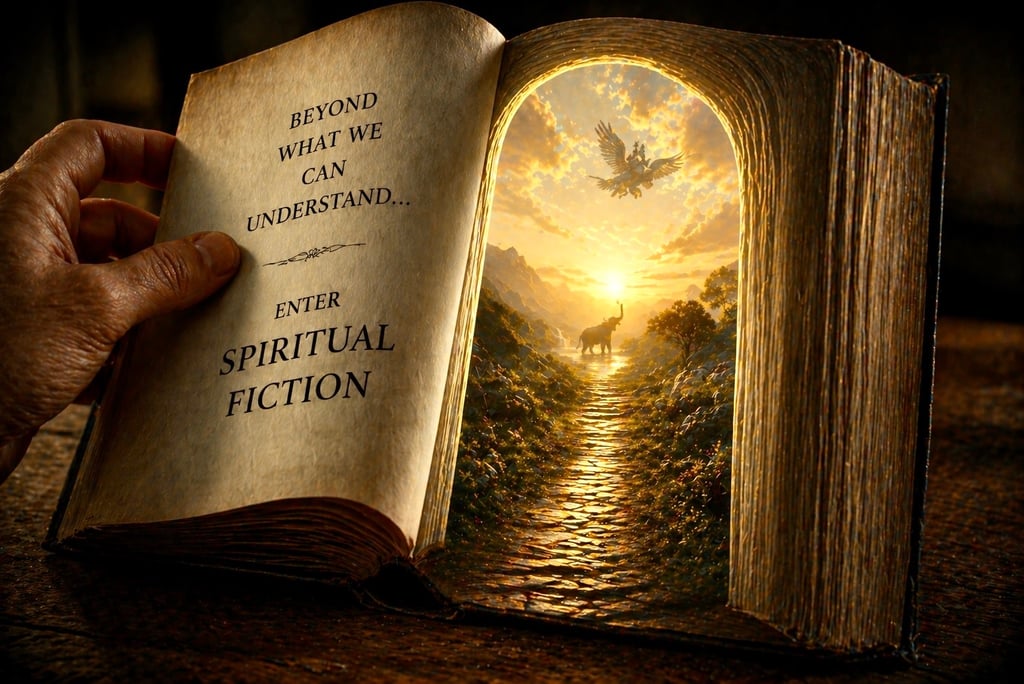

First, we discover that the saints not only accept the story of Gajendra—they celebrate it, rejoice in it, and glorify it.
“This Shrimad-Bhagavatam propounds the highest truth… It is the literary incarnation of God… meant for the ultimate good of all people.” (Shrimad-Bhagavatam 1.1.2–3)
This alone tells us something important. The story of Gajendra is not ordinary, and it is certainly not comparable to science fiction. It is something sacred—something the saints deeply treasure. And if the saints accept it, then what they accept becomes meaningful, worthy, and spiritually substantial.
Second, they strongly recommend that we hear the story of Gajendra. That places it in a category far above ordinary literature.
Third, its very content awakens our interest in God, and nothing is more important than that. Without interest, how will we ever seek Him? How will we ever discover His message?
Fourth, every one of these narratives glorifies God.
As Lord Krishna tells Arjuna: “One should meditate upon the Supreme Person… who knows everything… who is beyond all material conception… inconceivable… and always a person.”
(Bhagavad-gita 8.9)
And again: “With one-pointed attention, one should constantly hear about, glorify, remember, and worship the Personality of Godhead.” (Shrimad-Bhagavatam 1.2.14)
In this way, what I call “spiritual fiction” fulfills a real spiritual function—it keeps us engaged in remembering God.
Fifth, there is another dimension to consider—one that helps explain why these accounts can seem so extraordinary.
This has to do with the nature of sacred sound. This is something I have already touched on in the last chapter but here's a different look at it.
In his book, "Vaishnavism: Contemporary Scholars Discuss the Gaudiya Tradition," Dr. Guy L. Beck explains that sacred sound exists in multiple layers—only one of which we can hear. The deeper layers remain hidden, accessible only to realized souls.
In other words, what the saints experience—and later describe—may originate from realities beyond our ordinary perception. And if that is true, then of course, these descriptions will sound inconceivable. After all, when one touches a higher dimension, the impossible begins to happen.
So when Scripture speaks of such things, perhaps it is not exaggeration—but instead our limited language, mental and spiritual capacities attempting to describe, absorb and accept an unlimited and divine reality that exist within an entirely different realm.
In light of this, it becomes easier to understand why doubt arises. But it also becomes easier to move beyond it. Instead of rejecting these accounts, I allow simply tag them as spiritual fiction and in doing so, I continue to receive what they are meant to give.
Before I tell you about Gajendra the elephant, consider this account from The Way of a Pilgrim.
After praying day and night without ceasing, the Pilgrim finally fell asleep, having first secured his few possessions safely away. In a dream, his departed spiritual master appeared to him and instructed him on how to read the Philokalia. (Fee-low-kah-LEE-uh)
His late spiritual master even marked a page in the book with a piece of black charcoal.
When the Pilgrim opened his eyes, the Philokalia was somehow lying open beside him, turned to the very page discussed in the dream. It was even marked with a black line, and the piece of charcoal was lying next to it.
What are we to do with such an account? Reject it? Or remain open? For me, the answer has been simple. I remain open.
This, then, is what I mean by “spiritual fiction.” Not something false—but something presently beyond my capacity to fully grasp.
By approaching these accounts in this way, I am able to continue reading, continue learning, and continue growing—without allowing doubt to shut the door.
With this understanding in place, we can now return—more receptive and more prepared—to the story of a very uncommon elephant. It is said that anyone who hears this sacred narration is blessed by the Lord, and in many ways we become...we are our blessings.
The most famous elephant of all time is Gajendra. Who he was and what happened to him was spoken by the great saint Sukadeva Goswami to the emperor Maharaja Pariksit. This remarkable conversation took place thousands of years ago along the banks of the Ganges River, where a vast assembly of sages and devotees had gathered. As for Maharaja Pariksit, he had only seven days left to live.

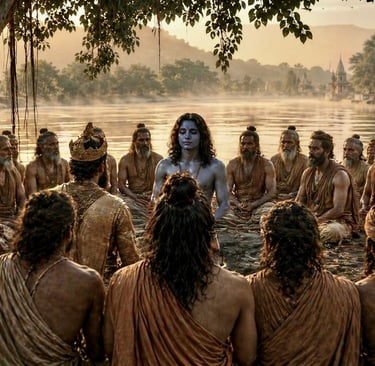
When I first read this I remember asking myself how could a young boy be blue. I was even more curious as to why, out of the entire Śrīmad-Bhāgavatam, why did Sukadeva Goswami choose to tell the unfortunate King this particular story? Now I understand and the answer makes sense because Gajendra’s plight reveals exactly what a person must do when there is no escape, no material solution, and death is certain. Indeed, time was short, so nothing trivial could be spoken. This was the predicament that both the King and Gajendra found themselves in. They both knew that they were about to die.
Surrounded by sages, the king was hearing the essence of all knowledge. Therefore this is not just a story about an elephant, but rather a lesson that one day everyone must draw strength from.
Sukadeva Goswami was the son of Śrīla Vyasadeva—the literary incarnation of God—and had heard the narration of Gajendra from his divine father. Later, though only sixteen years old, Sukadeva appeared before that great assembly, where he was immediately recognized as a self-realized soul and asked to speak.
Maharaja Pariksit, who life was about to end, asked Sukadeve Goswami a profound question: What is the duty of a man who knows he is about to die?
In response, Sukadeva Goswami recited the Śrīmad-Bhāgavatam for the king; for the sages; and for the welfare of all humanity. The Vedas take us back in time and have been flawlessly written down. By the Lord's mercy let us now listen in to one of the most remarkable conversations ever recorded by man. (Note: due to the length of the original narration, I have shortened it to avoid fatiguing my readers)
Sukadeva Goswami said: "My dear King, there is a very large mountain called Trikuta. It is eighty thousand miles high. Being surrounded by an ocean of milk, it is very beautifully situated. Its three principal peaks, which are made of iron, silver and gold, beautify the sky. The mountain also has other peaks, which are full of jewels and minerals, and are decorated with nice trees, creepers and shrubs. The sounds of the waterfalls on the mountain create a pleasing vibration. In this way the mountain stands, increasing the beauty in all directions.
"The ground at the foot of the mountain is always washed by waves of milk that produce emeralds. Trikuta Mountain has many lakes and rivers, with beaches covered by small gems resembling grains of sand. The water is as clear as crystal, and when the demigod damsels bathe in it, their bodies lend fragrance to the water and the breeze, thus enriching the atmosphere.
"In a valley of Trikuta Mountain there was a garden called Ritumat. This garden belonged to the great devotee Varuna and was the sporting place for the damsels of the demigods. Flowers and fruits grew there in all seasons. Among them were mango, coconut, date and pomegranate trees. There were palm trees, banyan trees and sandalwood trees. There were also grapes, sugarcane and bananas.
"In that garden there was a very large lake filled with shining, golden lotus flowers. Intoxicated bumblebees drank honey and hummed with the chirping of the birds, whose songs were very melodious. The lake was crowded with swans, cranes, and flocks of water chickens and other murmuring birds. Because of the agitating movements of the fish and tortoises, the water was decorated with pollen that had fallen from the lotus flowers. Thus the entire mountain stood gloriously decorated.
"The leader of the elephants who lived in the forest once wandered toward the lake with his female elephants. He broke many plants, creepers, thickets and trees, not caring for their piercing thorns. Surrounded by the herd's other elephants, including females, and followed by the young ones, Gajendra, the leader of the elephants, made Trikuta Mountain tremble all around because of the weight of his body. Thus surrounded by his associates, who were afflicted by thirst, he soon arrived at the bank of the lake.
"The King of the Elephants entered the lake, bathed thoroughly and was relieved of his fatigue. Then, with the aid of his trunk, he drank the cold, clear, nectarean water, which was mixed with the dust of the lotus flowers and water lilies, until he was fully satisfied."


"By the arrangement of Providence, O King, a strong crocodile was angry at the Gajendra and attacked the elephant's leg in the water.
"The elephant was certainly strong and he tried his best to get free from this danger. Thereafter, seeing Gajendra in that grave condition, his wives felt very, very sorry and began to cry. The other elephants wanted to help Gajendra, but because of the crocodile's great strength, they could not rescue him by grasping him from behind.
"O King, the elephant and the crocodile fought in this way, pulling one another in and out of the water for one thousand years. Because of being pulled into the water and fighting for many long years, the elephant became diminished in his mental, physical and sensual strength. The crocodile, on the contrary, being an animal of the water, increased in enthusiasm, physical strength and sensual power.
"When the King of Elephants saw that he could not save himself from danger, he consequently thought for a long time and finally reached the following decision:
"It is by the Will of Providence that I have been attacked by this crocodile, and therefore I shall seek shelter of the Supreme Personality of Godhead. If one seeks shelter of the Lord, the Lord gives him protection."
In the Śrīmad-Bhāgavatam it is mentioned that in their previous births, both the crocodile and the elephant had been great kings. For different reasons, both kings had been cursed; the first king being forced to take birth as the crocodile, and King Indradyumna, as the elephant, Gajendra.
King Indradyumna, in the body of the stricken elephant, was able to remember prayers that he had recited to the Lord in his previous birth. Thus Gajendra began to utter these famous prayers to the Lord:
"I offer my respectful obeisances unto the Supreme Person...He has entered the heart of every living being. Let me meditate upon Him...May that Supreme Personality of Godhead give me protection...May that same Supreme Personality of Godhead be my destination...He has immense potency, and in various forms, all free from material contamination, He acts wonderfully. He is therefore the Supreme Brahmana (God). I offer my respects to Him....who is the witness in everyone's heart, who enlightens the individual soul and who cannot be reached by exercises of the mind, words or consciousness...Since an animal such as I has surrendered unto You, who are supremely liberated, certainly You will release me from this dangerous position...I do not wish to live anymore after I am released from the attack of the crocodile."
Sukadeva Goswami continued: "When the King of the Elephants was describing the Supreme Authority, the Personality of Godhead appeared before Gajendra. Carrying His disc and other weapons, He appeared there on the back of His (bird) carrier, Garuda (ga-roo-da), with great speed, according to His desire.
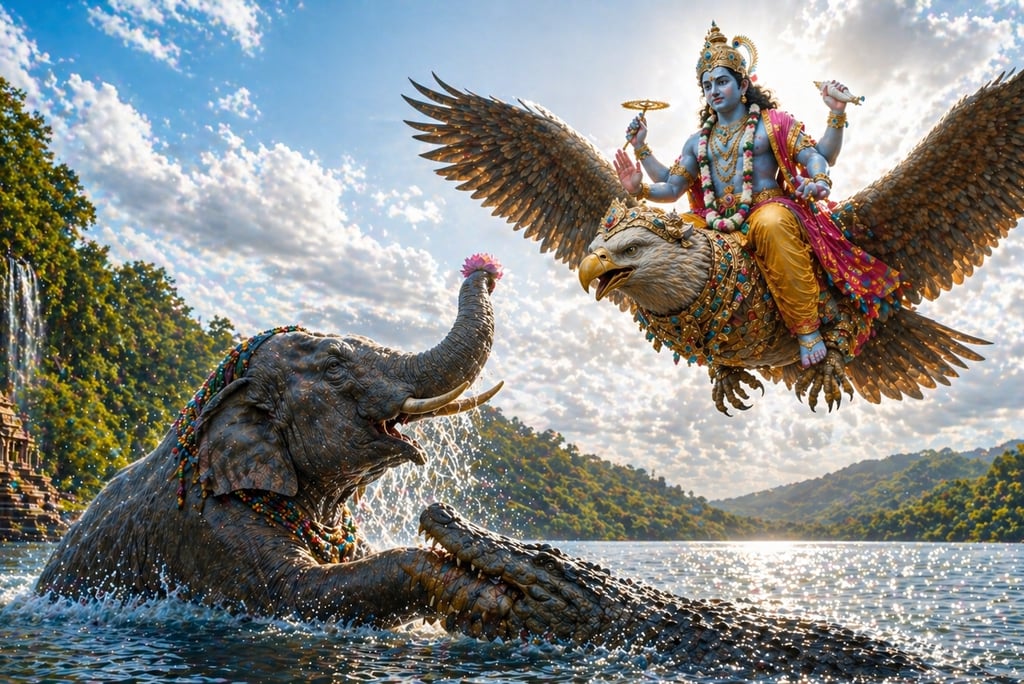
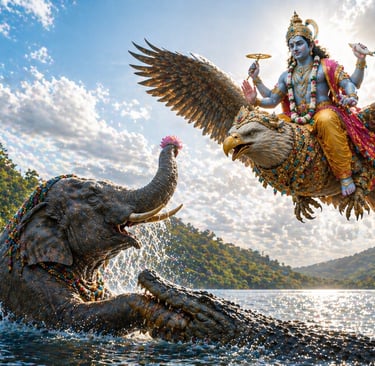
"Gajendra had been forcefully captured by the crocodile in the water and was feeling acute pain. But when he saw the Lord coming in the sky on the back of Garuda, he immediately took a lotus flower in his trunk, and with great difficulty due to his painful condition, he uttered the following words: 'O my Lord, master of the universe, O Supreme Personality of Godhead, I offer my respectful obeisances unto You.'
"Thereafter, seeing Gajendra in such an aggrieved position, Lord Vishnu immediately got down from the back of Garuda and pulled the King of Elephants, along with the crocodile, out of the water. Then, in the presence of all the demigods, who were looking on, the Lord severed the crocodile's mouth from its body with His disc. In this way He saved Gajendra, the King of Elephants."
Sukadeva Goswami said: "King Huhu, having been cursed by Devala Muni (day-va-la—moo-knee), had become a crocodile. Now, having been delivered by the Supreme Personality of Godhead, he assumed the beautiful form of a Gandharva (a celestial being, engaged in the art of music, dance, singing). Understanding by whose mercy this had happened, he immediately offered his respectful obeisances and began chanting prayers just suitable for the transcendental Lord, the Supreme Eternal, who is worshiped by the choicest verses.
"Because Gajendra, King of the Elephants, had been touched directly by the hands of the Supreme Personality of Godhead, he was immediately freed of all material ignorance and bondage. Thus he received the salvation of sarupya-mukti (SA-ROOP-ya—mook-tee), in which he achieved the same bodily features as the Lord, being dressed in yellow garments and possessing four hands.
"Upon delivering the King of the Elephants from the clutches of the crocodile, the Lord, sitting on the back of His carrier, Garuda, returned to His all-wonderful abode and took Gajendra with Him." (Śrīmad-Bhāgavatam, Eighth Canto, Chapters 2-4)
---🔧---
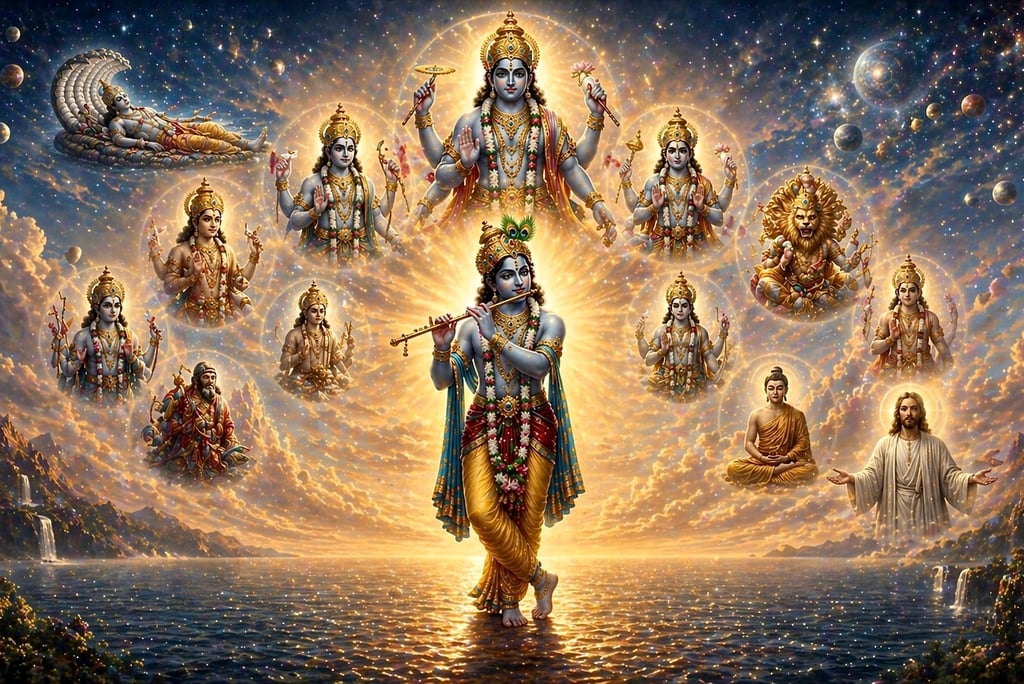
As this book's author I am constantly trying to make Krishna and the Art of Bicycle Maintenance interesting. At this point, however, some readers may feel confused by the frequent use of the word “Lord.” Indeed, the Vedic scriptures refer to many different Lords: Lord Krishna, Lord Balarama, Lord Narayana, Lord Ramachandra, Lord Vishnu, Lord Buddha, Lord Jagannatha, Lord Shiva, Lord Nrsimha (nri-sing-ha), etc. In fact, the list of such names could easily fill pages.
Fortunately, this confusion is easily resolved.
Because God possesses the ability to expand Himself unlimitedly into different forms—each of His manifestations is known by a suitable name. Moreover, each expansion may have many names. Out of affection, devotees also give God numerous “pet names,” each reflecting a particular quality, pastime, or relationship. In this way, the Supreme acquires countless names, each meaningful and personal.
To properly understand Lord Krishna—and why there are so many “Lords”—one must hear from a realized devotee. His Divine Grace A. C. Bhaktivedanta Swami Prabhupada explains:
“This indicates that the four-handed forms and other forms mentioned in Vedic literature are all emanations of the original two-handed Krishna. He is the origin of all emanations. As far as the four-handed forms of Krishna are concerned, it is stated clearly that even the most identical four-handed form of Krishna, known as Maha-Vishnu (ma-HA-vish-noo), is also an expansion of the Supreme Lord.
"As stated in the Brahma-samhita (5.48): ‘The Maha-Vishnu, into whom all the innumerable universes enter and from whom they come forth again simply by His breathing process, is a plenary (complete) expansion of Krishna. Therefore I worship Govinda (Krishna) the cause of all causes.’
"Therefore, one should conclusively worship the personal form of Krishna as the Supreme Personality of Godhead. He is the source of all forms of Vishnu, of all incarnations, and is confirmed in the Bhagavad-gita as the original Supreme Person.
"Elsewhere it is said: ‘The Supreme Absolute Truth is a person, His name is Krishna, and He sometimes descends to this earth.’ In the Śrīmad-Bhāgavatam, many incarnations of the Supreme are described. Among them, Krishna also appears—but it is then clarified that Krishna is not an incarnation of God; rather, He is the original Supreme Personality of Godhead." (Bhagavad-gita 11.54)
Śrīla Prabhupāda further states: “Lord Krishna has innumerable expansions. One who is engaged in the service of any of His forms, or of His plenary expansions (such as Lord Jesus Christ), is considered transcendentally situated. All these forms of Krishna are fully transcendental, blissful, full of knowledge, and eternal.”
Changing gears for a moment—besides repairing bicycle, I was still trying to discover and clarify "my message," and I felt that reading might provide what I was looking for. This is how I first encountered the notion that a person could expand into an identical form. I came across this concept while reading the Autobiography of a Yogi, by Paramahansa Yogananda.
I read how as a young man, Swami Yogananda traveled to Benares in search of his father’s friend, Kedar Nath Babu. Seeking guidance, his first meeting is with the respectable Shri Pranabananda, who tells Swami Yogananda that Kedar Nath will soon arrive.
Later, Yogananda learns something astonishing. While he had been speaking with Shri Pranabananda, the very same Shri Pranabananda, at the exact same time, was talking to Kedar Nath—personally instructing him to go meet Yogananda. Reflecting on this, Swami Yogananda writes, “Now I find he (Shri Pranabananda) can materialize an extra body and work through it.”
Researchers have come across this phenomenon time and time again, giving it the name, "bilocation." For example, in 1774, "at the deathbed of Pope Clement XIV, Saint Alphonsus Maria de'Ligouri was observed kneeling in prayer, although, in fact, he was confined to his cell (room) in a location four days journey away." (ROSEMARY GUILEY, Harper's Encyclopedia of Mystical and Paranormal Experiences, p. 57, Harper & Row, 1991)
As I mentioned, during the time that the Adirondack Wheel Works was open for business, I began to spend a lot of time reading. The books were like stepping stones, but so was working on bicycles. This is the important thing to know—at first I was still at loss about who Krishna was, or if He was even real. This was being saved for me later. But still, a tremendous force was helping me. I've even called it my guardian angel, and it knew that the best way to keep me focused on discovering my message, was to keep me interested—I mean highly interested—and reading about bilocation and the miracle of finding those cookies certainly did the trick.
As I said, these were all stepping stones that eventually led me to understand more about God, Himself. This didn't happen overnight, but over time I began to learn bits and pieces and slowly a picture of God began to emerge—encompassing both His nature and His actual appearance.
For example, after His resurrection, Jesus Christ appeared in a totally different form. As it is written, “Later He appeared to two of them (his disciples) while they were walking in the country, but they did not recognize Him ...because He appeared in a different form.” Though His appearance changed, it was still Him. (Mark 16:12)
Throughout the Bible, God reveals Himself in many ways—even as a burning bush (Exodus 3:2). These are not separate beings, but expressions of the same divine source.
To help us to understand these various forms, Shrila Prabhupada has taught us that God can be compared to a conscious, lit candle. This original candle, according to its own sweet Will (because nothing can force God), then ignites another candle. As Shrila Prabhupada has explained, millions of these "eternal-divine candles" exist. Although they are identical in power, the proper understanding is that all the candles were lit by the first.
That first candle is called, Krishna. He is the true, inconceivable miracle, having always existed, and without source. No one created this "candle." No one ever lit this "candle." God exists, always has, and always will, burning eternally bright—a concept that gives me the chills whenever I try to comprehend its full meaning.
One of the most unambiguous statements in the Holy Bible concerning God's divine form is found in GENESIS 1:27: "So God created man in His own image." Doesn't this strongly suggests that like us, God has two arms, two legs, a head, a face, et cetera, thus matching the overall description of Lord Krishna.
Although the Scriptures tell us that God has expanded himself into different looking forms, the Lord's original form looks quite similar to us. But, remember, His body is eternal and full of knowledge and bliss—not filled with blood and pus, or suffering from aches and pains. The Lord's form may resemble ours in some ways, but in many more ways it is totally different.


I gave Krishna and the Art of Bicycle Maintenance a mighty spin, starting way back at chapter one. It is now beginning to slow down but before it stops entirely, I have saved the best for last: the importance of God’s Holy Name.
In both the Christian tradition and the Hare Krishna tradition, the Name of God is not seen as a mere label—but understood to be "a sacred sound fully invested with the presence and power of God Himself."
The Padma Purana explains: "The Holy Name of Krishna is transcendentally blissful. It bestows all spiritual benedictions, for it is Krishna Himself. Since Krishna’s Name is not contaminated by material qualities, it is never subject to illusion. The Name of Krishna and Krishna Himself are identical.”
This same truth echoes throughout the Bible: “The Lord is His Name.” (Exodus 15:3)
Repeatedly we read the same instruction: "Call upon His Name; Praise His Name; Live in His Name." (Romans 10:13; Psalm 113:1; Colossians 3:17)
“From the rising of the sun unto the going down of the same, the Lord’s Name is to be praised.” (Psalms 113:3)
Christ, Krishna, and the Name of God
I also came across a fascinating conversation between Father Emmanuel and Shrila Prabhupada that helped me understand how the name of God is not limited to a certain sound or a certain religion.
Father Emmanuel explained that “Christ” comes from the Greek Christos, meaning “the Anointed One.”
After listening, Shrila Prabhupada responded by noting the similarity to the Sanskrit word “Krishta,” meaning “all-attractive.” He explained that whether one says Christ, Krishta, or Krishna, one is ultimately addressing the same Supreme Personality of Godhead—the all-attractive source of everything.
He then made a simple but powerful point—a son may call his father “father,” but the father also has a specific name. In the same way, “God” is a general term—but the Supreme Person has many specific names, and because God is unlimited, He has unlimited names.
The Infinite Power Within the Name
The Bible speaks of the “unsearchable riches” found in Christ (Ephesians 3:8). This phrase is deeply significant. It means:
the glories of God’s Name are infinite.
its blessings can never be exhausted.
even a lifetime of exploration would not uncover them all.
This is why Saint Paul urges us to: “Pray without ceasing.” (1 Thessalonians 5:17).
Trying to understand how to “pray without ceasing” is what first inspired the Pilgrim. In The Way of a Pilgrim, we read how his search for the meaning of this command led him to walk across the Russian countryside, visiting one holy person after another.
Always seeking instruction, the Pilgrim eventually discovered a profound truth: that prayer—especially the constant repetition of the Holy Name—is the foundation of spiritual life.
As written in the Philokalia: “Without prayer, no other good work can be accomplished. Therefore, one must pray often—indeed, pray always.”
The Living Practice
Hinted at within the pages of the Holy Bible, the real formation of the continuous repetition of the Jesus Prayer happened among the Desert Fathers—those early monks living in Egypt, Syria, and Palestine. For the Christian: “Lord Jesus Christ, Son of God, have mercy on me.” has been fundamental.
For the devotee of Lord Krishna, their great prayer originates from the Vedas. Both Narada Muni and the Kali-Santarana Upanishad mention the Maha Mantra and key to spiritual life:
Hare Krishna, Hare Krishna, Krishna Krishna, Hare Hare
Hare Rama, Hare Rama, Rama Rama, Hare Hare
Though the sounds diffe, the principle is the same—the power is the same—the goal is the same.
Final Insight
The Holy Name is not distant. It is not restricted. It is not hidden. Instead it is immediately available at any moment, in any place. Within the Lord's Holy Names are endless treasures and unsearchable riches and the direct presence of God.


Not daring to call what follows even a partial summary of these “endless treasures,” I have nevertheless gathered together a few notes concerning the Holy Name of God. There is, however, one thing I will boldly proclaim. As I mentioned at the end of Chapter Three, “The divine path is very narrow.” To help us walk this narrow path, God has illuminated it with three great lanterns. The Third Light is the sacred sound vibration of God’s Holy Name.
In the same way that a lit match ignites the wick of a lantern, so the recitation of the Holy Name ignites this most essential light within us. This is not merely a poetic comparison, but a living reality recognized across traditions. Lord Chaitanya taught it, and the Desert Fathers confirmed it. Hesychius of Jerusalem wrote that once we begin to live attentively—with humility, recollection, and prayer—we will make progress on our inner journey through the Holy Name of Jesus Christ, which lights our way like a lamp.
The best way I have come to understand my message and the Holy Name, is to see it as a gift from God—a gift that contains within it all other gifts. As it has been said, “Prayer is a gift from God that can bring you all of God’s gifts, if you only believe.”
At first, the idea that something so simple could contain something so vast, may seem difficult to grasp but it is echoed again and again in both the sacred teachings, and the songs sung by the holy fathers of every great religions.
An illustration of this truth is found in the Śrīmad-Bhāgavatam. There was once a poor brahmin who worshiped Lord Shiva for material prosperity. One day Shiva instructed him to go to Sanatana Goswami, an advanced disciple of Lord Chaitanya, where the poor brahmin would receive his heart’s desire. It was said that Sanatana possessed a rare touchstone—one that could turn iron into gold. When the brahmin approached Sanatana Goswami and asked for it, Sanatana casually pointed to a place near a pile of refuse. There, among the discarded items, lay the touchstone.
Without hesitation the brahmin took the stone and was initially overjoyed. Yet, as he walked away a thought began to trouble him. "If this stone was so valuable, why had it been kept with the garbage?" Surely, he reasoned, Sanatana Goswami must possess something far more precious. Without delay, he returned and asked why such a treasure had been treated so carelessly. Sanatana replied that while it was true the brahmin had been sent to him for a great benediction, the touchstone was not the greatest gift he could offer. If the brahmin truly wanted the highest treasure, he would first have to throw the stone into the nearby river.
Trusting in this instruction, the brahmana cast the touchstone into the water and returned. Only then did Sanatana Goswami give him the true gift—the chanting of the Holy Names found in this prayer:
Hare Krishna, Hare Krishna, Krishna Krishna, Hare Hare
Hare Rama, Hare Rama, Rama Rama, Hare Hare
The lesson from this story is both simple and profound. That which can turn iron into gold is not the greatest wealth one can posses. Instead, the most valuable treasure is that which transforms the heart, illuminates the path, and connects us directly to God. This treasure is not distant or hidden. It is immediately available—carried on the breath, spoken by the tongue, heard by the ear. It is the Holy Name.
The Pilgrim: "So now I walk and say the Jesus Prayer without ceasing and it is more precious and sweet to me than anything else in the world."

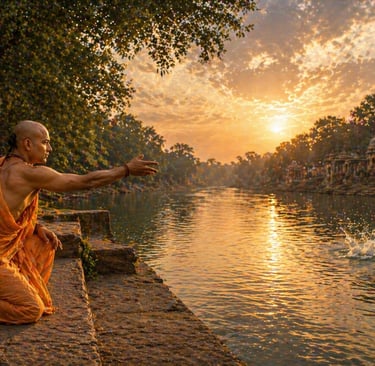
While organizing the material for this final chapter, I found myself reflecting on my own life—especially in light of what the Scriptures say about the power of chanting the maha-mantra.
The word maha means “great,” and mantra means “prayer.” This maha-mantra is the same treasure that Sanatana Goswami gave to the poor brahmin:
Hare Krishna, Hare Krishna, Krishna Krishna, Hare Hare
Hare Rama, Hare Rama, Rama Rama, Hare Hare
As one well-known author wrote, “The power of the Holy Name to absolve sins—past and present—is declared emphatically in the Scripture.”
This same assurance appears elsewhere. In the Garuda Purana it is said: “If one chants the Holy Name of the Lord, even in helplessness or without desiring to do so, all the reactions of his sinful life depart, just as when a lion roars all the small animals flee in fear.”
And in early Christian writings we find a similar truth, that "through the frequent calling on the Name of the Lord, every offense is purified by grace."
Everyday these statements have given my life a fresh meaning. I wake up with a fresh start. I am deeply encouraged and energized to keep doing what "my message" is telling me to do, regardless of my shortcomings—past and present.
But it's also true that my message did not come to me suddenly. Rather it unfolded almost imperceptibly, and with it has come something I had never known before—a genuine, day-to-day affection for God. Now I find myself thinking of Him naturally throughout the day.
It is also important to ask whether “my message” arrived all at once, like a one-time email telling me exactly where to go. This is important to understand.
The answer is no.
Once I understood that I was created to serve God, and that God is always increasing, I also began to understand that “my message” is not fixed in one place forever. It, too, continues to unfold. As my understanding grows, my service grows. And as my service grows, the message entrusted to me becomes clearer, deeper, and more personal.
I have worked on this book for over thirty years and as I bring it to a close, my hope is simple: that these final pages may be a blessing to those who read them.
I believe I am saving the best for last.
There is something wonderful I wish to share about God—about Lord Krishna—and I am deeply grateful that Shrila Prabhupada has given me a deep spiritual tradition that lends both authority and clarity to what I have come to understand as "my message."
The Holy Name of Lord Krishna is a gift—freely given, without condition.This gift was personally given to the world by Lord Chaitanya, and it is available to anyone willing to receive it.
But still, a question remains: How can a simple name be more valuable than a touchstone that could produce unlimited gold? The answer lies not in speculation, but in the teachings of Lord Krishna and His devotees. There are no strings attached, except that we have to hear about it. Likewise, when that wealthy lady gave her housemaid her entire estate, there was no condition, but of course the old lady had to first hear about it.
Just imagine how different her life might have been if she had only learned about the fabulous gift that had been given to her.
What if someone had told her about the will? What if a plumber, while fixing a leak in her kitchen, had noticed the document and said something?
Actually, the more I think about it, the more I realize that her story was very similar to my own.
It is also important to ask whether “my message” arrives all at once, like a one-time email telling me exactly where to go. This is important to understand.
The answer is no.
Once I understood that I was created to serve God, and that God is always increasing, I also began to understand that “my message” is not fixed in one place forever. It continues to unfold. As my understanding grows, my service grows. And as my service grows, the message entrusted to me becomes clearer, deeper, and more personal.
And so, with gratitude, I offer my respectful obeisances to my spiritual master, His Divine Grace A.C. Bhaktivedanta Swami Prabhupada. I also offer my respectful obeisances to Lord Krishna, who also appeared over 500 years ago as Lord Chaitanya. Therefore, I offer my obeisances to Lord Chaitanya.
I also offer my heartfelt respectful obeisances to Jesus Christ and to the Holy Bible. Both encourages us to honor the Lord's Holy Name: "Let us offer the sacrifice of praise to God continually, that is, the fruit of our lips giving thanks to His Name." (HEBREWS 13:15)
I also offer my respectful obeisances to the Lord's devotees who are doing the leg work—constantly taking their time to tell whoever they meet about the good news waiting for them.
And finally, I offer my respects to you, the reader, for letting me share with you "my message."
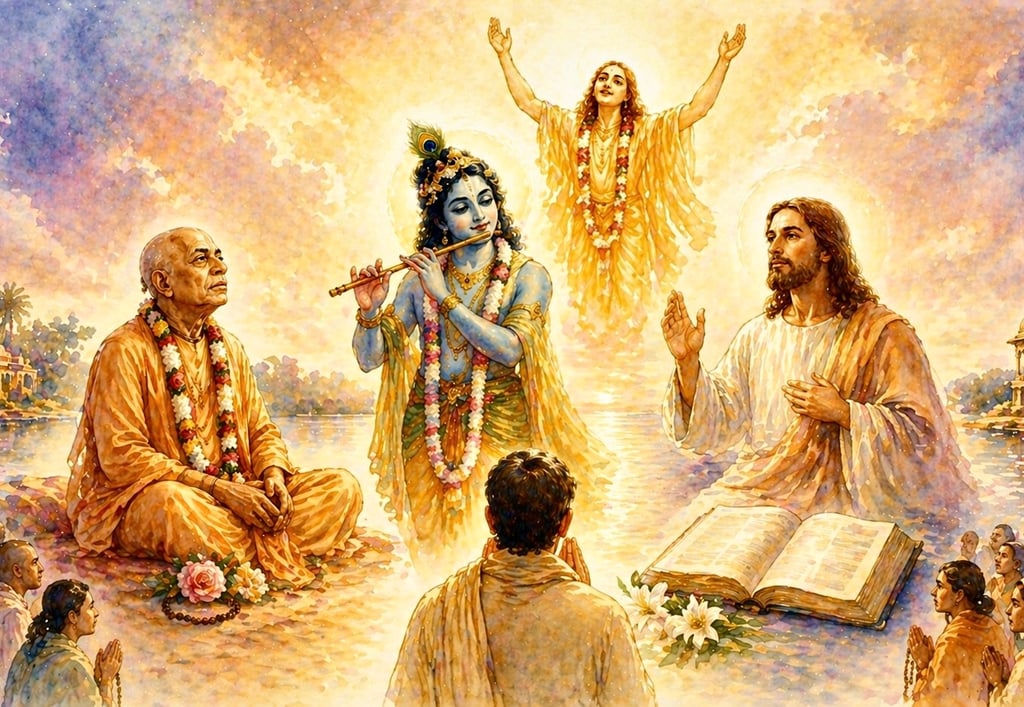
By the year 1516 A.D., the stage had been set for what can only be described as one of the greatest spiritual gifts ever offered to humanity.
Never before had such an “endless treasure” been revealed so freely—an inheritance not reserved for a select few, but opened to everyone.
It was during this time that the great sage Rupa Goswami, one of Lord Chaitanya’s foremost disciples, approached Him with deep reverence and spoke a prayer that has since become celebrated throughout the spiritual world:
“I offer my respectful obeisances unto the Supreme Lord Shri Krishna Chaitanya, who is more magnanimous than any other incarnation—even Krishna Himself—because He is bestowing freely what no one else has ever given: pure love of Krishna.” (Chaitanya-charitamrita, Madhya-lila 19.53)
In that moment, something remarkable was taking place. Many present began to perceive what had previously been hidden—Lord Chaitanya’s true identity. It was not declared with spectacle, but recognized through devotion.
For just as a devoted dog can recognize its master’s voice, regardless of the clothes he wears, so too can the lover of God recognize the God of love, no matter the form in which He appears.
This truth, quietly profound, transcends time and tradition. It was once expressed by an anonymous Christian in prayer, yet it echoes perfectly within the heart of Lord Chaitanya’s divine revelation: that God may appear in many forms, but to one who loves Him, He is always unmistakable.
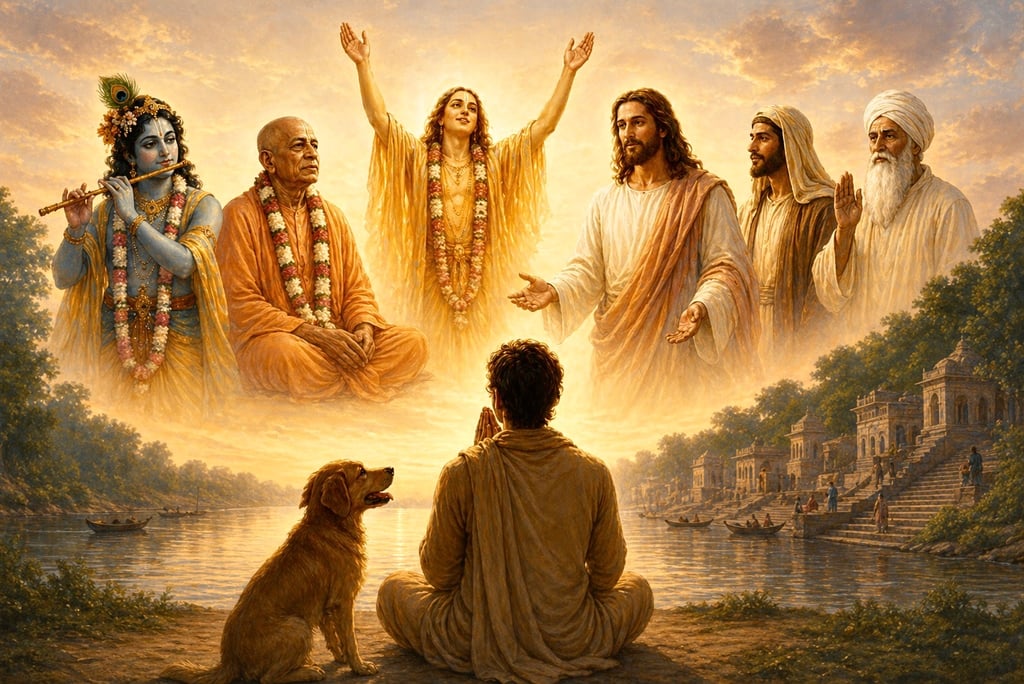

Able to accurately predict the future, the Vedas declare that although Kali-yuga—the present age of quarrel and confusion—is filled with faults, there remains one extraordinary blessing. As stated in the Śrīmad-Bhāgavatam: “Although this age is full of faults, there is still one great quality about it: by simply chanting the Holy Name of Krishna, one can become free from material bondage and be promoted to the transcendental kingdom.” It was Lord Chaitanya who extended this divine concession to the fallen souls of this age.
It is precisely this great boon that Lord Chaitanya desired to flood the world with—a gift described as “a special creation of the Lord” (Chaitanya-charitamrita, Madhya-lila 11.97). His message was both simple and profound: Chant the Hare Krishna maha-mantra—the great prayer—and you will be delivered.
Indeed, Lord Chaitanya especially emphasized this process as the most practical and effective means of spiritual realization in this age of Kali-yuga (Chaitanya-charitamrita, Antya-lila 20.8). In a time when distraction, conflict, and uncertainty dominate human life, this method requires no elaborate qualification. It is accessible, immediate, and universal.
A parallel current of this same principle exists within the Christian tradition, although it is not as widely known or appreciated as it should be. As I have tried to emphasize throughout this work, my Christian friends need not feel any pressure to abandon their faith. Rather, I encourage them to discover for themselves the “endless treasures” available in Christ. Regardless of one’s religious background, such a search will only truly appeal to those gentle and sincere souls who are genuinely seeking spiritual truth—those who, as it has been said, “will recognize true instruction even when it comes from simple, ordinary people.” (The Way of a Pilgrim, p. 166).
In complete harmony with Lord Chaitanya’s divine message, the Holy Bible also encourages us to approach God through continual prayer—the cultivation of an interior spiritual life. It was Lord Jesus Christ Himself who instructed, “Men ought always to pray, and not to faint” (Luke 18:1).
Honoring these words, the early Christian Fathers withdrew into the wilderness, gathering in monasteries to dedicate themselves to unceasing prayer. Among them were great spiritual teachers such as St. John Chrysostom, St. Gregory of Sinai, St. Simeon, St. John Climacus, and many others who devoted their lives to this sacred practice.
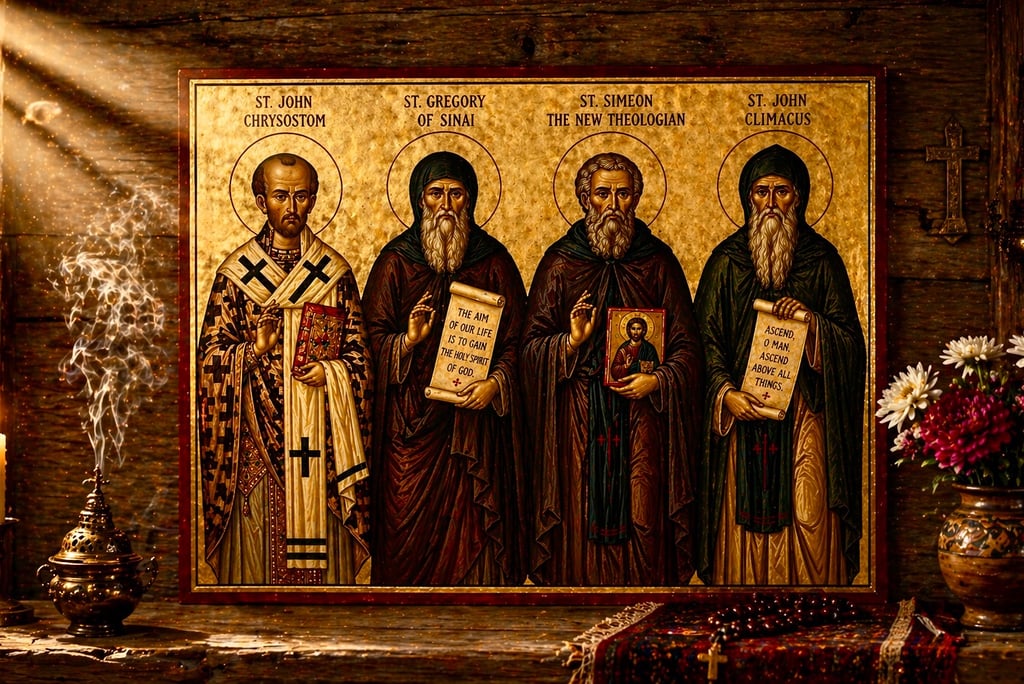
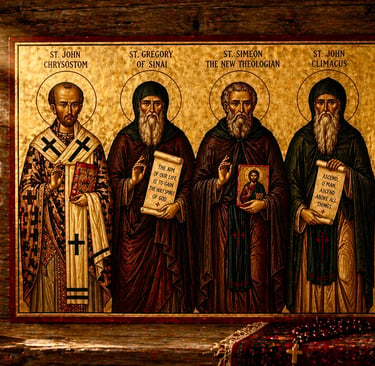
What they taught and practiced among themselves remains just as true today. They understood and wrote that “prayer is the chief and most powerful means of our renewal and transformation.” (The Way of a Pilgrim, p. 118)
Beyond this, they taught that prayer is the best means for attaining both the soul’s salvation and the ultimate goal of spiritual life: love of God. They saw the act of calling out to Christ as “both the first step and the crown of a devout life.” (The Way of a Pilgrim, p. 131)
In their wisdom, the Holy Fathers summarized the entire Gospel into one prayer—the Jesus Prayer: “Lord Jesus Christ, Son of God, have mercy on me, a sinner.”
Within the Holy Name of Christ, they discovered an “endless treasure.” They boldly declared, “It is more necessary to learn to call on the name of God than it is to breathe!” The Holy Fathers referred to the Jesus Prayer as “the art of arts," and together they set aside all other spiritual pursuits, giving themselves wholeheartedly to calling upon the Name of Christ. As St. Nicephorus wrote, “Only the interior life”—that is, absorbing oneself in calling upon Christ—“is a truly Christian life. All the Fathers give witness to this.” (The Way of a Pilgrim, pp. 74, 185, 177, 181)
Only the generous, expansive heart of God could conceive such unconditional mercy.
“The Supreme Personality of Godhead, who is known as Purushottama (the greatest of all persons), has a pure mind. He is so gentle. My dear Lord, You have set a plan in motion by descending into the material world. The most munificent Supreme Personality of Godhead (Lord Chaitanya), known as Gaurakrishna (go-ra-krish-na) distributed to everyone—even to the lowest of men—His own confidential treasury in the form of the nectar of the Holy Name. This was never given to the people at any time before.” (Chaitanya-charitamrita, Antya-lila 1.108; 3.82; Madhya-lila 23.1)
But some will ask, "how must mankind endeavor to embrace such a transcendental practice?" Referring again to "The Mystery of Salvation Revealed Through Ceaseless Prayer," this very question is addressed. Its wise author instructs us that “true prayer must have its conditions. It must be offered with a pure mind and heart, with ardent zeal, with undivided attention, with reverence, and with the deepest humility.”
Let us be thankful. After all, who among us truly possesses a pure mind—what to speak of a pure heart? The Lord’s Holy Name is so great that even when these conditions are lacking, its mercy is still freely bestowed upon those who pray. This is the value of the Holy Name. This is the grace and mercy of the Holy Name.
“Simply by hearing the Holy Name one becomes purified. Even if the Hare Krishna mantra is not chanted properly, it still has so much potency that the chanter gains the effect.” (Shrimad-Bhagavatam, 6.8.8–10)
Again, this is exactly what the Desert Fathers taught regarding the Name of Christ:
“The power of the Name of the Lord, if frequently called upon, will bear fruit in due time—even if this cry comes from a heart that is distracted and filled with worldly concerns. Do not worry, for prayer will purify itself by repetition—even in one who seems to say it mechanically and without devotion, it will clearly and effectively bear fruit.” (The Way of a Pilgrim, pp. 91, 148–49)
As we can see, in both the Christian and Hare Krishna traditions, frequent chanting of the Holy Name is the sacred path that leads to God. Saint Thérèse of Lisieux once said, “The power of prayer is truly tremendous. It makes one like a queen who can approach the king at any time and obtain whatever she asks.”
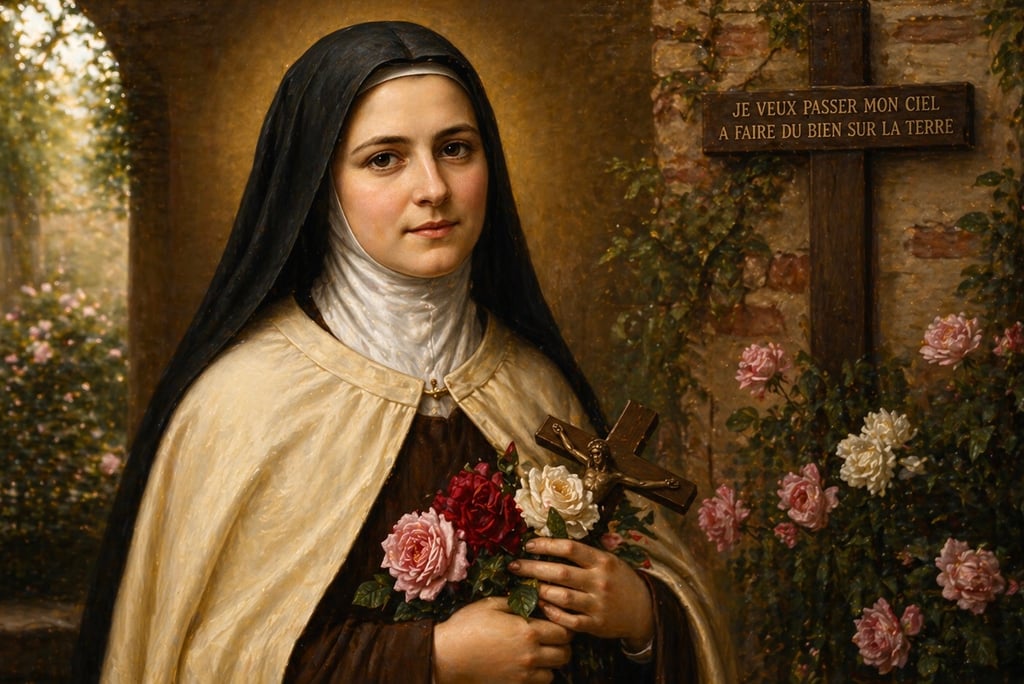
Śrīla Prabhupāda explains that, “The devotee always prays to the Lord so that he may engage in transcendental loving service.” (Chaitanya-charitamrita, Madhya-lila 22.16)
Prabhupāda further tells us that, “Chanting is a spiritual call for the Lord and His energy to give protection to the conditioned soul. This chanting is exactly like the genuine cry of a child for its mother’s presence.”
It is not surprising, then, that the Holy Fathers say the same thing about the Jesus Prayer. They write that, “It is a sincere cry of filial (childlike) love and trust in the mercy of God; it is a cry of a soul humbly aware of its weakness.” (The Way of a Pilgrim, pp. 120–21)
One of the most beautiful aspects of prayer is that it is available to everyone. The Jesus Prayer and the Hare Krishna mantra can be chanted by anyone—rich or poor—regardless of caste, creed, color, or social position.
Regarding the Lord’s Names—Hare Krishna, Hare Rama—Lord Chaitanya has given special emphasis to their chanting as the foundational principle of spiritual advancement. He has distilled the essence of the Vedas and is freely distributing it: the “endless treasures” of Lord Krishna’s Holy Name. (Śrīmad-Bhāgavatam 3.29.18)
As described in the Chaitanya-charitamrita:
“The characteristics of Krishna are understood to be a storehouse of transcendental love. Although that storehouse of love certainly came with Krishna when He was present, it remained sealed. But when Lord Chaitanya came with His associates, they broke the seal and began to distribute that treasure so all could taste the transcendental love of Krishna.
The more they tasted it, the more their thirst increased. They danced again and again, making it easier for others to drink the nectarean love of Godhead. They danced, cried, laughed, and chanted like madmen, and in this way they distributed love of Godhead. In doing so, Lord Chaitanya and His associates made no distinctions—they did not consider who was qualified or unqualified, nor where such distribution should or should not take place. Wherever there was an opportunity, they freely gave this love of God.” (Adi-lila 7.20–23):
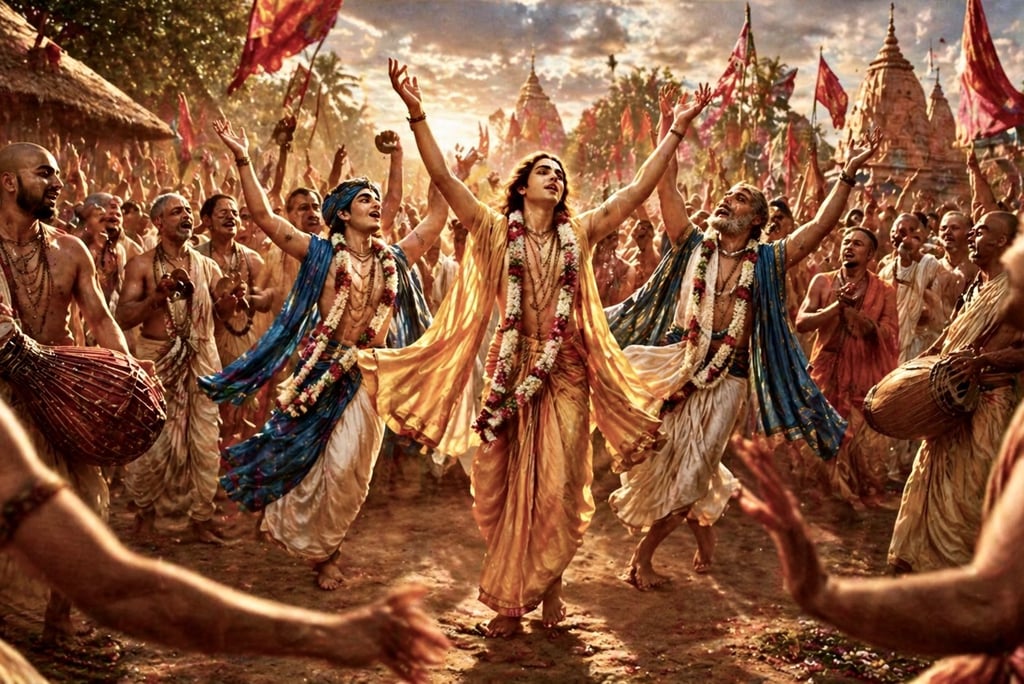
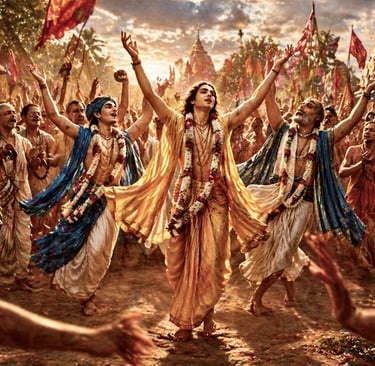
God has unlimited potencies and, “similarly, in the Holy Name of Krishna there are unlimited potencies” (endless treasures). Not only is the Name “Krishna” God’s most important or principal name, it is the most powerful of all the Holy Names of the Supreme Personality of Godhead, including Vishnu and Rama. Emphasizing this very fact, when Lord Chaitanya asked Ramananda Raya (RA-MA-non-da—ROY), one of His intimate associates, “Among all worshipable objects, which is the chief?” Ramananda Raya greatly satisfied Him by replying, “The chief worshipable object is the Hare Krishna mantra.” (Chaitanya-charitamrita, Madhya-lila 17.51)
At this point we can understand that the audible sound of “Krishna” or “Christ” is not ordinary. It may sound worldly, but it is not. Rather, calling upon the Lord’s Holy Name envelops a person within an aura of sacred sound. Shrila Prabhupada explains that sometimes Krishna descends personally, sometimes as sound vibration, and sometimes as a devotee. In this present age, Krishna has descended in His Holy Name:
Hare Krishna, Hare Krishna, Krishna Krishna, Hare Hare
Hare Rama, Hare Rama, Rama Rama, Hare Hare
Lord Chaitanya confirmed that in this age of Kali-yuga, Krishna has descended in the form of sound vibration. Sound is one of the forms the Lord takes.


Knowing perfectly well the integrity of God’s character, the saints tell us that the Name of God is never contaminated or subject to decay. There is nothing more pure than His Holy Name. It is simultaneously the most important aspect of devotional service, as well as the key ingredient that initiates us on the path of devotion.
Just as Lord Chaitanya distilled the Vedas through the promulgation of the Holy Name, the same conclusion can be found in the Gospel of Matthew. Prayer is to have a pre-eminent place in our lives and is to be frequent. It is not only to accompany all our actions, but to precede them. Therefore, we must always remember how impossible it is to succeed in acts of devotion without frequent prayer.
The Vedas fully agree: “Whatever one does in executing devotional service must be accompanied by the chanting of the Holy Name of the Lord…Of the nine processes of devotional service, the most important is to always chant the Holy Name.” (Chaitanya-charitamrita, Antya-lila 4.71)
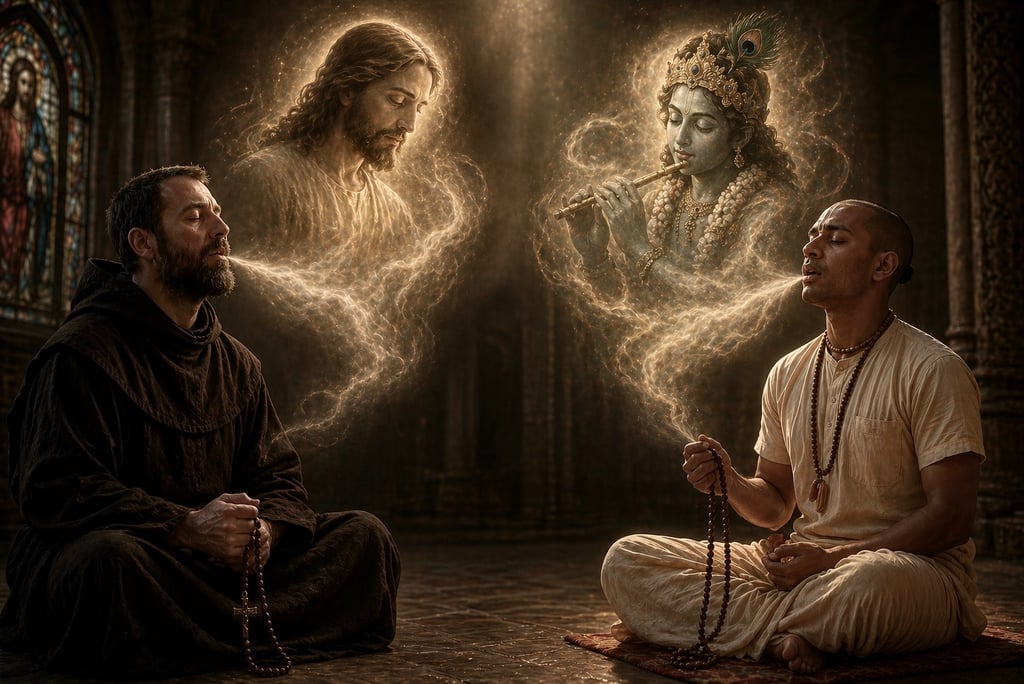
As just stated, “chanting the name of God is also the simplest way to please the Lord.” On several occasions, A.C. Bhaktivedanat even compared the Holy Name of God to a modern elevator.
Prabhupada explains that if one practices forms of yoga other than bhakti-yoga (loving devotional service) and thinks that he has attained the ultimate goal, he is mistaken, for further progress is still required. He compares the various yoga systems to a staircase leading upward toward the Supreme. "If one must reach the top floor—say, the hundredth floor—it would be an error to think the destination has been reached while standing only on the thirtieth."
In this way, the different yoga processes gradually elevate the practitioner step by step. But why climb laboriously, step after step, if a direct means has been provided?

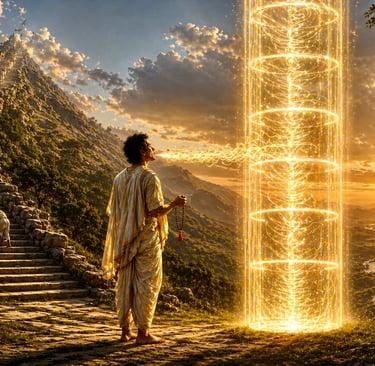


Isn’t this what we want—to be closer to God? This is the gift of prayer. In both religious traditions, “To pray means to direct the mind and heart to constant remembrance of God—to arouse within oneself the love of God by saying the name of Jesus Christ in harmony with one’s breathing and the beating of one’s heart. We begin this process by vocally calling on the Holy Name of Jesus Christ at all times, in all places, and in all occupations, without interruption.
“Many pseudo-enlightened people regard this frequent repetition of the same prayer as useless and trivial—a mechanical and senseless occupation for simple people. Those who criticize frequent vocal prayer can be compared to little children who are being taught to read by learning the alphabet. They complain constantly about having to repeat the ABCs. The benefits—the enlightenment that comes from reading, which is the result of repeating letters—remain a mystery to them.
“This so-called mechanical exercise reveals a mystery of which they are, unfortunately, unaware. The name of Jesus Christ has self-activating power. They do not realize that the frequent vocal call is imperceptibly becoming a true cry of the heart—that it is becoming interiorized, natural to the soul; that it enlightens, nourishes, and unites the soul with God. The power of prayer prepares it for union with God. In this way, one reaches the summit of all virtues and becomes a dwelling place of the Holy Spirit.” (The Way of a Pilgrim, pp. 142–43, 154, 173, 187)
In the Padma Purana, the Lord tells Narada Muni, “My dear Narada, I do not actually reside in My abode, Vaikuntha, nor within the hearts of the yogis. I reside where My pure devotees chant My Holy Name.”
To live within this realm of divine union is our goal, and as the author of the Chaitanya-charitamrita has declared, “The Holy Name of Krishna is so attractive that anyone who chants it becomes imbued with love of Krishna.”
---🔧---
We have briefly examined the “seed packet” and tried to understand what it will produce. And yet, there is still so much more to discover about this “endless treasure.”
For instance, one might ask: "Was this gift only available five hundred years ago, when Lord Chaitanya personally distributed it?" The answer is no. Shastra—truth preserved in sacred scripture—is not bound by time. It stands for the past, present, and future.
Although Lord Chaitanya appeared five hundred years ago, the potency of the Hare Krishna maha-mantra has not diminished in the slightest. This gracious provision remains ever fresh, imperishable, and fully accessible to anyone who embraces it. The Maha Mantra gives exactly what the scriptures declare to be life’s highest attainment: Love of God. (Chaitanya-charitamrita, Madhya-lila 17.51)
It is this very love that is compressed within the Holy Name itself. The ultimate result of devotional life is not abstract knowledge or ritual accomplishment, but the awakening of genuine love for the Supreme Lord.
As for the quality of that love, in his books, lectures and podcast, Swami Padmanabha emphasizes the ever fresh, always expanding, and the eternal evolution of divine love. This kind of love never slows down or comes to a stop. And those who try to explain it, can never do so fully.
This love is described as the highest and most complete expression of divine relationship—so deep that it brings the soul into the Lord’s intimate circle. In that state, Krishna and His devotee relate with perfect closeness, sharing a transcendental exchange that is full, personal, and alive.
The saints repeatedly emphasize that this is the very love Lord Chaitanya came to give. Now let us ask, "how is it received?"
Again, first by hearing about it and then through the sincere chanting of the Holy Name. As one chants, something begins to awaken within the heart. A spirit of devotion gradually takes root, and along with it, a growing eagerness—a kind of spiritual longing—to take shelter at the lotus feet of Lord Krishna through loving devotional service.
This is the treasure within the seed, and it is available now, just as it always has been.


---🔧---
We all enjoy our hobbies. Although I don’t get out into the field as much as I used to, one of mine has always been searching for old relics and lost treasure.
Who wouldn’t be excited to uncover a hidden cave, sealed for centuries and filled with the wealth of a long-forgotten king? In every corner, chest after chest—each one revealing gold molded into the most exquisite forms imaginable.
And not just gold. There would be garments, armor, weapons, spices, incense, scrolls carefully preserved, ornate boxes, pottery, rugs, jewelry, tools, coins, precious stones, medicines, and musical instruments—an entire world of objects, untouched for thousands of years, waiting quietly to be discovered.
Archaeologists readily admit that even today, in many parts of the world, treasures like this still lie hidden—vast quantities—undisturbed, and waiting.
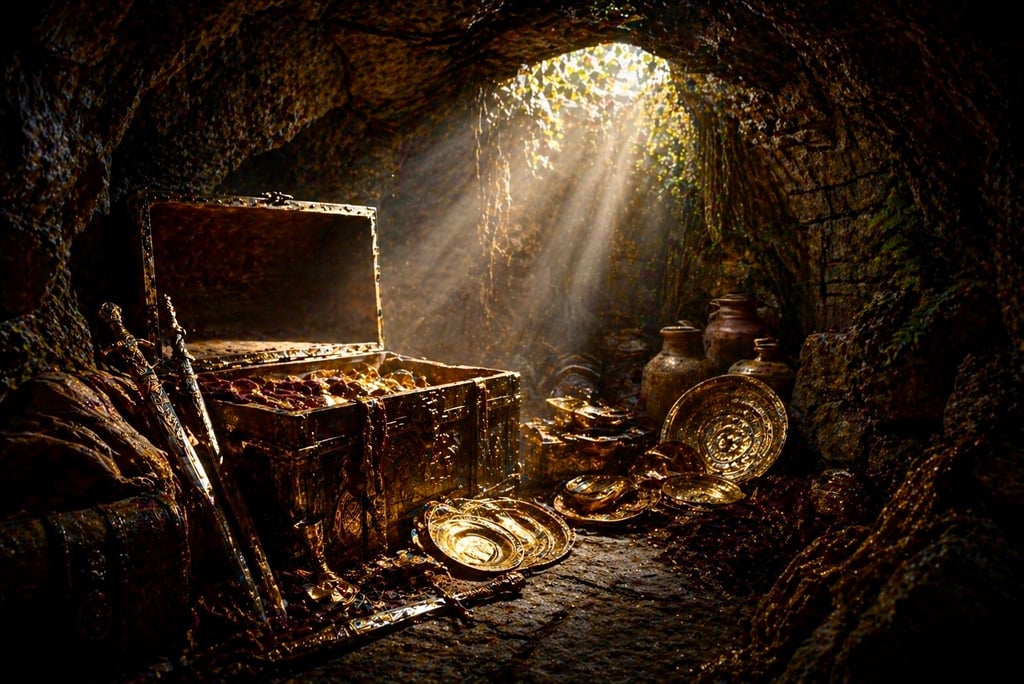
Unlike a modern archaeologist who must invest enormous time and resources to search for hidden treasure, a different kind of treasure—one containing an endless wealth—is already within everyone’s reach.
And the tool required to uncover it? Prayer.
The holy Fathers teach that every person has been given the ability to pray. Because of this, in every religion we find some form of prayer being actively taught. It is not reserved for the few, but offered to all.
In this chapter of Krishna and the Art of Bicycle Maintenance, I have been exploring the shared understanding of prayer found within both Christianity and the Hare Krishna tradition. In both of these great paths—through their founders, saints, and scriptures—the Holy Name is given central importance.
The Desert Fathers go so far as to say that when the Holy Name of God is invoked, the one who calls upon Him becomes aligned with the saints, the blessed, and the martyrs. In a similar spirit, the devotees of Lord Krishna glorify the chanting of the Maha Mantra:
Hare Krishna, Hare Krishna, Krishna Krishna, Hare Hare
Hare Rama, Hare Rama, Rama Rama, Hare Hare
And in the Christian tradition:
Lord Jesus Christ, Son of God, have mercy on me, a sinner.
Both are revered as supremely effective forms of prayer. The saints urge us: "Awaken your zeal—chant the Holy Name! Call upon the Name at all times!”
Scripture echoes the same instruction: “Pray all the time.” (Ephesians 6) “I will, therefore, that men pray everywhere.” (1 Timothy 2)
Although even a single utterance of the Holy Name is considered all-auspicious, what is most encouraged is frequent and uninterrupted prayer. This is why the holy fathers of Christ and the devotees of Lord Krishna are often seen holding their beads—continuously engaged in remembrance.
They tell us to give prayer the first place in our lives, for it fully satisfies the deepest longing of both the heart and the scriptures, and unlike other forms of devotion, prayer has no appointed time.
What is to stop someone from praying while riding their bicycle down a quiet road? Prayer is not only the primary means of spiritual realization—it is also the most accessible.
“And it shall come to pass, that whosoever shall call on the name of the Lord shall be saved.” (Acts 2:21)
The Holy Name is purity personified. And it does exactly that—it purifies everything it touches.
The Bicycle
Unfortunately, our “spiritual bicycle” has become covered with layers of rust and dirt. What is needs is a powerful solution—a spiritual WD-40: The Holy Name.
When applied, disturbing thoughts begin to dissolve. The inclination toward harmful habits weakens. Strength replaces weakness. Character is restored. Gradually, everything becomes cleaner, clearer, and filled with a quiet joy.
The most neglected part of any bicycle is its chain. If you’ve ever handled one, it immediately blackens your hands. And yet, for me, it has always been the most fascinating part of a bicycle
In my shop in Saratoga Springs, I cleaned many bicycle chains. After removing them with a special tool I would soak them in a vat of gasoline. Then, with an old toothbrush, I would begin scrubbing—slowly revealing what had been hidden beneath the grime. A final application of WD-40, and the chain would move freely again, as good as new.
But what makes the chain so remarkable is what it does. It is a single, continuous loop that connects the rider’s effort—the downward force of the legs—to the very purpose of the bicycle: to move forward.
Repetitive prayer is like that chain. It, too, is circular in nature—bringing you back to where you began, only to begin again. And yet, with each repetition, something is being transmitted, something is being restored, and something is quietly moving you forward.

Just think about it: the tires can be low, the handlebars loose, the gears stuck, the brakes failing, the seat too low, the wheel wobbling—but if the chain is working, the bicycle will still move forward.
Likewise, our lives may be in disarray. We may come from a broken home. We may carry wounds from the past. Our relationships may struggle. Our work may feel like “spinning our wheels.” At times, nothing seems to be working.
And yet—by the Lord’s grace, something essential remains. We have been given the ability to call out to Him. We can pray. In other words, by His grace, the chain is still intact—and we can still move forward.
Spiritually, we are meant to advance. This advancement is the true maturity of the soul, and it should not surprise us that chanting the Lord’s Holy Name has been given as the most direct and merciful path forward.
Over time, a deeper conviction begins to form—that the Holy Name will deliver exactly what it promises. As that conviction grows, doubt loosens its grip and love begins to fill the heart.
This kind of faith does not appear all at once. It develops by hearing about God and by regularly calling upon Him—by chanting His Holy Names.
Our walk with God is, in every tradition, a walk of faith.
As A.C. Bhaktivedanta Swami Prabhupada explains in the Bhagavad-gita, one advances in God consciousness only by faith. The Holy Bible speaks in the same way:
“The one who is righteous will live by faith.” (Galatians 3:11) “We are not of those who shrink back… but of those who have faith.” (Hebrews 10:39)
And in the Chaitanya-charitamrita: “Faith is the complete conviction that simply by chanting the Holy Name one can achieve all perfection.”
In a similar spirit, the Christian Fathers taught ...that faith is strengthened through prayer—
that it animates the soul and gives rise to all virtue.
Mankind has been given not only a rare privilege, but a real opportunity. Lord Chaitanya understands our condition perfectly. Our lives may feel uncertain, even fragile—but His promise is not. What He gives does not fail.
Within God's Holy Names, everything is already present—the same treasure we have been seeking from the very beginning—compressed, complete, and waiting to be awakened.


Sadly, many of us are like the prodigal son—having turned away from our Heavenly Father. But unlike the young man in the parable who could retrace his steps, we have been wandering for lifetimes, lost in a world that often pulls us further away. And yet, by some unfathomable mercy, a way back has been given.
That is why I have taken the time to write this book—not to present something new, but to share something eternal. Shall we dare believe? Can we take the Lord at His word?
Just as a farmer places faith in fragile seeds, let us place our faith in these imperishable seeds: The Holy Names of God. If we trust the laws of nature, why not trust the Lord of nature, who gives His personal assurance?
I did not set out in this life to find Krishna. In 1967, I was simply sitting next to my girlfriend, about to listen to a lecture. When I first heard the name “Krishna,” something stirred within me—something unmistakable. The Holy Name took effect. Through His humble servant, A.C. Bhaktivedanta Swami Prabhupada, that connection was made.
From that moment on, everything began to change in my life. What I received from Shrila Prabhupada was faith—faith in Krishna and in faith in His Holy Names—something far more valuable than any treasure.
As the Bhagavad-gita reminds us, without faith we remain bound within this world. But with faith, everything opens.
My sincere hope is that my spiritual master and the devotees of the Lord are pleased with this effort, and that somehow it may help increase faith in all who read it. More than anything, I hope this book inspires a genuine desire to chant the Holy Name.
And for my Christian friends, I leave you with these words from St. John Chrysostom: “Never stop reciting this prayer… the name of Christ will regenerate and save the soul.”


- Conclusion: The Path Forward -
We have covered a great deal of ground together.
We have looked at bicycles and broken chains, at rust and repair, at seeds and hidden treasure. We have considered prayer, the Holy Name, and the quiet but powerful work that takes place within the heart. And along the way, we have listened to the saints of the Christian tradition, to the devotees of Lord Krishna, and perhaps, at times, to something within ourselves.
If there is one thing that has been shown again and again, the most valuable things are often the simplest. Something small, easily overlooked—and yet containing far more than we first imagined.
A seed…
A name…
A prayer…
We live in a world that is often noisy, complicated, and uncertain. It is easy to feel worn down, distracted, or even lost. Like a neglected bicycle, our lives can become burdened with rust and resistance. We may try to fix everything at once, only to find ourselves overwhelmed. And yet, as we have seen, everything does not have to be perfect for us to begin moving forward.
If the chain is intact, even if it is rusty and desperately needing to be oiled, the bicycle will still move. In the same way, even when much in our lives feels out of place, something essential remains available to us. We can still call out. We can still pray. We can still take hold of the Holy Name. That alone is enough to begin.
Both the Christian fathers and the devotees of Lord Krishna speak with one voice on this point: the repetition of the Holy Name is not empty—it is alive. It carries presence. It purifies, strengthens, and gradually transforms the one who takes it seriously; like a chain turning; like a wheel moving forward; like a seed quietly becoming something far greater than itself.
Faith, too, grows in this way. It is not forced. It is not demanded. It develops through hearing, through practice, and through experience. Over time, what once felt uncertain begins to feel trustworthy. What once seemed distant becomes close. What once felt like effort becomes natural. And eventually, something remarkable happens:
The practice is no longer something we do—it becomes something we live.
If there is any encouragement to take from these pages, let it be this: You do not need to have everything figured out. You do not need to be perfect. You do not need to wait for the right moment. You can begin exactly where you are.
Take the Holy Name—however you understand it, within your own tradition—and give it a place in your life. Repeat it. Return to it. Let it accompany you in quiet moments, in difficult moments, in ordinary moments.
And then with patience, watch what happens because within that simple act lies something extraordinary. What appears small is not small. What appears ordinary is not ordinary. What appears to be just a name is, in truth, something living—something given—something meant to awaken what has always been there.
The journey, in one sense, has been described in these pages, but in another sense, it has not yet begun. That part belongs to you. So wherever you are, and however you are able: Begin.
Ronald E. Boutelle
April 29th, 2026
Canyon Lake, Texas
rboutelle@gmail.com
Krishna and the Art of Bicycle Maintenance
Table of Contents


Abandoned is another fully illustrated book by the same author. Also a Vietnam War veteran, Ronald Boutelle is offering Abandoned free of charge to both his fellow veterans and the people he meets. You can read it > HERE