
Krishna and the Art of Bicycle Maintenance

- Chapter Four -
The Triangular Theory of Bicycle Maintenance
As I recall, the first bicycles I worked on belonged to a schoolteacher who lived down the street from my apartment in Saratoga Springs. They had flat tires and only needed minor adjustments, having been stored in a shed through the long winter.
Without any transportation of my own—and wanting a 10-speed—I began noticing used bicycles for sale around town. After looking around, I found a very nice one at a used furniture store for thirty-five dollars. Being able to find a bicycle so quickly, at such a reasonable price, and having just made a few dollars repairing my neighbor’s bikes, I began to wonder if there might be a way for me to make a living by repairing bicycles.
And sure enough, before long I had four or five bicycles in my upstairs apartment, doing the work right there in the living room.
With the opportunity to rent an old garage still on the table, the idea of opening a shop began to feel real. What finally convinced me, however, came during a trip to a few yard sales. While my friend searched for a television set, I found two bicycles for about ten dollars each, another that was simply given to me, and a handful of parts—wheels, seats, and other odds and ends for next to nothing.
That was the turning point.
From that moment on, the Adirondack Wheel Works came to life. I borrowed the name from the "Chicago Wheel Works" that existed in 1896. It was one of many small bicycle companies; most notable for manufacturing both the "Admiral" and "Century" models.
As for my shop, I bought bicycles wherever I could find them—repaired and sold them at a modest profit. At one point, I counted nearly sixty bikes in my shop.
Wanting to grow my business, I placed a ad in the local "Pennysaver." Almost immediately, cars began pulling up, one after another, unloading bicycles in need of repair.
As the work increased, so did the variety of problems. No two bicycles were quite the same, yet the issues began to feel familiar. Over time, I found that the secret to earning a decent wage was not just in the repair itself, but in the care that followed. I would spend an extra thirty minutes cleaning and polishing each bicycle—something no one asked for.
More than once, a customer would return and not even recognize their own bike. It looked brand new. And when they saw it sitting there in the shop, they never hesitated to pay.
After hundreds of hours at the workbench, something began to happen. I started to notice patterns—subtle at first, then undeniable. Each problem, no matter how different it appeared, seemed to follow a similar path toward being solved.
I hadn’t set out to discover anything. These ideas simply began to come to me.
Over time, I realized that every repair I made depended on three essential factors. It was a simple observation, but one that seemed to explain everything I was doing.
I eventually gave it a name: "The Triangular Theory of Bicycle Maintenance."
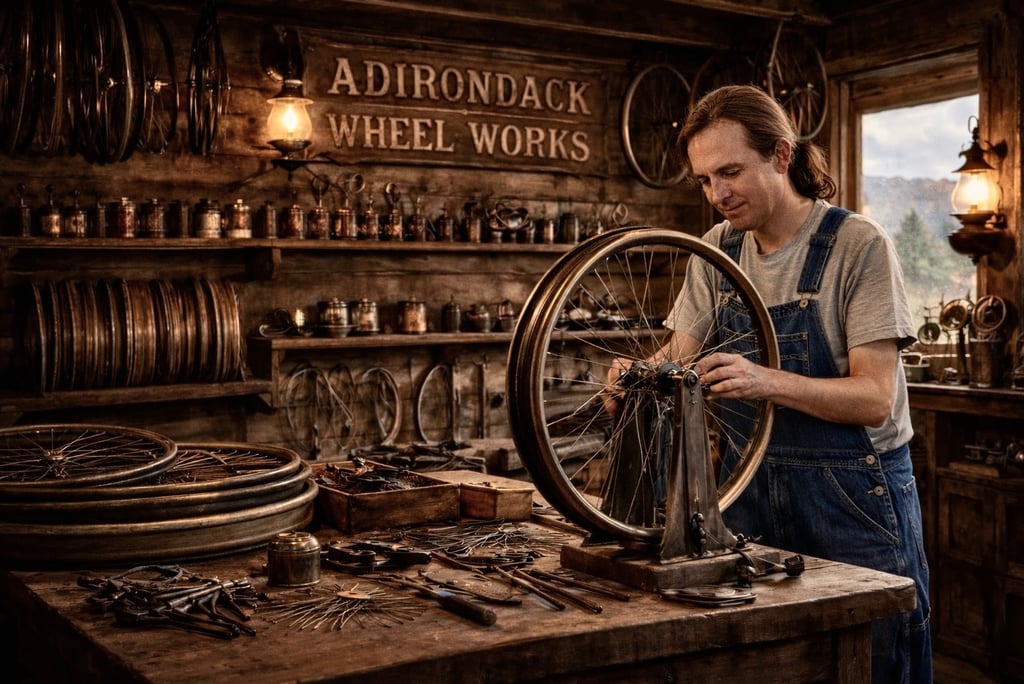
The three factors correspond to the three points of a triangle: the right knowledge, the right parts, and the right tools.
At first, I didn’t think much about it. The process felt almost automatic. But over time, especially when dealing with more difficult repairs, I began to notice how much smoother the work became when these three elements were clearly in place.
Having opened the Adirondack Wheel Works without any formal training, I was often forced to figure things out on the spot. This simple way of looking at a problem helped narrow everything down. Instead of feeling overwhelmed, I could approach each repair step-by-step.
Gradually, what had started as a practical way to solve problems began to take on a deeper meaning. To understand it more clearly, it helps to picture the triangle itself.
At each point is one of these three elements—knowledge, parts, and tools, and at the center stands the mechanic. Everything depends on him.
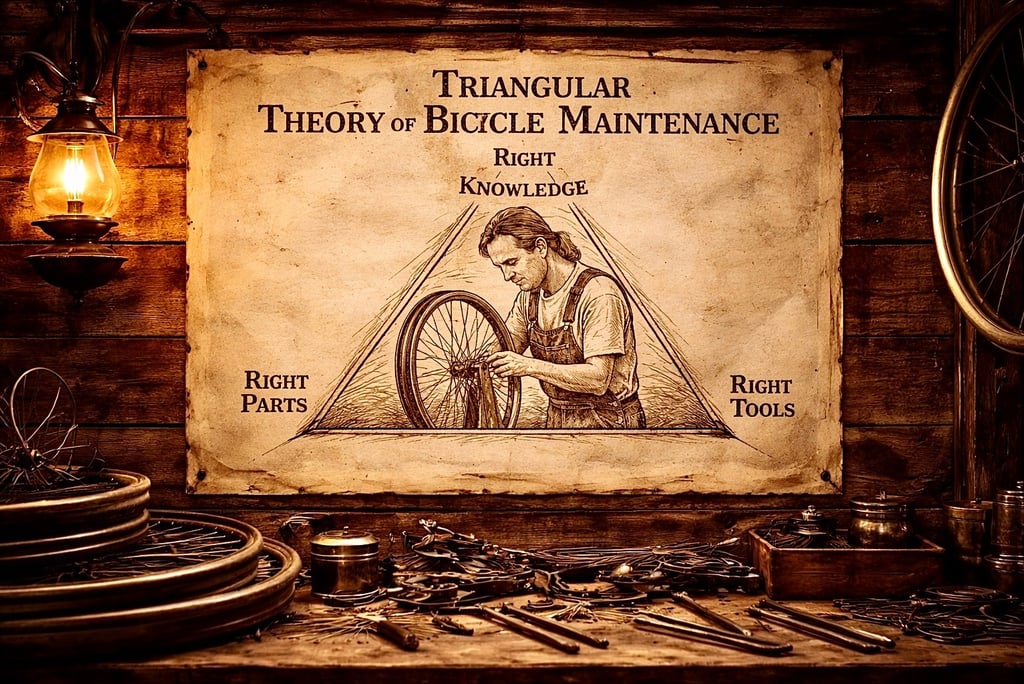

By applying his knowledge, his parts, and his tools, the mechanic is able to make the necessary repairs. In his shop, he is the most important factor—the conscious force that brings life back into what is broken.
Outwardly, he may appear ordinary. But it is not his background that matters. What matters is what is happening within him.
When a broken bicycle is placed before him, he is not simply looking at what is wrong. He is comparing it to something else—to an image held quietly in his mind: that of a perfect bicycle.
He knows how it is supposed to behave. A wheel should spin true, without wobble. The spokes should be straight and tight. The movement should be smooth, quiet, and effortless. This internal picture guides everything he does.
In this way, the mechanic deals only in perfection. Even when handling something broken, he is always working toward what is whole—restoring it as closely as possible to the original design intended by its creator.
Because of this, we trust him. We don’t let just anyone touch what is broken. But a skilled mechanic is different. We know that when he is finished, the bicycle will be returned as good as new—sometimes better.
What he is really working from is an understanding of the bicycle’s original design—its blueprint. Within his mind, he holds that design clearly. When he looks at a bicycle wheel, he immediately recognizes what is out of place—what is too loose, what is worn, what is missing, and what must be restored.
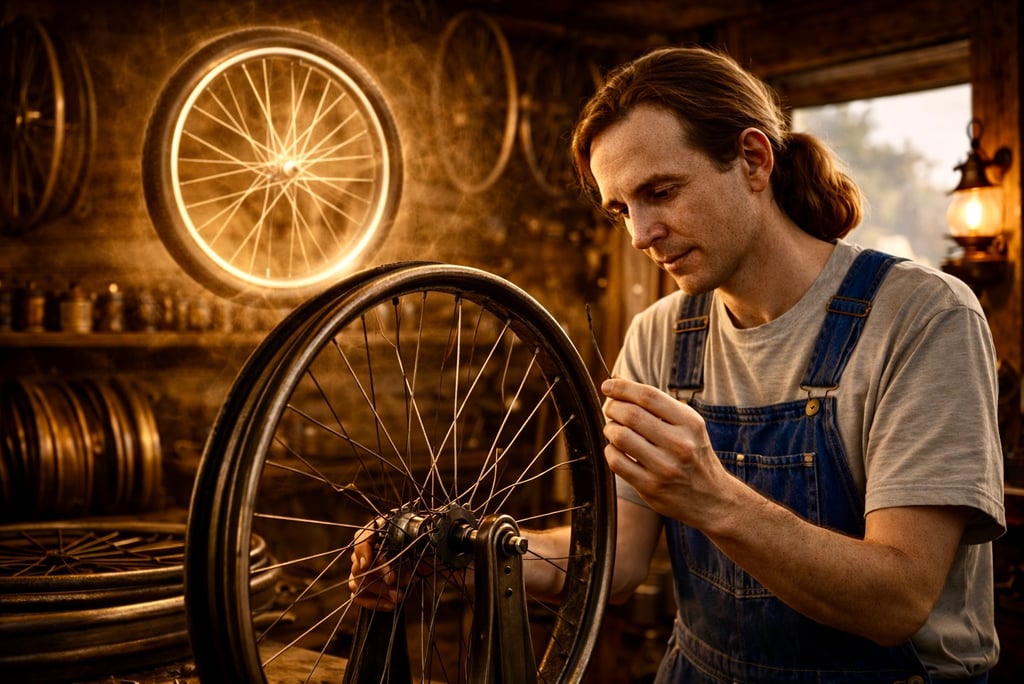
But knowledge alone is not enough. There must also be the will to act.
A good mechanic is driven to fix what is broken. Whether it is love of the work, pride in his craftsmanship, or simply the desire to see things made right, something within is pushing him forward. Without this inner drive, nothing would ever be repaired.
Then come the tools. The mechanic reaches out and begins the work, using his tools to remove what is damaged and restore what can be saved. Without the proper tool, the work stops. No matter how much he understands the problem, he cannot proceed.
And finally, there are the parts. What is broken must be replaced with what is sound. Each part must fit perfectly and function as intended. A bicycle is nothing more than a collection of parts working together in harmony—and when even one is out of place, the whole is affected.
Therefore, all three are required. If the knowledge is there but the tool is missing, the repair cannot be made. If the tool is available but the part is not, the work cannot continue. And if both the part and the tool are present, but the knowledge is lacking, the problem remains unsolved.
It is only when all three come together that something broken can be made whole again.
Take, for example, a problem that once happened to me.
I had a bicycle and wanted to replace the stem and handlebars. At a garage sale, I had found the replacement parts in mint condition, and I had more than enough tools to do the job.
It seemed simple enough. All I had to do was loosen the nut on top of the stem and pull the entire assembly out—or so I thought.
I loosened the nut. The handlebars turned freely. Everything felt loose. But when I tried to pull the stem out… it wouldn’t budge. I pulled harder. Nothing. No matter what I did, it stayed locked in place.
I had the parts. I had the tools, but I didn’t have the knowledge and without that, everything came to a stop.
Later, a friend at another bike shop gave me the missing piece. “Loosen the nut on top of the stem,” he said, “but keep turning it until the bolt comes up about one inch. Then give it a firm tap downward with a hammer.”
And that was it. The moment I hit it the top of the bolt, it broke free, loosening a specially designed "slip-wedge nut," something, that at the time, I had no idea that such a part even existed.
What had seemed impossible just moments before was suddenly simple—all because I finally had the knowledge I needed.
---🔧---
During the time I kept the Adirondack Wheel Works open for business, I resolved countless challenges. There was always a new bicycle to work on, each with its own peculiar problems. But no matter what came through that door, it seemed that every issue could be solved by applying what I came to call, The Triangular Theory of Bicycle Maintenance. I had my tools, plenty of spare parts, and—perhaps most important of all—I had been blessed with a fair amount of common sense (knowledge).
And yet, as satisfying as that work was, it quietly taught me something else.
There are problems that begin with a little p—the kind that can be fixed with the right tools, the right parts, and a bit of patience. But then there are problems that begin with a capital P.
What about the problem that none of my tools could reach?
What about death?
While visiting Mumbai in the fall of 1973, A. C. Bhaktivedanta Swami Prabhupada spoke candidly to his guests:
“Nobody wants to die. Is that not a fact? Nobody wants to become old. Nobody wants to get an old body like me… But I am forced to accept. I was also a young man like you. I would like to go back again to that young life, but there is no possibility. The question is that I am eternal, as spirit soul. I do not die after the annihilation of this body. But why am I forced to accept another body, which will again be annihilated? The real problem of life is how to solve the repetition of birth, old age, disease, and death.” (Conversations with Shrila Prabhupada, Vol. 6, p. 179)
His words cut straight to the heart of the matter. No matter how advanced we become, no matter how clever our solutions, we are all confronted with the same unavoidable problem that Prabhupada just mentioned.
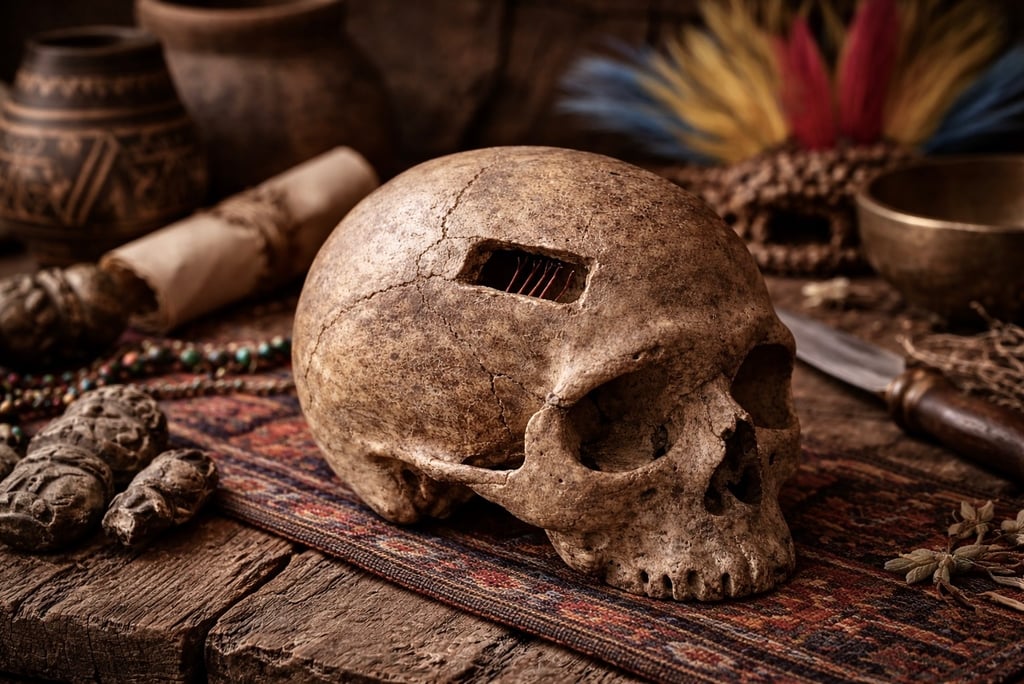
History has long recorded mankind’s attempts to overcome death. In 1863, while serving as a diplomat in Peru, the American explorer Ephraim George Squier uncovered a two-thousand-year-old human skull. Inside were six small wires, along with a carefully chiseled opening—strongly suggesting that some form of brain surgery had been attempted.
Even then, it seems, man was searching for a way to extend life, but in the end, death still claimed that poor fellow—just as it will claim us all.
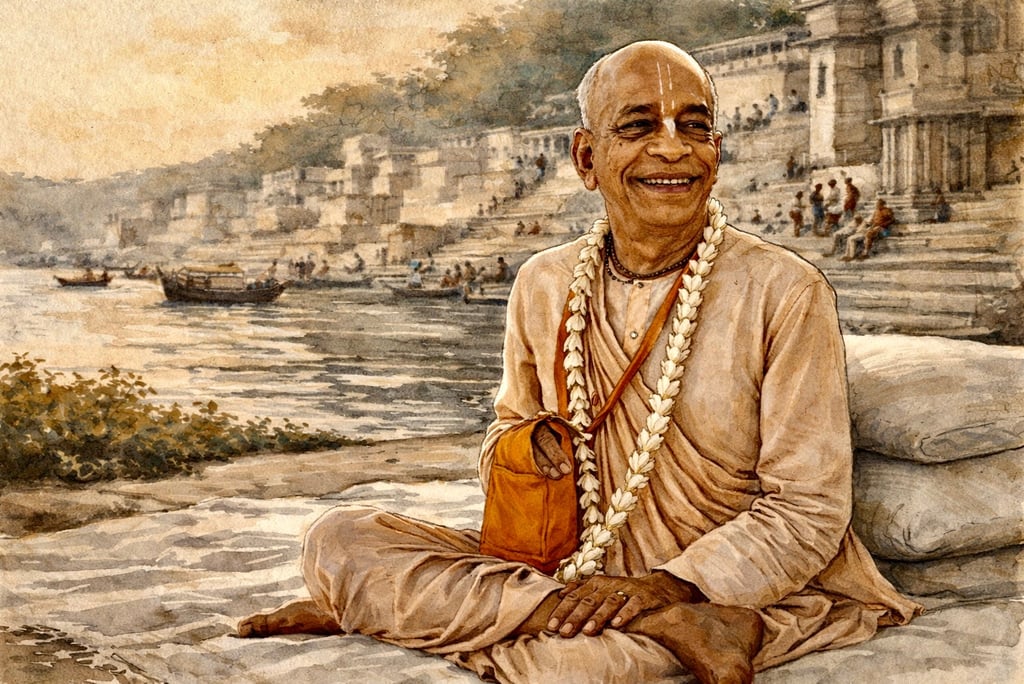
Just as we studied the bicycle mechanic, we must now look beyond the outward appearance of the spiritual master and discover the “inner man.” Who is he, really? What qualifies him? What are the tools he uses, and what are the spiritual “parts” he works with? What does he know that we do not? And why is he so deeply committed to his work—yet at the same time, so peaceful?
One thing must be clearly understood: we are no longer speaking about repairing a simple flat tire. We are dealing with a problem of the highest order—a problem that confronts every one of us.
If the Triangular Theory of Bicycle Maintenance is to solve the problem of repeated birth, old age, disease, and death, then every part of it must have spiritual roots—roots that are directly connected to God, the master of death. As it is stated in the Book of Revelation, “I have the keys of hell and of death.” (1:18)
Although the bicycle mechanic commands a certain degree of authority and respect among his customers and friends, his influence is actually limited—both in scope and in duration. It is nothing when compared to the position of the spiritual master.
The spiritual master’s credentials are not of this world. They are established and affirmed throughout the Vedas, revealing not only his divine authority, but also his jurisdiction over death itself.
And since that authority originates from our Supreme Father, we must now take a closer look at God Himself.
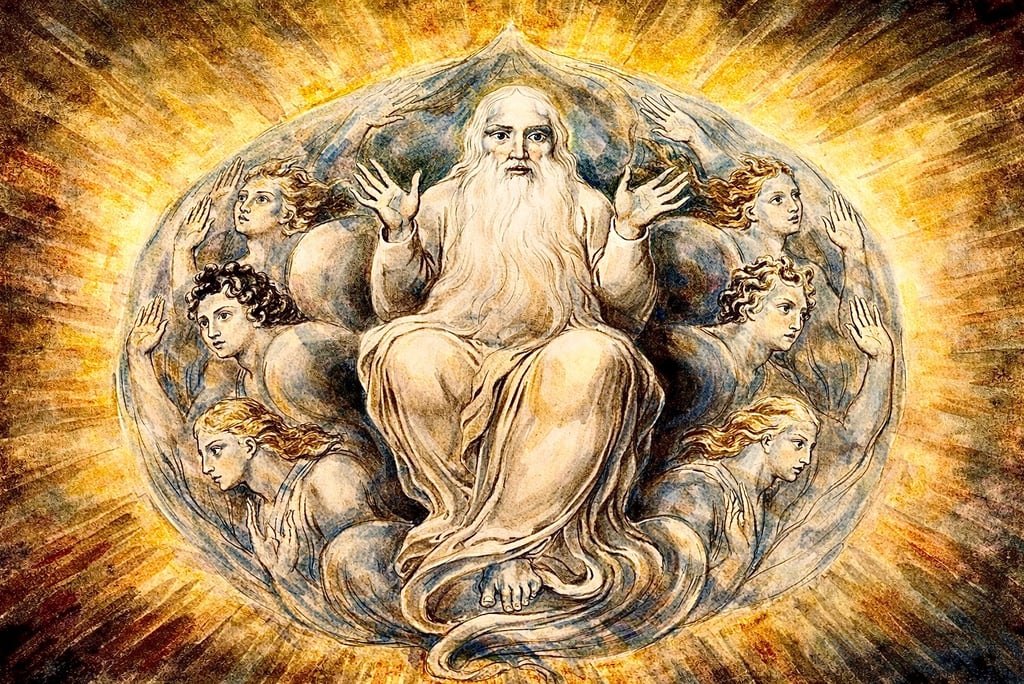
In doing so, we are reminded of how artists throughout history have attempted to portray the Divine—one such example being this striking vision created by William Blake in 1805. Though no image can fully capture the infinite, such paintings help us to contemplate the majesty, mystery, and authority of God—the One who holds dominion over life and death.
When we speak of God, one essential truth must first be understood: God is without source. Nothing caused Him to come into existence. If God were created, then that which created Him would be superior—and therefore, God would not be the greatest.
For this reason, in his opening prayers, Shrila Vyasadeva declares that he worships the Lord as the primeval cause of all causes—fully independent, with no cause beyond Him. (Shrimad Bhagavatam 1.1.1)
This same understanding is confirmed throughout the Bhagavad-gita, where the Lord explains that He is unborn, the source of all creation, and the foundation upon which everything rests.
A similar conclusion is found in the Holy Bible:
“It is His power that holds everything together.” (Colossians 1:17)
“I am the Alpha and the Omega, the beginning and the end.” (Revelation 1:8)
“Christ himself is the Creator who made everything in heaven and earth.” (Colossians 1:16)
By definition, God is the supreme authority. There is no higher power to question Him, no force that can interrupt Him, and no law that governs Him. His position is absolute.
The saints have long affirmed this truth. Although there may be many great personalities possessing extraordinary qualities, none can surpass the Supreme. (Bhagavad-gita 2.2)
What else makes God so uniquely compelling?
The Vedic scriptures describe Him as possessing all opulences in full—qualities that naturally attract the heart: fame, strength, beauty, wealth, knowledge, and renunciation.
Take fame, for example. Throughout history, many individuals have become widely known—leaders, artists, and influential figures. Yet their recognition is limited by time and place. God, however, is known across all ages, all cultures, and all of existence. His fame is not temporary—it is eternal.
Power is another attractive feature which the saints have identified. Physically, there are many powerful people, able to perform many Herculean feats, but all are dwarfed by the power of God. At night, in any city, there are many powerful lights. However, when the morning sun appears, no matter how powerful the light bulb, its intensity becomes dwarfed and is turned off as useless. Similarly, although there are many invincible personalities who impress others with their enormous strength, the most powerful person is the Supreme Personality of Godhead (Lord Krishna) creating billions of suns, planets and moons simultaneously.
The Lord Himself states: “Know that I am the strength of the strong… the splendor of the sun that illuminates the world comes from Me.” (Bhagavad-gita 7:10–11, 15:12)
Another opulence that attracts our attention is beauty. We have all experienced the effect of coming in contact with a beautiful woman, or very handsome man. Especially the beauty of women is glorified by society, with their charming elegance splashed over the covers of countless magazines. But again, no one is more beautiful than God: “His unique loveliness charming millions of Cupids.” (Brahma-samhita 5.30)
Along with the other opulence’s I’ve just mentioned, similarly, no one has more wealth than God. This is why the Lord is so often referred to as “the husband of the goddess of fortune” and why, “whenever and wherever the Lord is present, the goddess of fortune is also there, because the goddess of fortune never lives without her husband.” (Bhagavad-gita, p. xi)
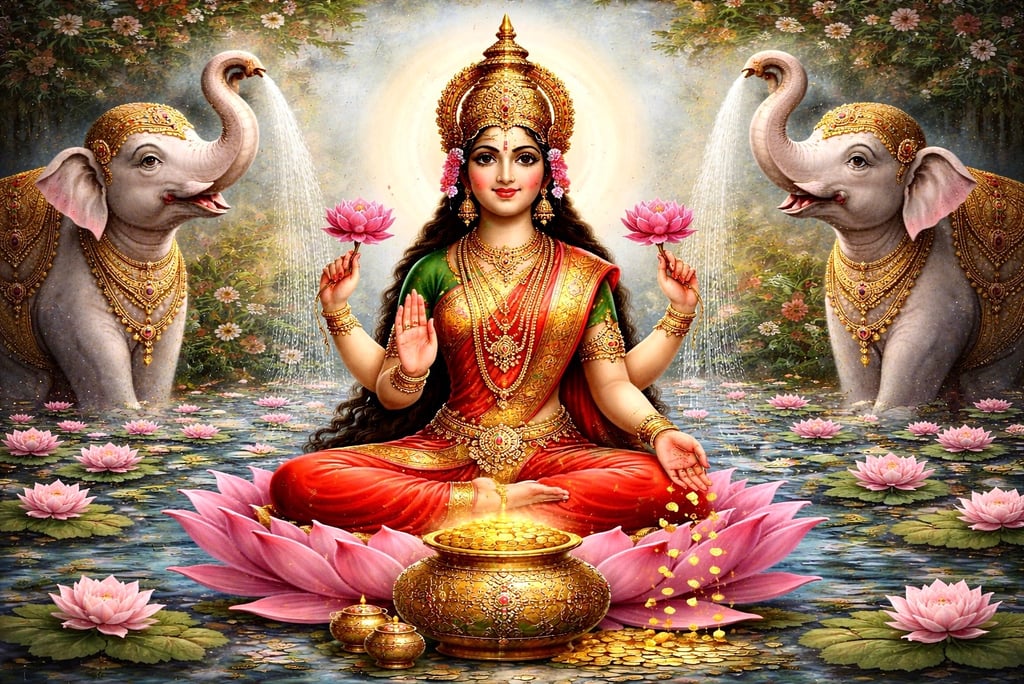
Up to this point, we have been describing God in terms of His position—His authority, His power, and His independence. But there is another aspect that must be understood:
God is not only supreme—He is supremely attractive. In fact, this is the meaning of the Sanskrit name Krishna: The All-attractive One.
Although the Lord possesses unlimited spiritual forms, the scriptures explain that His original and most enchanting form is known as Govinda (go-vin-da). In this form, He is not distant or abstract, but deeply personal—captivating the hearts of His devotees.
The Shrimad-Bhagavatam confirms that this attraction to the Supreme Person is the highest perfection of life:
“After carefully studying the Vedas, Lord Brahma concluded that loving attraction to Shri Krishna, the Supreme Personality of Godhead, is the ultimate goal of religion.” (Shrimad Bhagavatam: 2.2.34)
This understanding is expressed even more vividly in the ancient prayers known as the Brahma-samhita—some of the most poetic and heartfelt glorifications ever offered to God.
Although the majority of the Brahma-samhita (Song of Lord Brahma) has been lost over the eons of time, what does remain describes Krishna as Govinda—the primeval Lord—who is eternal, blissful, and the origin of all causes. In His divine abode, He is surrounded by wish-fulfilling trees and spiritual opulence beyond imagination, lovingly served by countless devotees.
Yet what stands out most is not His power—but His beauty. He is described as playing upon His flute, His eyes like blooming lotus petals, a peacock feather resting upon His head, His form tinged with the soft hue of rain-filled clouds—so exquisitely attractive that His loveliness surpasses that of millions of Cupids. (Sri Brahma-samhita 1: 29–30)
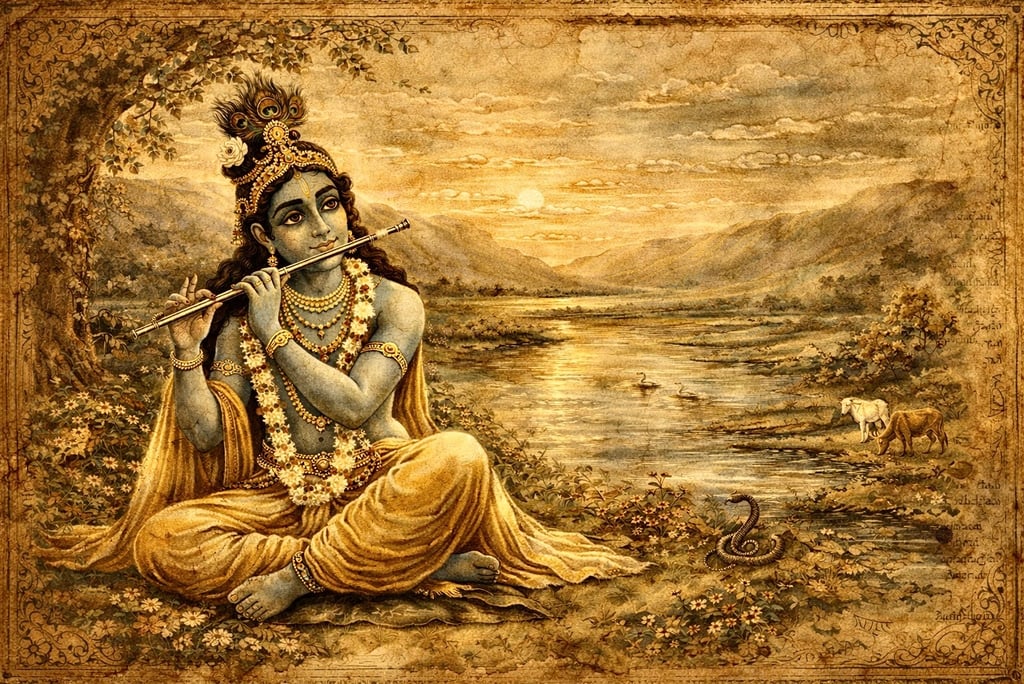
A broken bicycle and the results of having it repaired by an expert mechanic is one thing. But it is nothing compared to allowing oneself to be touched by the spiritual master.
To understand who he truly is, we must now turn again to the word of God and discover how the Lord Himself describes this extraordinary personality.
“One should know the spiritual master as Myself and never disrespect him in any way. One should not envy him, thinking him an ordinary man, for he is the representative of all the demigods… the disciple should accept the spiritual master not only as spiritual master, but also as the representative of the Supreme Personality of Godhead and the Supersoul—the indwelling guide within every living being.” (The Spiritual Master and Disciple, Subhananda dasa)
“According to the deliberate opinion of all revealed Scriptures, the spiritual master is non-different from Krishna. Lord Krishna, in the form of the spiritual master, delivers His devotees.”
(The Spiritual Master and Disciple, Subhananda dasa)
These statements require careful understanding. The spiritual master is honored as non-different from God—not because he claims to be the Supreme Himself, but because he perfectly represents Him. He carries divine knowledge without change. He speaks on behalf of the Lord and acts as a transparent medium through which God’s mercy flows.
In this sense, to approach the spiritual master properly is to come into direct contact with God’s guidance.
Even in the Christian tradition, we find a glimpse of this divine representation: “Christ is himself God.” (JOHN 1:1)
Thus, the qualification of the spiritual master is not ordinary. He is uniquely equipped to address the most serious Problem we face—not merely the temporary difficulties of this life, but the cycle of repeated birth and death itself.
As Shrila Prabhupada explains: “Actually, we are giving the technological knowledge by which one stops death. This is Krishna Consciousness.” (Conversations with Shrila Prabhupada, Vol. 6)
However, this does not mean stopping the body from dying, but rather ending the cycle that forces us to experience birth & death again and again. To better understand how such knowledge is preserved, let us consider a simple example.
I once heard a news story about a cheese factory in France that was closing its doors after four hundred years. The reason was not financial failure or lack of demand—but something far more surprising. There was no one qualified to become the next “Master Cheese Maker.”
For centuries, the secret recipe had been carefully passed down through an unbroken chain of masters. Each generation entrusted a single apprentice—someone who had proven both faithful and capable—to preserve the integrity of the craft. Over time, that apprentice would become the next master, passing the knowledge forward without alteration.
As a result, the cheese produced in modern times tasted exactly the same as it had hundreds of years earlier. But if even one person in that chain had decided to change the formula—to improve it, modify it, or make it their own—the entire tradition would have been broken.
In spiritual life, this same principle exists. Sacred knowledge is not invented—it is received, preserved, and passed down unchanged. This unbroken chain of transmission is known as parampara, or disciplic succession.
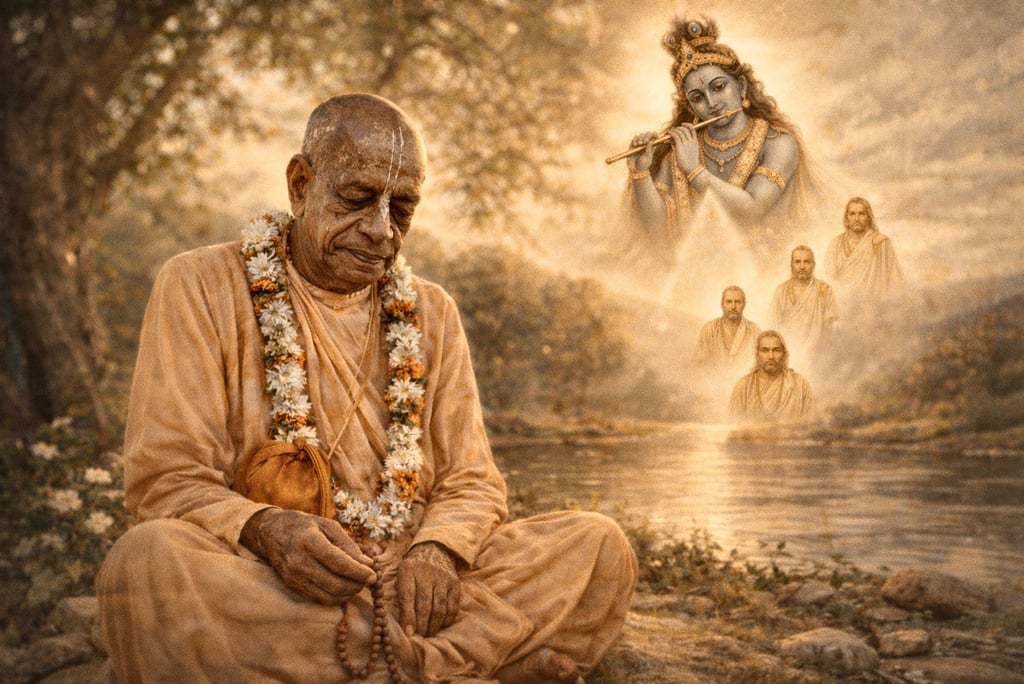
In the Bhagavad-gita, Lord Krishna explains this to Arjuna: “Evam paramparam praptam”—this supreme science is received through the chain of disciplic succession. (4.2)
The disciplic succession is, in a sense, a spiritual family tree. And while we naturally honor our biological parents, it is this spiritual lineage that ultimately guides us beyond birth and death.
Of course this does not diminish the importance of one’s family. In fact, the life of Shrila Prabhupada offers a beautiful example of how spiritual culture is nurtured within the home.
Shrila Prabhupada’s father, Gour Mohan, was a cloth merchant in Calcutta and a deeply devoted Vaishnava—a worshiper of Lord Krishna. Having been raised in a family of devotees, he strictly followed spiritual principles throughout his life. He never touched meat, fish, eggs, tea, or coffee. His nature was gentle, his habits disciplined, and his devotion steady.
Each evening, before closing his shop, he would place a bowl of rice on the floor for the rats, so that they would not damage the cloth in their hunger.
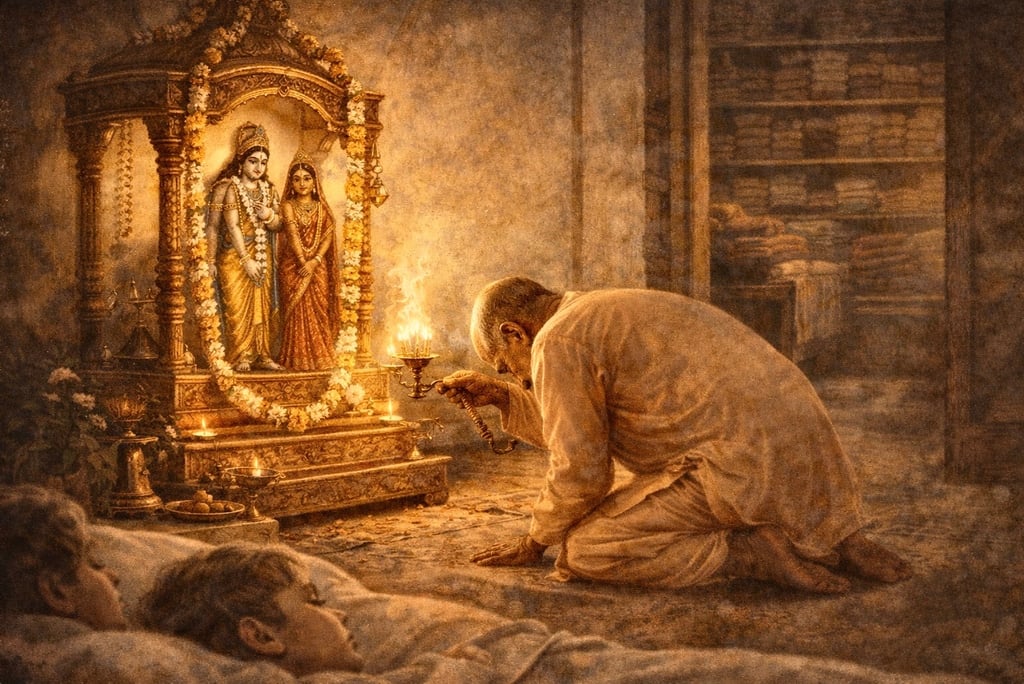
Returning home late at night, he would read sacred texts such as the Chaitanya-Charitamrita and Shrimad-Bhagavatam, chant on his prayer beads, and worship the Deity of Lord Krishna with great care and sincerity.
One memory remained especially vivid for Shrila Prabhupada throughout his life.
“We would be sleeping,” he recalled, “and father would be doing arati. We would hear the ding, ding, ding of the bell and wake up to see him bowing down before Krishna.”
In this way, devotion was not merely taught—it was lived. And from such beginnings, a great spiritual master would later emerge, carrying forward the same unbroken line of knowledge for the benefit of the entire world.
Viewed from a distance, the family tree of our bicycle mechanic—rooted deeply in the soil of humanity—may appear similar to the tree of disciplic succession. If both lineages were drawn on a large sheet of paper, their branching structures might seem almost alike.
But upon closer inspection, the differences become profound.
The names would differ—Linkletter versus Patel, English versus Sanskrit, Europe versus India—and more importantly, so would the origin and purpose of each tree.
The bicycle mechanic’s lineage traces through the ordinary course of human history: generation after generation, branching outward through time, eventually producing the skilled craftsman we now admire. It is a natural lineage—impressive in its own way—but limited to the material world.
The disciplic succession, however, is of an entirely different nature.
If the Triangular Theory of Bicycle Maintenance is truly to solve the problem of birth, old age, disease, and death, then every aspect of it must be spiritually rooted—fully connected to God and His divine mercy. This cannot be based on speculation or personal opinion. It must be established through revealed knowledge and sacred scripture.
As it is stated in the Holy Bible: “If the roots of the tree are holy, the branches will be too." (ROMANS 11:16)
Just as the roots of a tree nourish every branch, the tree of disciplic succession transmits divine knowledge through a sacred lineage of spiritual masters—originating with God Himself and extending outward to benefit all of humanity.
“This is the method of disciplic succession: Krishna imparted knowledge into the heart of the first created being, Brahma. Brahma then imparted that knowledge to his disciple Narada, and Narada to Vyasadeva. Vyasadeva imparted it to Madhvacharya, and from him the knowledge descended through Madhavendra Puri, Ishvara Puri, and ultimately to Chaitanya Mahaprabhu.”
(Sri Chaitanya-charitamrita, Introduction)
Regarding the identity of Lord Chaitanya (1486–1534), the scriptures speak with great clarity: "Govinda personally appears as Chaitanya… He is not an expansion—He is Krishna Himself.”
(Chaitanya-charitamrita, Adi-lila 2.22)
Other sacred texts confirm this divine appearance: “I shall appear in Navadvipa as the son of Sacidevi.” (Krsna Yamala Tantra)
“Sometimes I appear in the world in the garb of a devotee… as the son of Saci in Kali-yuga, to inaugurate the congregational chanting of the Holy Names.” (Brahma Yamala Tantra)
What is especially remarkable is that we need only look back approximately five hundred years to encounter this divine root of the tree—Lord Krishna appearing again as Chaitanya Mahaprabhu.
This is not distant mythology, but well-documented history, preserved by the scholars, saints, and eyewitnesses of His time.
Thus, the roots of this tree are not only holy—they are alive with divine presence. “If the roots of the tree are holy, the branches will be holy, too.” (ROMANS 11:17)
And indeed, from these roots have grown countless branches—each representing a great spiritual master, each directly connected to the Supreme Lord.
Although it would be impossible in a book of this size to describe all of their lives, we may briefly consider a few examples.
From the book, Lives of the Vaishnava Saints, we learn of Shrinivas Acharya, whose meditation was so deep that it transcended the boundary between the internal and external worlds.
While absorbed in meditation on Lord Chaitanya’s pastimes, he once envisioned himself worshiping the Lord, who was seated upon a jeweled throne. With great devotion, Shrinivas anointed His body with sandalwood paste, placed a fragrant garland around His neck, and gently fanned Him with a chamara.
Such was the depth of his realization that, upon returning to ordinary consciousness, he found that these sacred items—once only seen within his meditation—had manifested in tangible form.
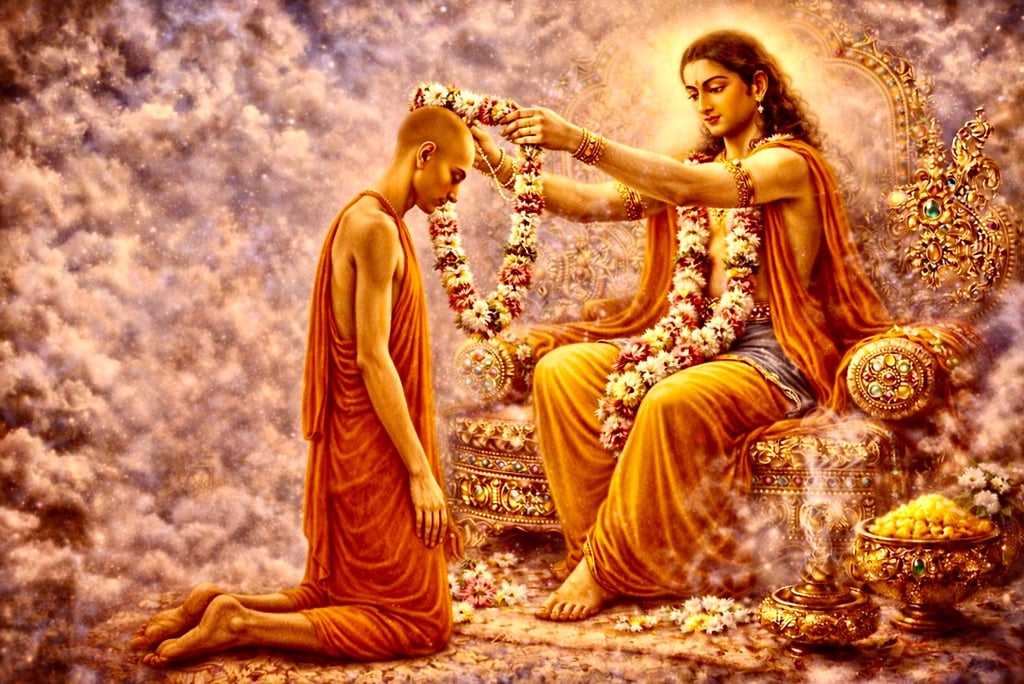
"As Shrinivas served the Lord in this way, he could no longer maintain his composure. Gazing upon the Lord’s magnificent form, he began to exhibit deep ecstatic symptoms.
"Seeing his devotion, Lord Chaitanya became pleased. With great affection He removed the very garland that Shrinivas had offered Him and gently placed it around Shrinivas’s neck.
"At that very moment, the meditation broke, but the garland remained. It rested upon Shrinivas’s chest, its fragrance unlike anything of this world—sweet, divine, and unmistakably real. Overwhelmed, he quickly removed and hid it, concealing what he understood to be a deeply confidential exchange between himself and the Lord."
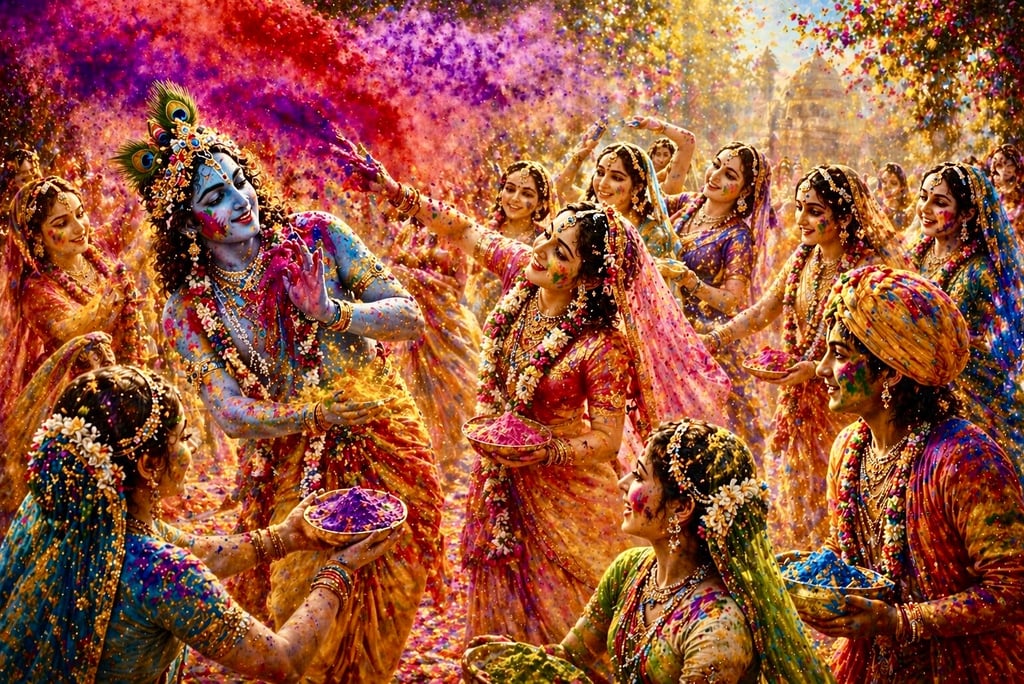
Such experiences were not isolated. On another occasion, during intense meditation, Shrinivas found himself present within the divine pastimes of Sri Radha and Krishna during the joyful festival of Holi.
In that sacred vision, Radha and Her intimate companions playfully hurled vibrant colors at Krishna, surrounding Him in waves of laughter and devotion. Krishna responded in kind, returning their playful attacks with even greater enthusiasm. Colors filled the air—reds, golds, blues—until the entire scene pulsed with life and divine joy.
As the playful battle intensified, the gopis turned toward Shrinivas—beckoning him to join them. In that moment, he was no longer himself as he knew it, but Mani Manjari, a servant of Srimati Radharani.
He rushed forward, assisting in the divine play—supplying colors, supporting Radhika, fully absorbed in the loving exchange. Yet Krishna would not be defeated. With increasing delight, He countered every effort, until the entire scene seemed to tremble with ecstatic energy.
Then, suddenly—the meditation ended and Shrinivas returned to external awareness, but his body was covered. The same brilliant colors from that spiritual festival now adorned him—visible, tangible, and undeniable.
Another sacred branch on this divine tree is the great Vaishnava saint, Sri Narottam das Thakura. Residing in Vrindavan—the holy land where Lord Krishna appeared five thousand years ago—Narottam developed a deep and intimate spiritual life. Over time, both his realization and his reputation grew, and he formed a close friendship with Shrinivas Acharya.
The story of Narottam’s life is filled with extraordinary events. One such incident took place during his stay in Vrindavan.
One night, a divine Vaishnavi appeared to him in a dream and spoke:
“Dedicate yourself fully to the feet of your spiritual master and carry out his instructions without hesitation. Your sincerity and austerity have pleased me. I will engage you in a confidential service.
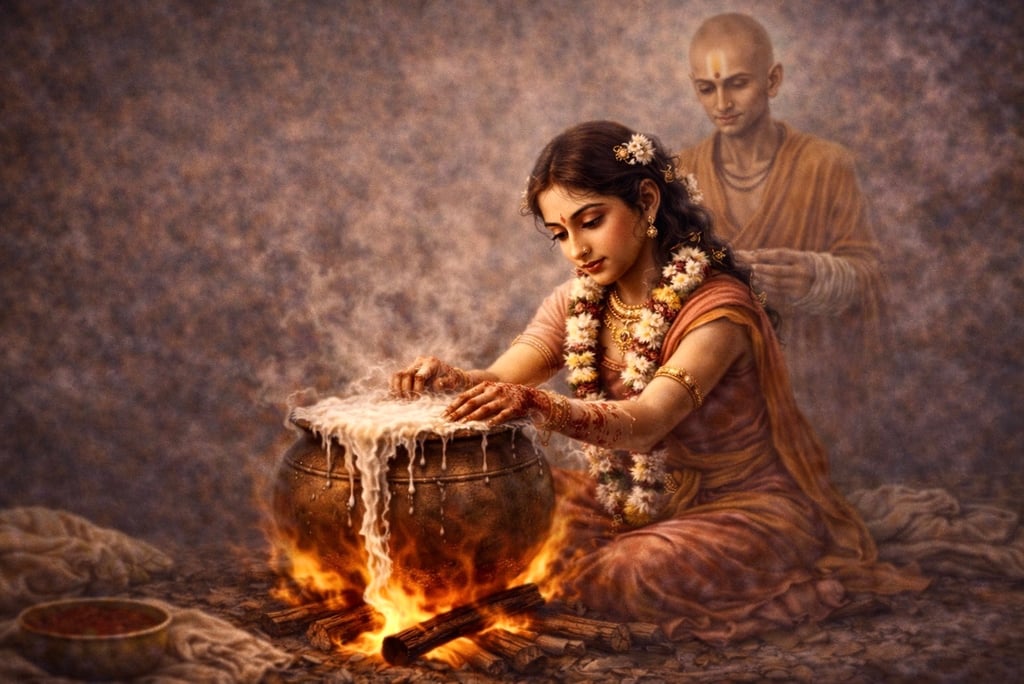
“When I meet Krishna each day, I observe how carefully He is served. A special milk preparation is made for Him, and Champakalata excels in this service. You shall assist her—boiling the milk. Know this: I am pleased when Krishna is pleased.”
When Narottam awoke, he immediately went to his spiritual master, Lokanath Goswami, and described the dream in full.
Lokanath embraced him and confirmed that the divine visitor was none other than Srimati Radharani—Krishna’s eternal consort. He also understood that this service—boiling milk for the Lord—was Narottam’s eternal identity, now being revealed and restored.
From that time forward, Narottam would enter deep meditative states in which he saw himself engaged in that very service—tending the fire, carefully heating the milk, assisting Radharani and the gopis in their loving offerings to Krishna.
In these visions, he worked with such absorption that he lost awareness of his external body.
At times, the milk would boil over, and in his eagerness to protect the offering, Narottam would instinctively reach out with his bare hands to stop it. The scalding milk burned him, yet he did not feel it. But when the meditation ended—when he returned to ordinary awareness—the burns remained.
The marks from that divine service had followed him back. Though he tried to conceal his hands beneath cloth, the residents of Vrindavan understood. They recognized the source of those wounds—not as ordinary burns, but as evidence of a life lived in direct connection with the spiritual world.
Another sacred branch on this divine tree is His Holiness Gopal Bhatta Goswami. A devoted follower of Lord Chaitanya, Gopal Bhatta Goswami lived as a true embodiment of the Scriptures. His fame spread throughout India, and in Vrindavan he became widely known for his deep realization in the path of Bhakti Yoga.
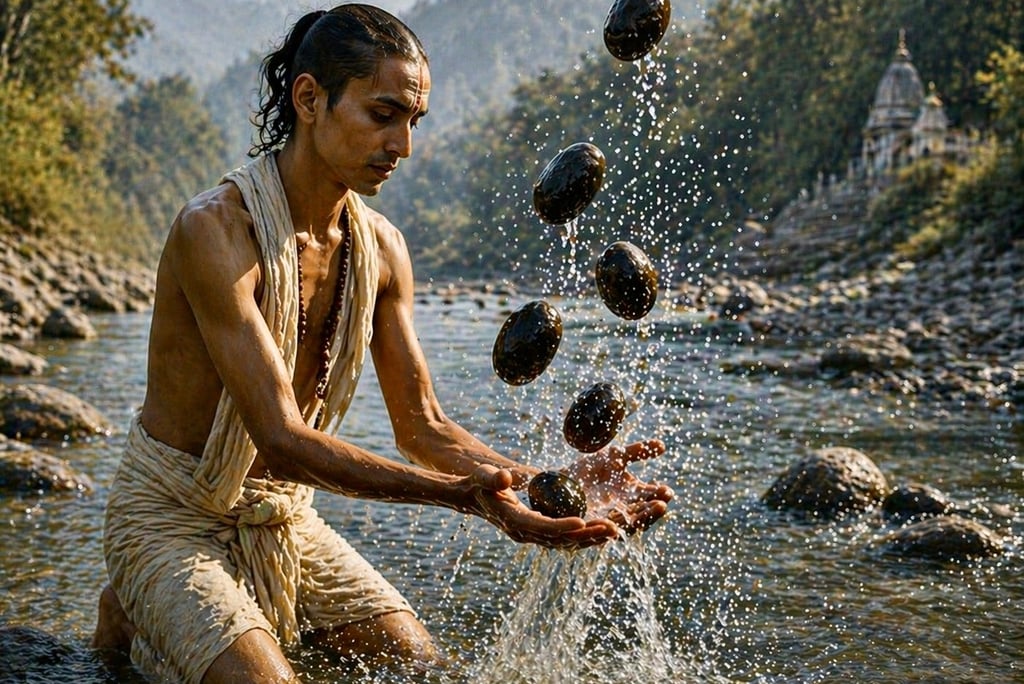
One of the most remarkable events of his life began with a journey to the Gandaki River in Nepal. There, he obtained twelve sacred stones—Shilas—revered as special manifestations of Lord Krishna. Carrying them with great care, he returned on foot to Vrindavan. But upon arriving, a sense of humility overcame him. He felt unqualified to properly worship such sacred objects.
Determined to correct what he perceived as an offense, he made the long journey back to the Gandaki River, intending to return the Shilas.
Standing at the river’s edge, he carefully placed the stones into the flowing water, chanting prayers.
But something extraordinary occurred: The Shilas would not remain. Again and again, as he released them into the river, they returned to his hands.
After several attempts, Gopal Bhatta understood. This was not chance—it was instruction. The Lord Himself was indicating that he should keep and worship them in Vrindavan.
Accepting this as divine will, he returned once more, carrying the Shilas in a cloth bag that hung from his neck, and became known for his constant devotion in serving them.
Years later, another longing arose within his heart. He desired to worship the Lord in a personal Deity form. This feeling deepened when a wealthy merchant offered him fine ornaments, cloth, and jewelry for the service of Krishna. But Gopal Bhatta felt troubled. The Shilas, though sacred, did not possess a human-like form upon which these offerings could be properly used.
Placing the items before the Shilas, he prayed earnestly for guidance. That night, no answer came, but the following morning everything had changed. One of the Shilas—known as the Damodhara Shila—had transformed.
“What had once been a simple stone now stood before him as the living form of the Lord.”Before him now stood a beautifully manifested Deity of Lord Krishna, fully formed and exquisitely detailed, just as he had long desired. Overcome with devotion, Gopal Bhatta fell to the ground, offering prayers in deep humility and love.
Word quickly spread throughout Vrindavan. Senior devotees gathered, astonished and joyful, to witness the miracle. It was then that the Deity was given the name: Shri Radharaman.
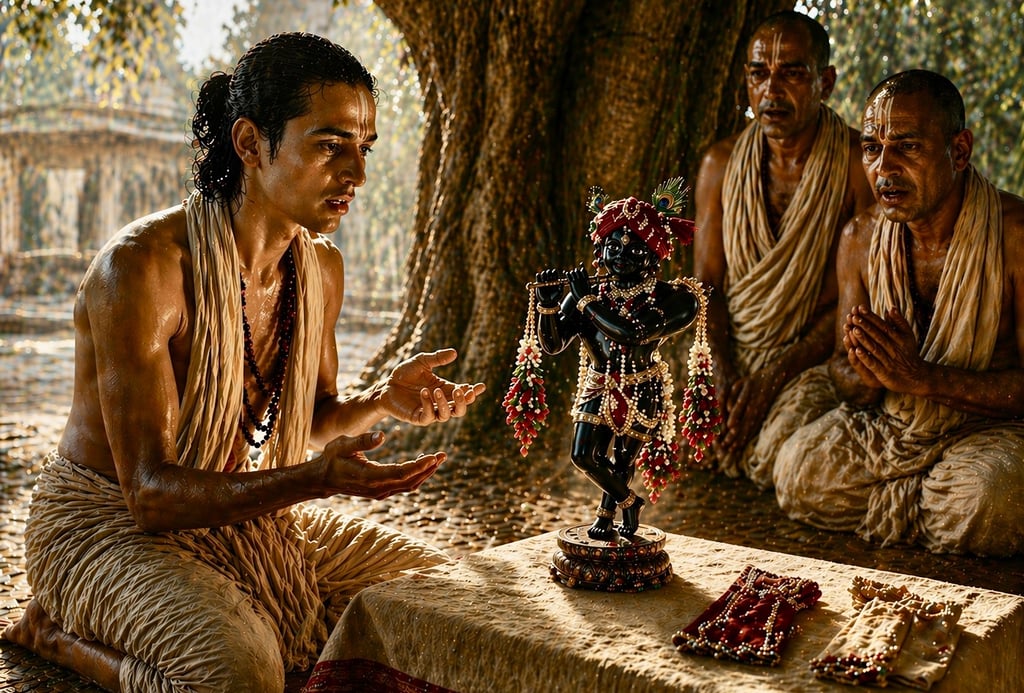
Shri Radharaman continues to be worshiped, to this very day in Vrindavan, India. You are welcome to visit Vrindavana and behold for yourself the sacred form of Gopal Bhatta’s Deity. (The Six Goswamis of Vrindavan, by Steven Rosen, p. 75)
On the subject of these “sacred stones,” I must admit that when I first encountered this idea I was more than a little skeptical. Yet what I later discovered made the matter even more remarkable: the concept of “living stones” is not confined to some distant Hindu tradition. In his thought-provoking book, Om Shalom: Judaism and Krishna Consciousness, Steven Rosen recounts a conversation with Rabbi Jacob N. Shimmel, a respected authority in Jewish theology. In their discussion, Rabbi Shimmel explains that within the "Kabbalah"—specifically in a section known as Sefer HaGilgulim—there are references to reincarnation, including the presence of divine life within certain kinds of stones.
---🔧---
No account of devotion would be complete without mentioning the extraordinary life of Haridasa Thakura. A great devotee of the Lord, he was personally honored by Lord Chaitanya as the foremost authority on the chanting of the Holy Name.
Although what follows may take a few extra minutes to read, I have included it for a reason: the blessing received simply by hearing about Haridasa Thakura has the power to transform one’s life, to the ends of eternity. In truth, we are shaped by the blessings we receive.
“Although no one can fully describe the qualities of Haridasa, one may say something of them simply to purify oneself.” (Chaitanya-charitamrita, Antya-lila 3.97)
To fully understand the identity of Haridasa Thakura, we must travel back some 5,000 years, to the divine childhood pastimes of Lord Krishna in Vrindavan. It was there that the Lord appeared as a simple cowherd boy, living among His eternal companions and delighting in the rhythms of rural life.
Even in childhood, however, Krishna's activities were extraordinary. He subdued powerful demons, transformed simple offerings into treasures, and performed countless wondrous deeds—all, while appearing as an ordinary child.
It was during this time that Brahma, the cosmic creator, became curious—and somewhat proud. Doubting Krishna’s divinity, he decided to test Him.
One day, while Krishna and His friends were tending calves in the forest, the boys sat down to eat their lunch. As they relaxed, the calves wandered off into the woods. Seeing the boys become anxious, Krishna reassured them: “My dear friends, continue eating. I will personally bring the calves back.”
Carrying His meal in hand, Krishna went off in search of them, exploring the forest’s hills, caves, and hidden paths.
Seizing the moment, Brahma used his mystic power to hide both the calves and the boys, placing them into a deep sleep. Though only moments passed for Brahma, a full year unfolded on earth.
When Krishna returned and saw that both His friends and the calves were missing, He understood what had happened. Without hesitation, He expanded Himself—perfectly replicating every boy and every calf, down to their unique features, clothing, personalities, and belongings.
For an entire year Krishna lived simultaneously as all the boys and calves of Vrindavan. During this time, the love of their parents deepened beyond measure, for each child was, in truth, the Lord, Himself.
When Brahma returned, expecting confusion, he instead found Krishna playing peacefully, surrounded by the very boys and calves he had hidden. Bewildered, Brahma could not comprehend what he was seeing.
Then, before his eyes, each boy and calf revealed a divine form of Vishnu, radiant and adorned in yellow silk. Overwhelmed, Brahma stood stunned, like a lifeless statue.
Regaining his awareness, he fell before Krishna in humility, his pride completely dissolved.
Yet the story does not end there. Ashamed of his arrogance, Brahma resolved that he would never again miss the opportunity to serve the Lord. Through deep austerity and prayer, he sought a future opportunity to redeem himself.
In time, the Lord appeared to him as Lord Chaitanya, radiant like the golden sun, and granted his request:
“In your next birth, you shall be born in a humble family, and through devotion you will become a great saint. You will chant My Holy Names constantly, and at the end of your life, you will attain My eternal abode.”
That promise was fulfilled in the life of Haridasa Thakura.
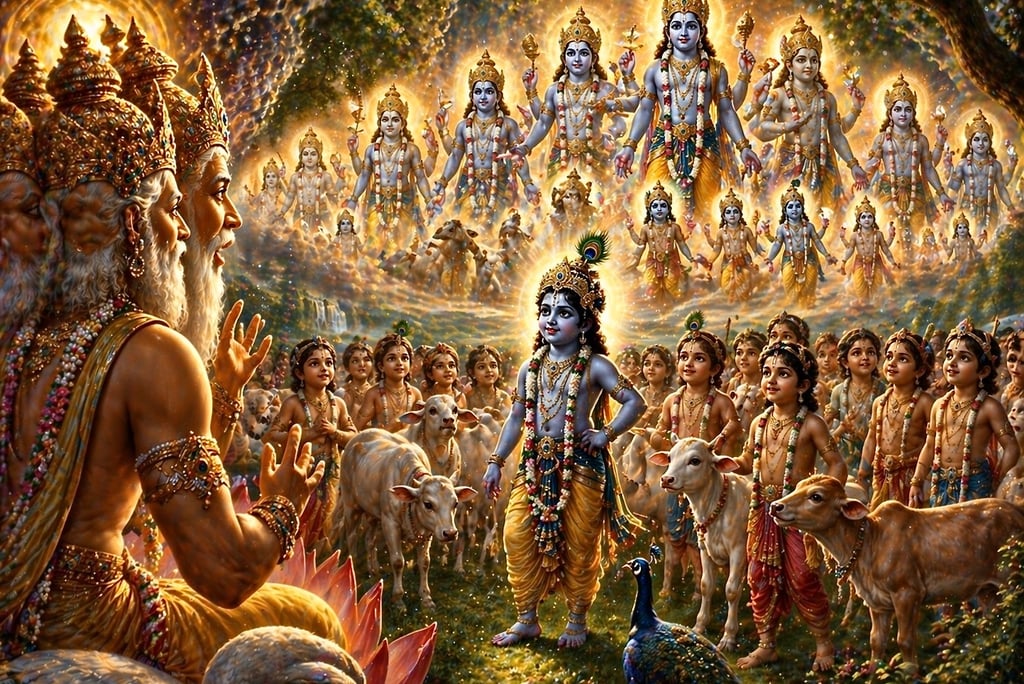
Smiling, Lord Chaitanya immediately promised Brahma that, yes, he would take part in His next appearance on earth. According to the traditional accounts of Haridasa Thakura’s life, his birth in a Muslim family was connected with the Lord’s mercy and the overcoming of pride. Haridasa later became famous as Namacharya, the great teacher of the Holy Name, chanting 300,000 names of Krishna daily. At the end of his life, he left this world in the presence of Lord Chaitanya, gazing upon the Lord’s face and chanting His Holy Name. In this way, the Lord revealed to Brahma many secrets of His next incarnation.
Although chanting the Lord’s Holy Name is the best process for spiritual upliftment in all yugas (ages), in Kali-yuga—the most degraded of the four yugas and the period in which the earth has now entered—the chanting of the Holy Name is the only means of redemption.
Lord Chaitanya personally established that whoever is convinced that all perfection is obtained by chanting the Lord’s Holy Name, that he alone is the topmost practitioner of devotional service. Being thus blessed, Lord Brahma would later take his birth as Haridasa Thakura and become that topmost person.
In time, Lord Chaitanya would ordain Haridasa as the prime authority on the art of chanting the Holy Name. His very life would become the perfect example of both the preaching and practice of chanting the great Hare Krishna prayer. Haridasa would teach that the loud chanting of the Lord’s Name is simultaneously the most perfect and most sublime means for attaining one’s heart’s desire, as well as the sacred goal of devotion, itself. Therefore, the life and teachings of Haridasa Thakura were praised by Lord Chaitanya.
To begin looking at the life of Haridas Thakura in earnest, let us go back in time. The date is approximately thirty years before the birth of Lord Chaitanya, in 1456—a dark passage in India’s long history when she was being ruled by a Muslim government. Naturally, great animosity existed between these two, very opposite cultures. It was during these tense and difficult years that the young Haridasa began his rise to fame.
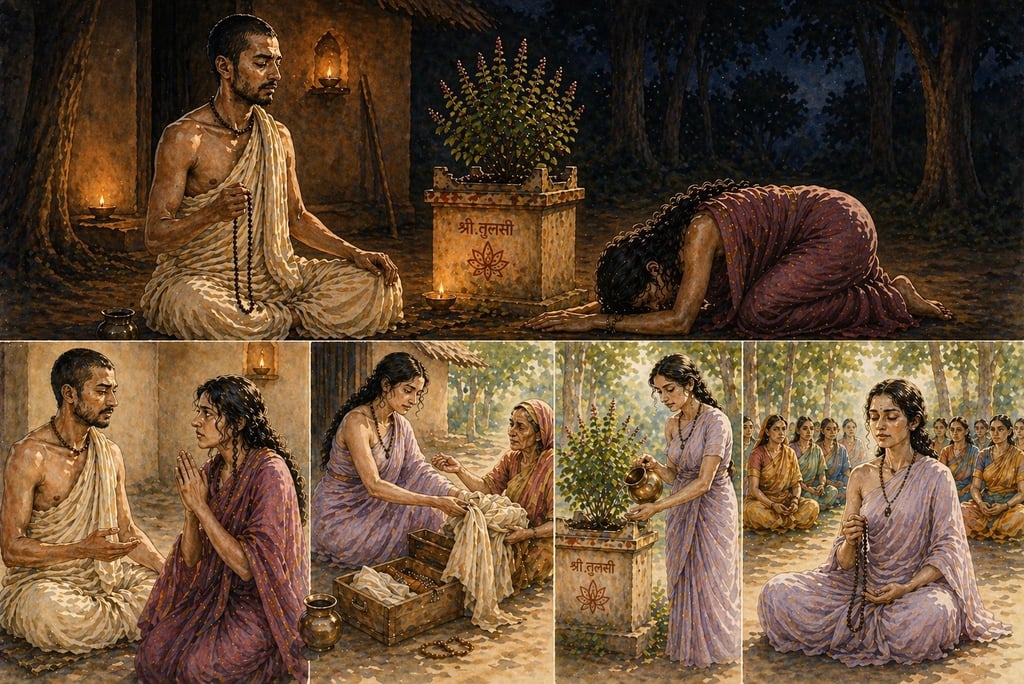
Because Haridasa was a Muslim and because he had adopted the Hindu practice of chanting the Holy Names of Krishna, the chief magistrate, Ramachandra Khand (RA-ma-chon-dra kon), had become especially hateful toward Haridasa. At the time, Haridasa was living in a forest hut as a recluse, chanting his 300,000 names of Krishna everyday, along with worshiping the holy Tulasi (TOLL-see) tree.
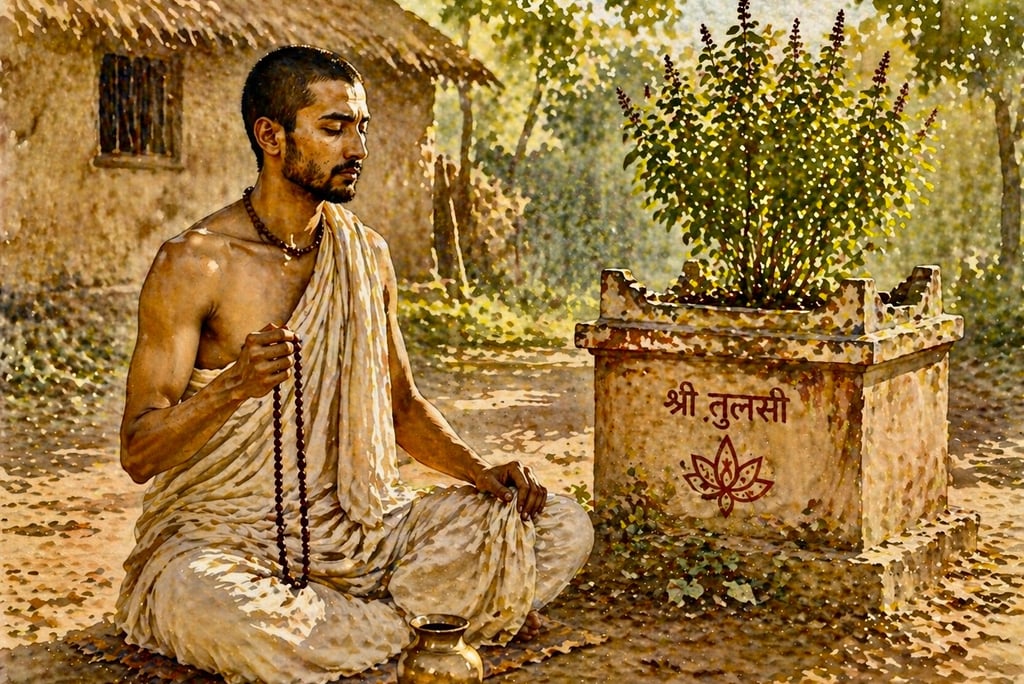
Whenever Haridas felt the necessity to eat, he would simply beg a little food from the local villagers. In this way, the reputation of Haridasa Thakura spread far and wide. The villagers loved and respected this gentle soul very much.
Unable to tolerate any public admiration shown toward Haridasa by the local hindus, the magistrate began to plot an trap to seal the fate of this Muslim traitor. Employing the help of a prostitute, an especially beautiful young girl was sent to Haridasa’s hut to entice him into having sex with her. The plan was to arrest Haridasa after his second encounter with the girl, so as to have irrefutable evidence against him. Of course, this meant that the young prostitute would have to be successful at least once before the soldiers would arrest him. Upon seeing the girl’s exquisite beauty, the magistrate knew that no man could resist her invitations. The heinous trap was thus set.
The forest in which Haridasa sat was enchanting. Cool breezes lifted exotic perfumes from the wild flowers which grew there, filling the evening air with an intoxicating smell. Haridasa sat on the ground, just outside his hut, gazing at his beloved Tulasi tree that he adored very much. Immersed in chanting the great prayer of deliverance (Hare Krishna-Hare Krishna-Krishna Krishna-Hare Hare-Hare Rama-Hare Rama-Rama Rama-Hare Hare), the prostitute suddenly appeared as if she had been carried there upon the evening breeze. After she offered her obeisances to the Tulasi tree, the young prostitute slowly began to reveal to Haridasa various parts of her naked body, exclaiming that she had come to give herself in union with him.
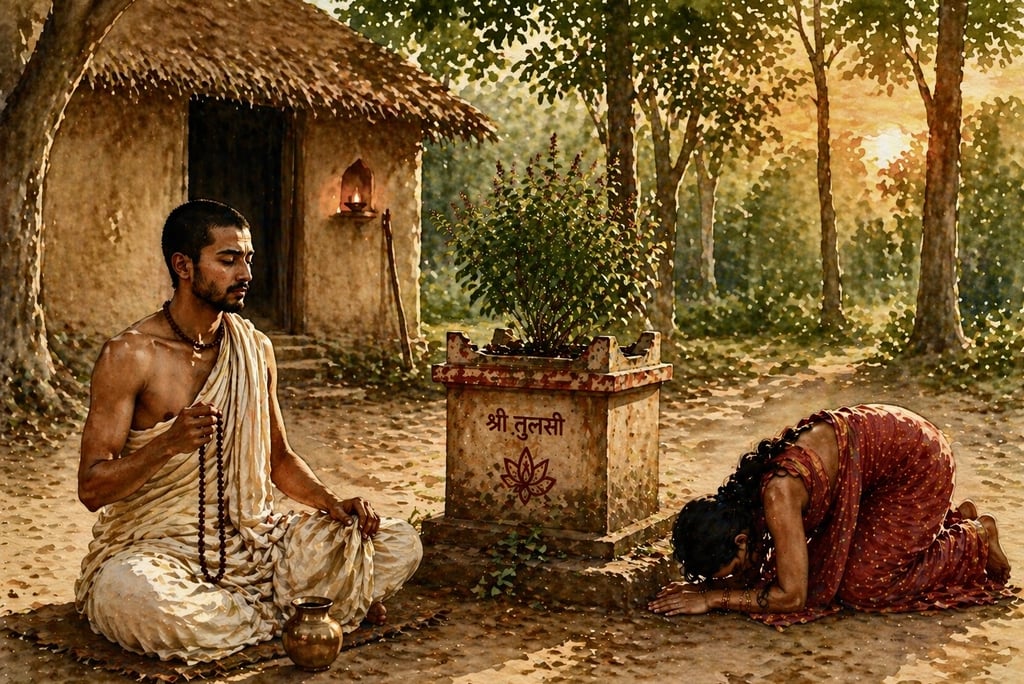
Hearing her thus speak, Haridasa told her to please sit down and that as soon as he finished his chanting, he would immediately satisfy her. He told her that until he completed his daily vow of chanting 300,000 names of God, he could not do anything else. But, he assured her, he would finish as soon as possible.
Throughout the night Haridasa chanted, with the prostitute listening. At times she chanted the Names of God with him. When dawn arrived, the prostitute got up to leave, telling Haridasa that she would come back that evening. Haridasa again assured her: next time, without fail, he would completely satisfy her .
As promised, once again the beautiful young girl approached Haridasa, first stopping to pay her obeisances to the sacred Tulasi tree, and just as before, Haridasa told her that as soon as he finished his required chanting, he would come to her. The prostitute then sat and listened to the prayers, and again, at times, chanted with him.
However, again the morning light repeated the disappointment of the previous day. Undeterred, she got up to leave, promising to come back a third time. Each time she had to tell the evil magistrate that one more night was required for the trap to work.
It was then on that third night that something very remarkable happened. Arriving, the prostitute paid her obeisances to Tulasi. Again she sat in a revealing position. But on that night, as she heard the Lord’s Holy Names being chanted by His topmost devotee, the prostitute’s heart suddenly changed. She covered herself and fell at the feet of Haridasa, confessing everything: the plot, the trap that the magistrate had set in motion, and now her deep shame.
After she spoke, Haridasa told the young girl that he already knew about the magistrate and his sinister trap, and that he had been prepared to leave days ago—but because he knew that she would be coming, he had stayed longer, just to deliver her.
Following the instructions of Haridasa, the girl gave away her worldly possessions and moved into the forest hut. Alone, she took care of Haridasa’s Tulasi tree and began, herself, chanting 300,000 names of God everyday. In fact, as time went by, she became a famous teacher of the Holy Name, guiding many souls on this great path of salvation.
Because of Haridasa’s Muslim birth, he had to undergo many trials during his lifetime. On another occasion, again brought about by his popularity amongst the local villagers, a much greater villain threatened his life. Haridasa was seen by this Muslim ruler as a great insult to the Holy Koran. To see Haridasa (a Muslim) attracting so many Hindu followers was something that could not be tolerated.
The Mohammedan ruler went to the Muslim King and arranged for soldiers to arrest Haridasa. Thrown into prison, Haridasa was given an ultimatum. If he agreed to renounce the chanting of Lord Krishna’s Holy Names and take up the Koran with his heart and soul, only then would Haridasa’s life be spared. Otherwise, Haridasa was assured that an example would be made of him to convince any other would-be Muslim converts that conversion to Hinduism would not be tolerated.
Hearing the ultimatum, Haridasa felt no fear and the king was astonished by his composure. But, still, the king wanted to know why Haridasa, a Muslim, was stooping so low as to chant the Names of a Hindu God.
Haridasa then spoke to the king and his ministers—telling them that he was a servant of God and that whatever the Lord’s Will for him was, that he was ready to embrace it fully. He told them that even if they tortured him, or cut his body into little pieces he would never give up chanting the Holy Names of Lord Krishna. “Even if you inflict suffering upon me which knows no end, I shall never deviate from chanting Hare Krishna.”
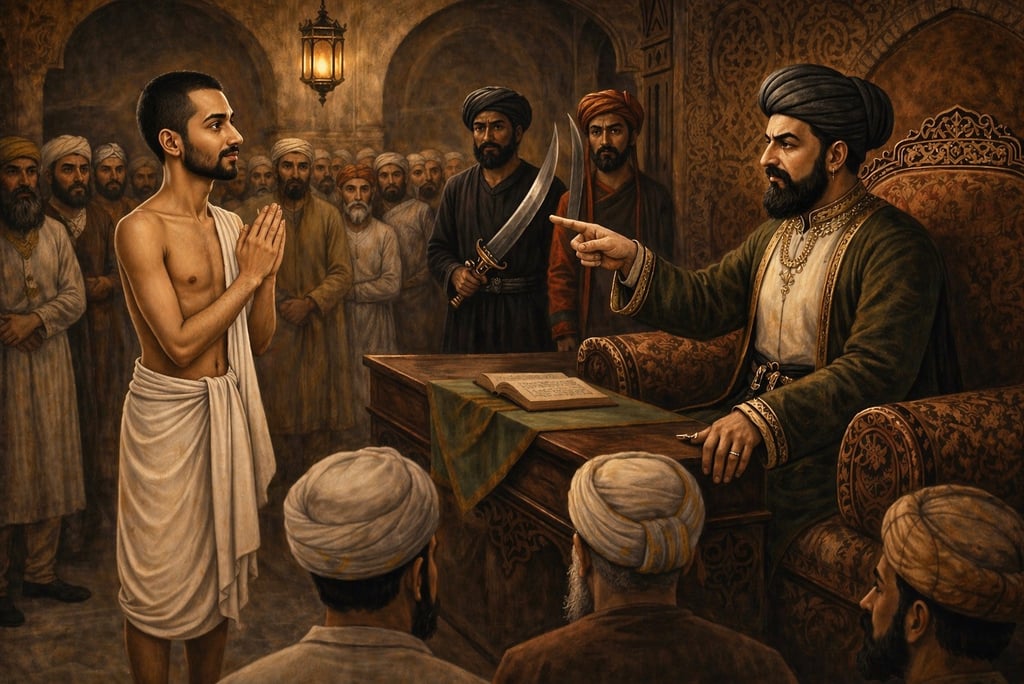
The Mohammedan ruler was furious. He told the king that Haridasa’s sin was so great that no amount of atonement would erase his guilt. Only public execution (a very brutal and violent death) was fitting for the likes of Haridasa Thakura.
Now the king had no choice. The executioner was summoned along with his many assistants. They were men of no mercy. Quickly they bound Haridasa tightly. He was then condemned to death by public caning; to be carried out immediately in the public markets for all to see. Although there were twenty-two marketplaces, even the most robust prisoner seldom survived beyond the third beating.
What happened next was a miracle. The beatings not only continued through the first three marketplaces, but all twenty-two markets! Exhausted, his executioners then began to panic, knowing very well that unless Haridasa was killed according to the instructions of the king, that they, too, would be subject to severe punishment. Pleading with Haridasa to die, he agreed to their appeal. Entering into a spiritual trance, all symptoms of life left his body.
Much relieved, the executioners took Haridasa’s limp body back to the king’s castle. The king wanted to give Haridasa a proper burial but the Mohammedan governor insisted otherwise. He said that any funeral would honor Haridasa, who deserved only dishonor. Therefore, the executioners were ordered to throw the body of Haridasa into the river so that his soul would never know any peace.
As the men placed Haridasa’s corpse by the river, suddenly Haridasa sat up, as his spiritual trance broke. Now the men became even more terrified for their lives. Again they begged Haridasa to die. Taking pity on his executioners, Haridasa told them to throw his body into the swift Ganges where he would surely drown.


Protected by this sacred river, who always provides shelter for the Lord’s humble devotees, far from all to see, Haridasa washed up on her banks, unseen except for one person, the king, who at the time was out riding his horse. Immediately the king dismounted and fell before Haridasa, begging for forgiveness. “You are everything that the people say you are.” The king then gave Haridasa permission to stay in his kingdom forever and to worship God however he saw fit.
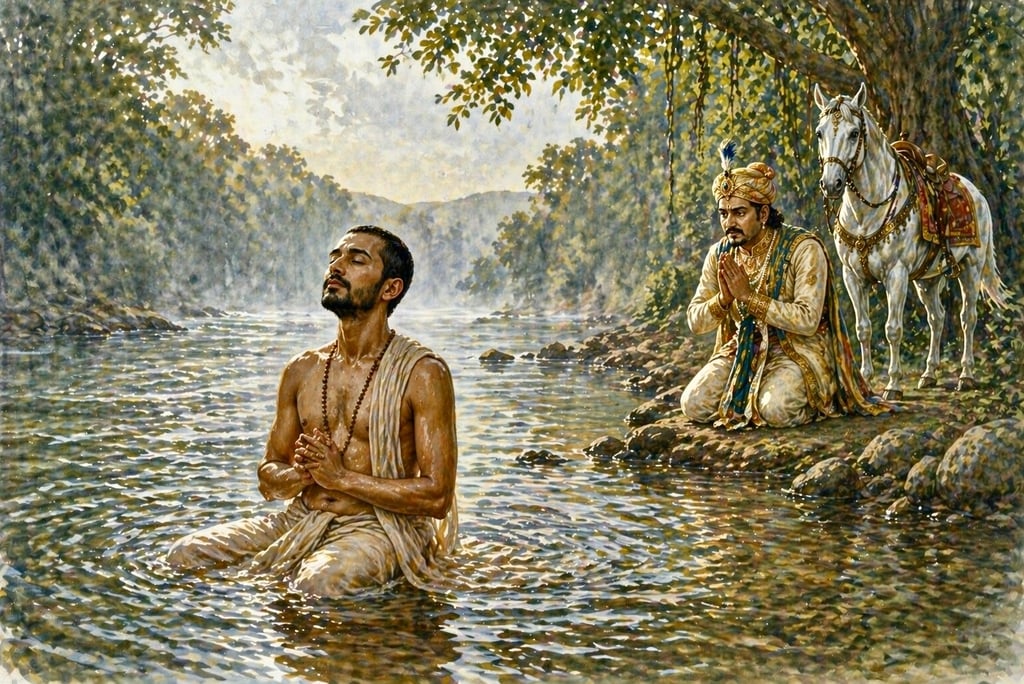
While it is true that Haridasa Thakura never condemned his attackers—only forgiving them—we need to jump twenty years in time to fully appreciate the purport of this amazing story. We need to hear how one day Lord Chaitanya motioned for Haridasa to approach Him: “Over here, Haridasa.”
The Lord spoke up so that everyone present could hear. “I want you to know, Haridasa, that My advent (upon the earth) was hastened by the beating you once took. I had to come because I could not tolerate your suffering. I was ready to destroy everyone, but when I found that you were praying for your punisher’s deliverance, I was controlled by your love. So I did the only thing I could. Standing over you, I took the beating, Myself.”
Rising, Lord Chaitanya turned around so that everyone could see His back. Seeing the deep scars, everyone gasped. Haridasa fainted.
After Haridasa regained consciousness, Lord Chaitanya gave the benediction (blessing): that anyone who gets Haridasa’s association, "or even hears about Haridasa Thakura," will attain the shelter of Lord Krishna.
There are many other stories about Haridasa Thakura—how he lived in a cave with a venomous snake—how the Lord’s divine energy assumed the form of a goddess and tested him again, in the same way that the young prostitute had. There is also a story of how a sacred twig, planted by Lord Chaitanya in front of Haridasa, immediately grew into a large shade tree, simply for Haridasa’s comfort. Eventually the final hours of Haridasa Thakura’s life arrived. Hearing how he died is how we shall end this narration.
---🔧---
One day, Govinda, who was the personal servant of Lord Chaitanya, went to deliver the remnants of Lord Jagannatha’s (jog-a-nath's) food to Haridasa Thakura. Lord Jagannatha is the wooden form of the Lord, located in an ancient temple located in Puri, India. When Govinda came to Haridasa, he saw that Haridasa was lying on his back and chanting his rounds very slowly.
“Please rise and take your meal,” Govinda said.
Haridasa replied, “Today I shall observe fasting. I have not finished chanting my regular number of rounds. How can I eat?”
The next day, Lord Chaitanya went to Haridasa’s place and inquired from him, “Haridasa, are you well?”
Haridasa offered his obeisances to the Lord and replied, “My disease is that I cannot complete my appointed rounds.”
“Now that you have become old,” the Lord said, “you may reduce the number of rounds you chant daily. You are already liberated, so therefore you need not follow the regulative principles very strictly. Your role in this incarnation was to deliver the people in general. You have sufficiently preached the glories of the Holy Name in this world. Now, therefore, please reduce the fixed number of times you chant Hare Krishna.”
Haridasa replied, “Kindly hear my real plea. I was born in an inferior family, and my body is most abominable. I have engaged in low work. Therefore, I am the lowest, most condemned of men. People should not even see or touch me, but You have accepted me as Your servant. This means that You have delivered me from a hellish condition and raised me to the topmost spiritual platform.
“My dear Lord, You are the fully independent Personality of Godhead. You act by Your own free will. You cause the whole world to dance and act as You like. By Your mercy, You have made me dance in many ways.
“I have had one desire for a very long time. I think that quite soon, my Lord, You will bring to a close Your pastimes within the material world. I wish that You not show me this closing chapter of Your pastimes. Before that time comes, kindly let my body fall down in Your presence. I wish to catch Your lotus-like feet upon my heart and see Your moon-like face with my eyes. With my tongue I shall chant Your Holy Name: Shri Krishna Chaitanya. That is my desire. Kindly let me give up my body in this way.”
The next morning, after visiting the temple, Lord Chaitanya, accompanied by His disciples, came to see Haridas, who immediately offered his respects to Lord Chaitanya, who was his life and soul. Haridasa then offered his respects to the assembled devotees.
Lord Chaitanya immediately began singing and dancing in the courtyard. All the devotees surrounded Haridasa and began congregational chanting.
In front of all these great devotees, Lord Chaitanya began to describe the holy attributes of Haridasa Thakura. As He described the transcendental attributes of Haridasa, Lord Chaitanya seemed to possess five mouths. The more He described, the more His happiness increased.
After hearing of the transcendental qualities of Haridasa, all the devotees present were struck with wonder. They offered their respectful obeisances to the lotus-feet of Haridasa Thakura.
Haridasa kindly asked Lord Chaitanya sit down in front of him and then fixed his eyes, like two bumblebees, on the lotus-face of the Lord. He held the lotus-feet of the Lord on his heart and then took the dust from the feet of all the devotees present, and put it on his head. He began to chant the Holy Name of Lord Chaitanya again and again. As he drank the sweetness of the Lord’s divine face, tears constantly glided down from his eyes. While chanting the Holy Name of Lord Chaitanya, he gave up his life air and left his body. Seeing the wonderful death of Haridasa by his own will, everyone remembered the passing away of Bhisma. (Note: Bishma had been given the benediction of not having to die until he chose to do so. The story of this mighty warrior is narrated in the great Indian classic, the Mahabharata.)
There was a tumultuous noise as they all chanted the Holy Names, ‘Hari’ and ‘Krishna.’ Lord Chaitanya became overwhelmed with ecstatic love. Because of His ecstatic love, all the devotees were helpless, and in ecstatic love they also began to dance and chant congregationally.
Lord Chaitanya danced for some time (carrying the body of Haridasa). Then the Lord was informed of other burial rituals for the body of Haridasa Thakura.
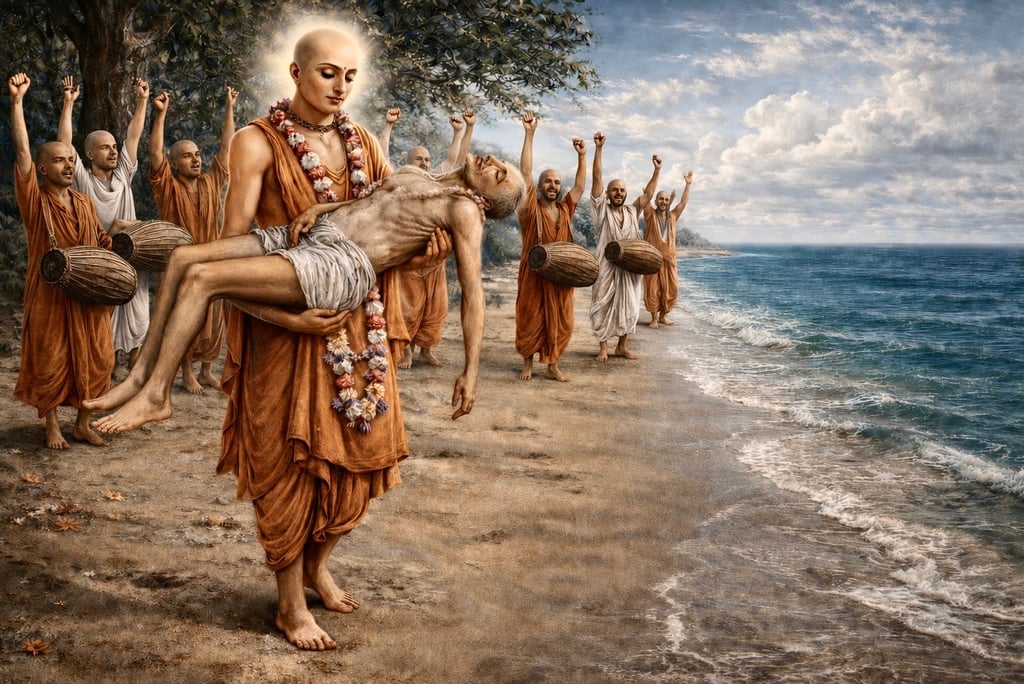
The body of Haridasa was raised onto a carrier that resembled an airship and taken to the sea, accompanied by congregational chanting. Lord Chaitanya bathed the body of Haridasa in the sea and then declared, “From this day on, this sea has become a great pilgrimage site” (Bay of Bengal).
Everyone drank the water that had touched the lotus-feet of Haridasa, and then they smeared remnants of the Deity’s sandalwood pulp over Haridasa’s body. After a hole was dug in the sand, the body of Haridasa Thakura was placed in it. Other remnants from the temple Deity, such as His silken ropes, sandalwood pulp, food and cloth, were placed on the body. All around the body, the devotees performed congregational chanting, and Vakreshvara Pandita danced in jubilation. With His transcendental hands, Lord Chaitanya personally covered the body of Haridasa with sand, chanting ‘Hari bol, Hari bol! (Chant the Holy Name of God).
Later that day, Lord Chaitanya presided over a great feast to honor Haridasa Thakura. Overwhelmed with ecstatic love, Lord Chaitanya offered a benediction to all the devotees, which they heard with great satisfaction. The Lord gave this benediction: “Anyone who has seen the festival of Haridasa Thakura’s passing away, anyone who has chanted and danced here, anyone who has offered sand on the body of Haridasa, and anyone who has joined this festival to partake of (this feast) will achieve the favor of Krishna very soon. Haridasa was the crown jewel on the head of this world; without him, this world is now bereft of its valuable jewel. Say, All glories to Haridasa Thakura and chant the Holy Name of Hari.”
Everyone began to chant: “All glories to Haridasa Thakura, who revealed the importance of chanting the Holy Name of the Lord.”
Thereafter, Chaitanya Mahaprabhu bid farewell to all the devotees and He, Himself, with mixed feeling of happiness and distress, took rest. (Chaitanya-charitamrita, Antya-lila, 11:16-100)
---🔧---
To end this section about Haridasa Thakura, perhaps it is best to quote directly from the Chaitanya-charitamrita:
“All glories to Lord Chaitanya. All glories to the devotees of Lord Chaitanya. I take shelter of the Supreme Personality of Godhead, Shri Chaitanya Mahaprabhu, who Himself is the tree of transcendental love of Krishna. He is the desire tree of devotional service. (He) became the main trunk of the tree of devotional service. From the trunk grew many branches and above them innumerable others. Thus the branches of the Chaitanya tree formed a cluster or society, with great branches covering all the universe. Since Lord Chaitanya was the original trunk, the taste of the fruits that grew on the branches and sub-branches surpassed the taste of nectar.”
“I offer my obeisances to all the dear devotees of Chaitanya Mahaprabhu, the eternal tree of love of Godhead. I offer my respects to all the branches of the tree: the devotees of the Lord who distribute the fruit of love of Krishna. The twentieth branch of the Chaitanya tree was Haridasa Thakura. His character was wonderful. He used to chant the Holy Name of Krishna 300,000 times a day without fail. There was no end to the transcendental qualities of Haridasa Thakura. He did not even slightly raise an eyebrow when persecuted by the Mohammedan ruler.” (Chaitanya-charitamrita, Adi-lila, 9:2-26 & 10:43,45)
---🔧---
The Inner Life of the Spiritual Master
Let us continue, then—not by defining the spiritual master from a distance, but by trying to understand what is happening within him.
When I began to think more deeply about this, one quality kept rising to the surface: compassion. Not ordinary kindness, but something far deeper.
From the scriptures and from the lives of great souls, we begin to see that the spiritual master is moved—almost driven—by a kind of sorrow. A sorrow that comes from seeing the condition of humanity.
Śrīla Prabhupāda spoke of this often. He explained that a true devotee is one who becomes unhappy upon seeing the unhappiness of others. That statement stayed with me, because it shifts everything. It tells us that compassion is not something we practice from a distance—it is something we deeply feel.
This same idea is expressed in this beautiful prayer: “I offer my respectful obeisances unto all the devotees of the Lord. They are just like desire-trees, able to fulfill the needs of everyone, and they are full of compassion for the fallen souls.”
At first, I had read this as poetry. But the more I reflected on it, the more I began to understand that it was not exaggeration—it was description.
And then we are given an even deeper glimpse into this inner life through the words of Vasudeva Datta. When I first came across his prayer, I had to stop and slowly read it again:
“My Lord, my heart breaks to see the suffering of all conditioned souls. Therefore I ask that You transfer the reactions of their sins upon my own head. Let me suffer endlessly, if it will free them from their misery.”
There is something almost difficult to comprehend here. Not just a willingness to help—but a willingness to suffer in place of others.
At that point, it began to dawn on me that we are not simply talking about a teacher. We are looking at a completely different kind of heart.
A Life That Is Not One’s Own
As I continued to think about this, another quality became clear—commitment.
Not the kind of commitment we usually speak about, but something absolute. The spiritual master’s life is no longer his own. It is given fully to God—and just as importantly, to his own spiritual teacher—and even to those who came before him.
This was something I had not fully appreciated before. Each morning, the spiritual master offers prayers—not as ritual, but as remembrance. In those prayers, we see how he views himself: “The lotus feet of my spiritual master are the only way by which I can attain pure devotional service. By his grace, one can cross the ocean of material suffering and obtain the mercy of Krishna. He opened my eyes, which were blinded by darkness, with the torch of knowledge. I offer my respectful obeisances unto him.”
The more I read these prayers, the more I realized—they are not formalities. They reveal identity.
The spiritual master does not see himself as independent or self-made. He sees himself as a servant—one who has received something sacred and is now responsible for passing it on.
No One Stands Alone
This led me to something else I had not fully considered. Even the greatest souls accepted guidance. Lord Krishna accepted a teacher, and Lord Chaitanya did the same—taking shelter of Ishvara Puri.
At first glance, this seems unnecessary. Why would one who is that divine accept a spiritual master? But then the answer becomes clear: to show us the way. Not by instruction alone, but by example.
This principle appears again and again, not just in one tradition, but across many.
We are told in the Bible that Jesus came to be baptized by John. There is also Saint Nicephorus who wrote, “It is necessary to look for a spiritual guide.” And a simple Russian pilgrim once said, “I read the Bible and asked for the whereabouts of a spiritual teacher.”
Different voices. Different times, but the same conclusion: No one advances alone.
What I Am Beginning to Understand
As I reflect on all of this, I find myself returning to a simple realization: The spiritual master does not live for himself. He feels deeply for others. He acts on that feeling, and he does so under the guidance of those who came before him.
Śrīla Prabhupāda once spoke about his own spiritual master, explaining that from their very first meeting, he had been instructed to carry this message to the world. He later said how that instruction stayed with him—impressed upon his heart.
So yes, what Prabhupada said has stayed with me, how the instructions of his Spiritual Master were impressed upon his heart. Not lightly held. Not occasionally remembered, but always present.
And perhaps that is the simplest way to understand the spiritual master—not as a distant figure. Not as an abstract authority, but as someone who has taken the suffering of others seriously…and who, because of that, has chosen a life of service.
A.C. Bhaktivedanta said, “My Guru Maharaja had an ambition to publish the message of Lord Chaitanya in all the languages of the world. Therefore the organization of press and literature, and public sales should be our main business.” (Note: This is a picture of His Divine Grace Bhaktisiddhanta Sarasvati Thakura, the spiritual master of Srila Prabhupada)
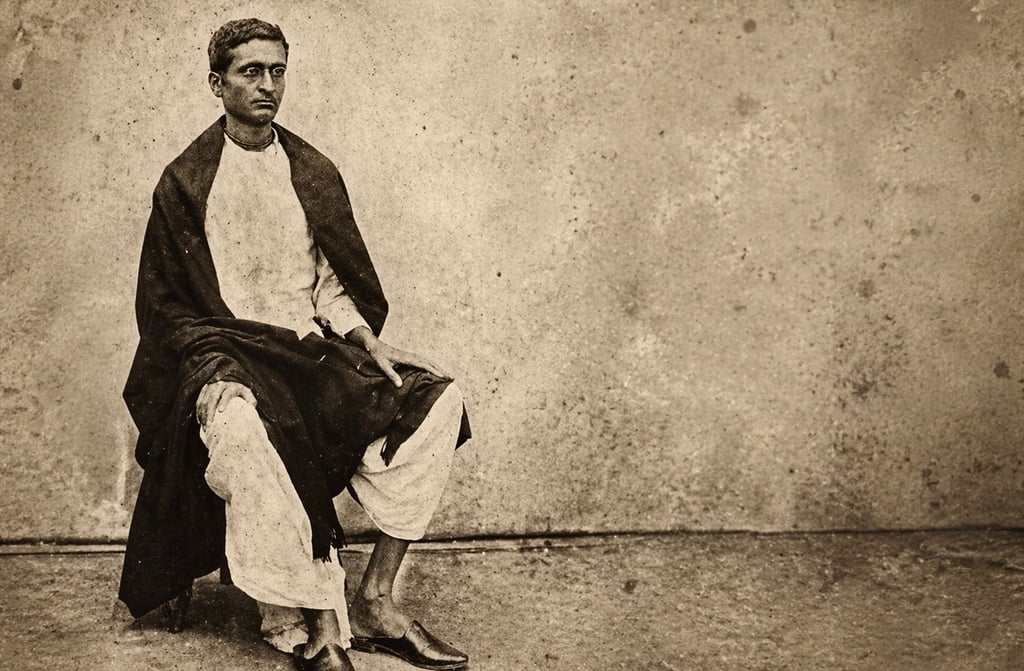
Elsewhere, Shrila Prabhupada further explains the heart of this mission: “Lord Chaitanya taught us—even His most intimate disciples were sent out—‘Go and preach. Go door-to-door. Teach them the chanting of Hare Krishna.’ So our mission is like that. We go door-to-door to connect people—to link them with this movement. Whomever you meet, simply deliver the instruction of Krishna. That is all. This is Lord Chaitanya’s mission. This is our movement—to help people become pure, moral, sinless, and advanced in God consciousness. Because I love Krishna, I want to see everyone come to love Him.” (Conversations with Shrila Prabhupada, Vol. 7, pp. 124–25)
Here again we see that the spiritual master does not live for himself. His life is an offering—an expression of love that naturally seeks to be shared. His compassion does not remain a feeling within the heart; it becomes action, movement, and sacrifice.
This same principle is echoed in other traditions. In his February, 1989 magazine, Word of Faith, Rev. Kenneth Hagin wrote: “Commitment to the Word is what produces a lifestyle of holiness and right-living before God.”
True commitment transforms a person. It reshapes not only what he believes, but how he lives, how he serves, and how he responds to the needs of others.
Earlier in this chapter I spoke about the bicycle mechanic—how he is dedicated to restoring life to broken bicycles. In the same way, the spiritual master is fully committed to restoring the spiritual life of others. Where others may see confusion, failure, or hopelessness, the spiritual master sees the opportunity to serve.
This enthusiasm to serve both God and his own spiritual teacher is not forced—it flows naturally from love. And when this love is combined with a deep compassion for all living beings, we begin to understand what truly rests upon the altar of the spiritual master’s heart.
It is not ambition. It is not recognition. It is not comfort. It is a single desire: To see others lifted, healed, and awakened in their relationship with God.
---🔧---
Tools & Knowledge:
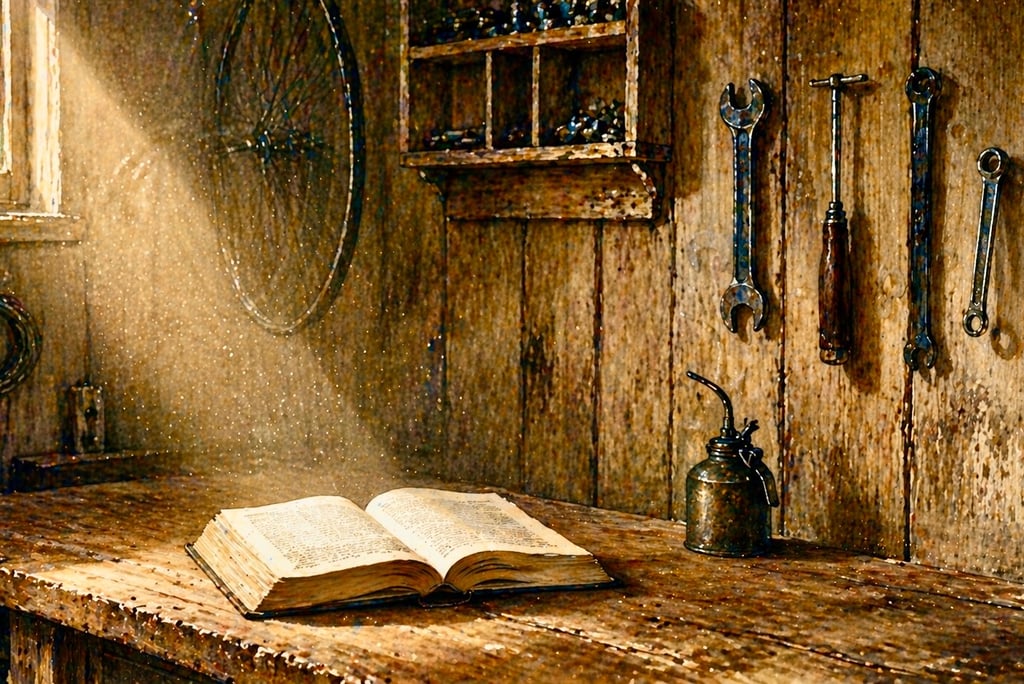
Spiritual tools—an unusual thought, as if we could see them hanging before us, radiant and alive—neatly arranged upon a wall.
But first, let us remember the cardinal rule I have set for myself:
"If the Triangular Theory of Bicycle Maintenance is to solve the Problem of death, then every part of it must be divinely alive—blessed by God’s presence, His Holy Words, and resting upon His absolute authority."
As we shall soon see, when the spiritual master comes into our presence, he comes to bless us with his touch. It is this holy touch that begins our deliverance.
Moments aboard the sinking Titanic were like this—when a hand was placed upon the shoulder of a passengers who then hears a voice say, “Come, get into the lifeboat.” Those who responded to that touch, lived.
In the same way, the spiritual master reaches out—not merely with his hand, but through something far more powerful: his words.
Just as the bicycle mechanic carries a bag filled with tools, the spiritual master also carries a “bag of tools." But unlike the lifeless wrenches of the bicycle mechanic, these tools are living, eternal, and perfect.
They are divine sound.
This is why each morning the devotees pray: “My only wish is to have my consciousness purified by the words emanating from his lotus-mouth.”
Shrila Prabhupada explains this clearly: “We are inventing nothing. Therefore I am guru. Because I am speaking Krishna’s words—not my own—I am guru. As soon as I speak my own words, I am no longer guru.” (Conversations with Shrila Prabhupada, Vol. 6, p. 369)
He further explains that knowledge from ordinary sources is always imperfect—subject to illusion, mistake, and even deception. But divine knowledge, descending from God, or from one who faithfully repeats the Lord's message, is free from all defects.
Therefore, the Vedic tradition declares: Bhagavan uvacha—“God has spoken.”
And in another tradition, we hear the same truth echoed: “Our words are wise because they are from God.” (1 Corinthians 2:7)
But what is the true power of these divine tools? How do they act when placed in the hands of a pure devotee—a divine mechanic—the spiritual master?
One day, while residing in Navadvīpa with His associates, Chaitanya Mahaprabhu asked that
a seed of a mango be brought before Him. When the seed was given, the Lord planted it in the ground. Then, covering it with earth, He glanced upon it and offered a simple prayer.
At once—before the eyes of all present—the seed sprouted. Within moments, the sprout became a young plant, then a flourishing tree, and immediately it stood fully grown—
its branches spread wide and bending beneath the weight of many ripe mangoes.
The devotees stood astonished, unable to comprehend what they were seeing. The Lord then ordered that the fruits be picked. Those mangoes were unlike any found in this world—perfect in form, golden in color, filled with sweet fragrance, and their taste was supremely nectarean.
Even after the fruits were picked, new mangoes would again appear on the tree. In this way, day after day, the tree continued to yield abundant fruit for the pleasure of the Lord and His devotees. (Chaitanya Bhagavata: Madhya-Khanda)
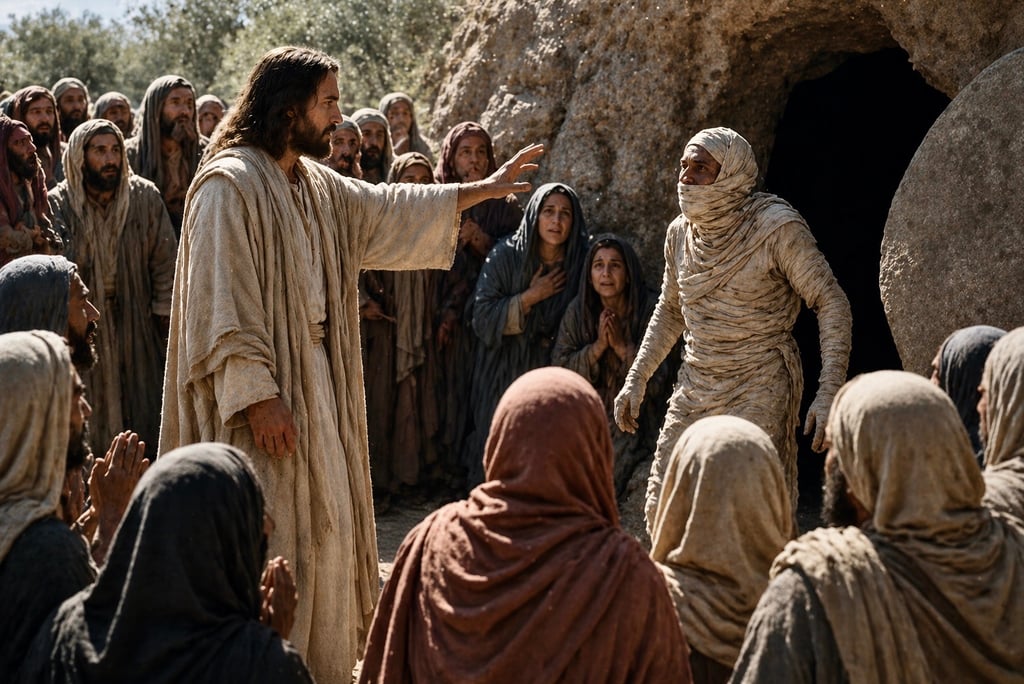
And in another time, in another land, we see this same power again. When Lord Jesus Christ arrived at the tomb of His dear friend Lazarus, the man had already been dead for four days. His body lay sealed within a cave and a heavy stone placed across its entrance.
“Roll the stone away,” Jesus said.
Despite hesitation, the stone was removed. Standing before the tomb, Jesus called out with authority: “Lazarus, come forth!”
Silence fell upon the crowd. Then, from within the darkness, movement. Slowly—unmistakably—Lazarus emerged, restored to life.
In both of these sacred accounts, we see the same principle revealed: When divine words are spoken by one who is truly connected to God, they are not merely sounds. Instead they become like tools—spiritual tools. They are power. They are life. They are the living tools by which the spiritual master awakens the soul with.
Spiritual Tools: The Words That Repair the Soul
When I think about spiritual tools, I can almost see them—neatly hanging on a wall. Each one has a purpose. Each one is used with the greatest care, and in the right hands, each one brings something broken, back to life.
But here is where the comparison begins to change. The bicycle mechanic reaches for cold steel—wrenches, pliers, a spoke wrench. Tools that are lifeless in themselves, waiting to be used, and if too much pressure is applied they can snap in half or bend, rendering them useless.
The spiritual master, however, reaches for something entirely different. He reaches for words, but not ordinary words—but words that are alive.
As it is written in the Bible: “All Scripture is given by inspiration of God, and is profitable for doctrine, for reproof, for correction, for instruction in righteousness.” (2 Timothy 3:16)
These spiritual tools are not formed in the mind of man. They are not guesses, opinions, or theories. Rather, they are holy, divine utterances, and because they are blessed by God, they carry a power that no human invention can ever match.
In the mechanic’s shop, if the tool is flawed, the repair will fail. In spiritual life, if the words are imperfect, the outcome will falter. That is why the spiritual master never manufactures his own tools.
He simply uses what has already been given. As Shrila Prabhupada said: “We are inventing nothing. Because I am saying Krishna’s words, not my words, therefore I am guru.”
This is the difference between a spiritual master and an ordinary teacher who speaks from speculation. The spiritual master speaks from authority and this authority is not limited to one place or one people.
In the Book of Acts we are told: “In every nation, he that fears Him and works righteousness is accepted by Him.” (10:35)
In every nation means that spiritual tools are not exclusive to only a single workshop—to only a certain religion. No, they are found wherever God has revealed Himself—among different people, different countries, different traditions, and even ancient civilizations.
In India, these living tools are preserved within the Vedas. The Shrimad-Bhagavatam describes itself as the “mature fruit of the desire tree of Vedic literatures—all-perfect and all-blissful.”
And in the Bhagavad-gita, the Lord speaks plainly: “I am the transcendental chanting of the Holy Names… I am the wisdom of the wise… The Vedas come from Me.”
So whether spoken in Sanskrit… or preserved in the Bible…the source is the same—the same voice—the same divine authority—the same living power.
Because I once owned Adirondack Wheel Works, I have lived these truths in a very practical way. When a broken bicycle is brought into the shop, the mechanic does not argue with the tools. He does not reshape them or try to improve them. He accepts them as they are and uses them according to their purpose. Only then can the broken bicycle be restored.
In the same way, when the spiritual master speaks the words of God—unchanged, undiluted, and faithfully delivered—something remarkable happens: The human heart begins to change; confusion gives way to clarity; weakness gives way to strength; and a life that once seemed beyond repair begins to move again.
These are the true spiritual tools. They do not wear out. They do not lose their edge. And in the hands of one who knows how to use them—they never fail.
And so we return again to the Triangular Theory of Bicycle Maintenance.
If this theory is to truly solve the Problem of death, then its foundation cannot rest upon human opinion or imperfect tools. Just as a bicycle cannot be properly repaired with defective instruments, the soul cannot be restored with manufactured words. The “tools” that are so indispensable to this formula, must be living, divine, and flawless—created by the spoken words of God, carried by the spiritual master, and applied with divine wisdom. Only then can the repair be complete… and the journey continue.
(Spiritual Parts):
Returning to our formula—the right knowledge, the right tools, and the right parts—we can now begin to see the complete picture.
Right knowledge comes from God. The spiritual master delivers that knowledge through his words—his divine tools. And we, ourselves, are the parts. Not ordinary parts, but living parts—divinely conscious, created by God, and meant to function in harmony with Him.
As the Bhagavad-gita declares: “I am the generating seed of all existences. There is no being that can exist without Me.” (10:39)
And in Genesis: “So God created man.” Yes—we are His parts and parcels.
(The Problem)
But something has gone terribly wrong. Like a broken bicycle wheel, we are no longer functioning as intended. We are spinning—but not correctly. We are moving—but not toward our true destination. The wheel turns, but it is out of true; the chain moves, but it slips; the road lies before us, but without proper repair, we cannot reach the place we were meant to go.
(The Intervention)
This is where the spiritual master enters. He does not speculate. He does not guess. He knows.
Just as a master mechanic understands how a wheel is meant to spin, the spiritual master understands how we are meant to live—in loving service to God.
And so he reaches out—not with metal tools, but with something far greater: his words.
These words are not ordinary. They carry divine authority, because they originate from God. When we hear them—truly hear them—something begins to change.
(The First Repair)
Interestingly, the first thing that the spiritual master touches is not our actions. Rather, it is our attitude, because if a part refuses adjustment, how can it be repaired? If the head of the screw is stripped or distorted, how will the tool take hold?
In the same way, unless we become receptive, humble, willing, and open—we cannot be helped. This is why Christ said: “Unless you receive the kingdom of God as a little child, you shall not enter it.” (Mark 10:15)
This is also why the saints urge us to listen—without resistance.
(The Turning Point)
Once we allow ourselves to be touched by these divine tools, something remarkable happens: Our eternal nature begins to awaken—demonstrated by the divine use of our life.
The Bhagavad-gita teaches: “Whoever remembers Me at the time of death attains My nature. Of this there is no doubt.” (8:5)
And Christ declares: “Whoever follows My teaching will not experience death...Truly, truly, I say to you, if anyone keeps My word, he shall never see death." (Gospel of John)
This is not poetry. This is instruction.
(The Awakening of the Parts)
Our spiritual parts—our eyes, ears, tongue, mind, and intelligence—were never meant for temporary pleasures alone.
They were meant for connection.
The tongue—to glorify God
The ears—to hear His Holy Name
The eyes—to see truth
The mind—to remember Him
When used properly, these parts do not decay. They awaken.
(Two Directions)
At every moment, two wheels are turning. One moves toward God—the wheel of loving devotional service. The other moves away—the wheel of illusion, suffering, and death.
We cannot turn both. “You cannot partake of both the Lord’s table and another.” (1 Corinthians 10/21)
The choice is always before us.
(The Result)
When the bicycle is perfectly repaired, no tools are needed. It simply works. In the same way, when we are restored to our true nature:
we no longer struggle in hopelessness
we no longer wander in the wrong direction
we no longer fear death
We simply live—fully, consciously, eternally—in a loving relationship with God, geared for service.
(Final Thought)
Imagine you have a broken bike—parts and tools scattered about, and it won't roll—the chain is off the sprocket, one of the peddles is missing, and both tires are completely flat. So it's not difficult to imagine how vitally important the bicycle mechanic is. The same can be said of the spiritual master.
But there is one thing he cannot supply: Our willingness. This is up to us.
If we will only allow ourselves to be touched by his words—truly touched—then our eternal purpose will be restored. You and I (the restored parts) will never perish in ignorance, but rather, will be living an active, devotional life—conscious, divine, and eternal.
In this material world, there are limits. This is especially true of our own longevity. Eventually, a time may come when we can no longer ride our bicycle. The bike itself may still be in perfect working order, but because of age, illness, or the natural weakness of the body, we are no longer able to ride.
But in the world beyond these limitations, everything is different—and everything is better. Not merely temporarily better, but eternally better.
The divine road described by the Good News of the Vaishnava Gospel has no final dead end. The adventure does not come to a close. God’s love never reaches the end of the road, and because we are eternally connected to Him, neither does our journey.
That is my message.
Let’s go for a ride.


- End of Chapter Four -
Chapter Five