Krishna and the Art of Bicycle Maintenance

- Chapter Three -
What Would Jesus Do?
In the early seventies, another school year and the promise of a new season brought to Saratoga Springs a beehive of activity, with many new faces appearing on the streets for the very first time.
Sperry’s had just opened with the look of the fifties—Davis had recently become the new owner of Saratoga Traders and for live music, the best was found every Wednesday night at Skidmore’s new basement coffeehouse, Lively Lucy’s.
Of course, certain things about Saratoga were perfect, just as they were, and especially for an early morning breakfast it was hard to beat the potatoes being served over at the Four Sons’ Cafe. Somewhere in the midst of all of this, my friend, David O’Neill, introduced me to Peter and his girlfriend. Late one afternoon we all took a short drive toward Wilton to look at a small cabin that Peter said I could live in.
At the time, I still owned the 1959 four-wheel drive, GMC panel truck that I had bought while I was in the Air Force and seeing how David’s friends mentioned that the road leading up to the cabin would be quite rough, I volunteered to drive. But a few months later after the owners of the property had asked me to be their caretaker, I decided that a recent offer to buy my GMC was just too good to pass up. Without hesitating, I sold it. Now that I was going to be living rent free and my utilities cut to zero, getting rid of this last big expense seemed like the right thing to do. It was always an invigorating experience walking to the cabin, especially in the dead of winter when I’d have to strap on my cross-country skis. Even so, nothing ever compared to the ebullience I felt when we all drove up on that first visit.
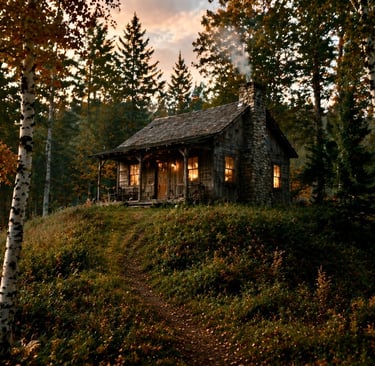
Including the two hundred acres that went along with the cabin, this location was much more isolated than the little house I found in Fischer, Texas many years later. Instead of stone, this cabin had been built entirely out of logs—probably around 1920 by some unknown Adirondack recluse. I remember when I first saw it I could hardly believe that something so beautiful and so old could still exist, and yet be completely abandoned. Inside and out everything had the unmistakable appearance of having withstood both the test of time and the ravages of man—a little forgotten cabin perched on top of a pine covered knoll, simply waiting for someone like me to come along and take care of it.

Following everyone through the back door, the first thing Peter wanted to show me turned out to be an old display case. It probably had two dozen, thin-sliding drawers, each full of moths and butterflies delicately laid out with their wings spread open. Someone had labeled their Latin names on little slips of faded paper, neatly pinned below each specimen: Lymantria dispar, Pieris rapae, Vanessa Virginiensis, Emperor Gum.
From this small room where the display case stood we entered the main room which was undivided except for two sleeping lofts overhead. Off to my left a stone fireplace suggested how the cabin was heated during the winter. Walking over to the mantel, I had never seen so many old National Geographic magazines in one place, stretching from one end to the other. Although a fireplace gives any cabin an added touch, what really gave the place its unique character was the nickel plated, Red Cross Tribune, wood stove, sitting off to the right. This kitchen stove was the type that had an old-fashioned warming oven on top.
After I got the knack of using it I even managed to bake a few loaves of bread. Nor could I wait to look through all those old National Geographic magazines. The dates on them proved that the cabin was as old as Peter had said it was.


Gradually fall gave way to winter and as the nights grew colder I enjoyed snuggling next to the fireplace inside my North Face sleeping bag. I definitely found this cozy atmosphere and the warm fire the perfect setting to ponder the many questions that seemed to be weighing heavily upon my mind. Perhaps I could even write a book.
As much as the next person, I wanted the sorrows of the world to go away and with more than enough time on my hands to write, my notebooks soon became stuffed. This approach, however, wasn’t solving anything and even writing about the problems in great length proved just as futile. I desperately felt the need for a more dynamic solution to the insanity around me.
“Why did the Lake Luzerne Highway Department cut down more than forty magnificent maple trees lining both sides of a lazy country road?” Answer: “Just to make a 10 mph hairpin turn into a 15 mph hairpin turn. Really? What was the point?”
Furthermore, what about the nuclear waste our government’s producing all over the world, and how deadly the stuff is? At the University of New York the speaker explained that if you get just one speck of it inside you, death by cancer is certain. Of course, radioactive waste does eventually decay through a phenomenon that scientists call half-life, meaning that after a certain timespan its lethal potency drops in half. Then, after that timespan passes by anew, it drops by half again, and so on. That’s not bad except for several facts. Besides being the most deadly substance on earth, after its half-life—after it becomes only fifty percent as lethal—the stuff will still kill you, “dead as a door nail.”
And here’s the clincher: It takes four times longer than the known written history of mankind for the stuff to reach its half-life. Now our “brainy” government is going to bury the stuff out in the desert and post a guard out front.
You need to let this sink in. This super deadly material will remain toxic at full strength, four times the known written history of mankind. Still a toxic threat, it will need to be guarded for several more periods that long. Do they really think they can do that? Just think of all the kings and queens and Napoleons and dynasties and earthquakes that have appeared over the countless centuries of yesteryear, and what we are now faced with, is guarding something more than four times that length of time!
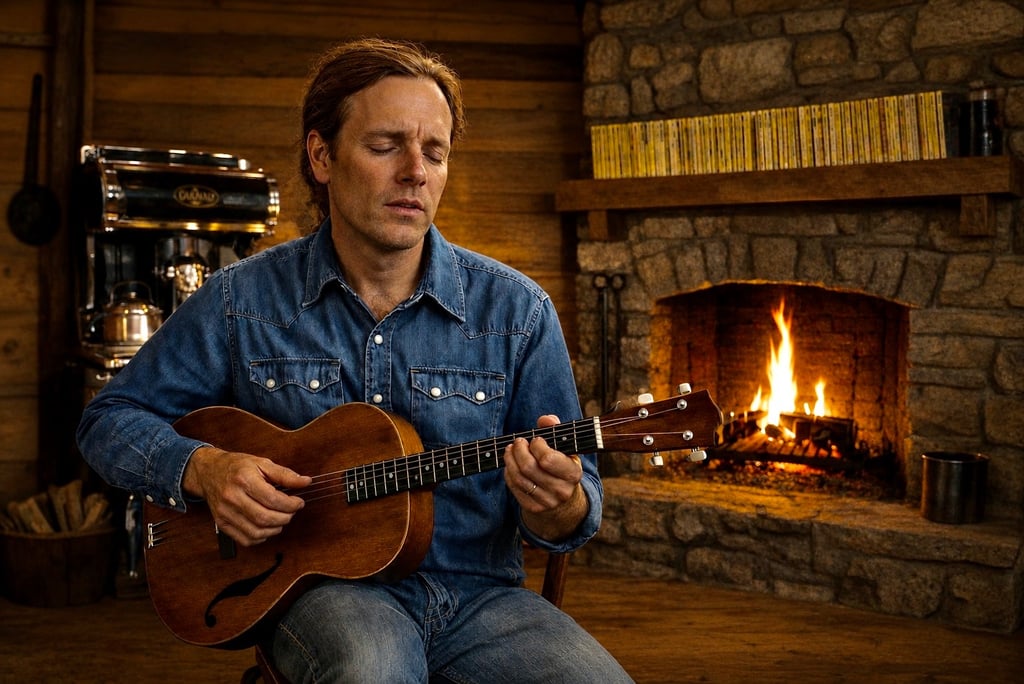
Reeling from frustration I started a large fire in the fireplace and standing back, tossed in every page I had written. All I had was a collection of problems, anyhow. In those trying times the only comfort I knew I could rely on was “Sealy,” my four-string tenor guitar. But even my most recent song had a sad story to tell. Still, I felt drawn to it and playing my guitar alway made me happy.
Propping myself against the back of an old chair, my fingers felt at home against the steel strings. Listening carefully as the tune slowly began to resonate with my feelings, I found it easy to remember the words.
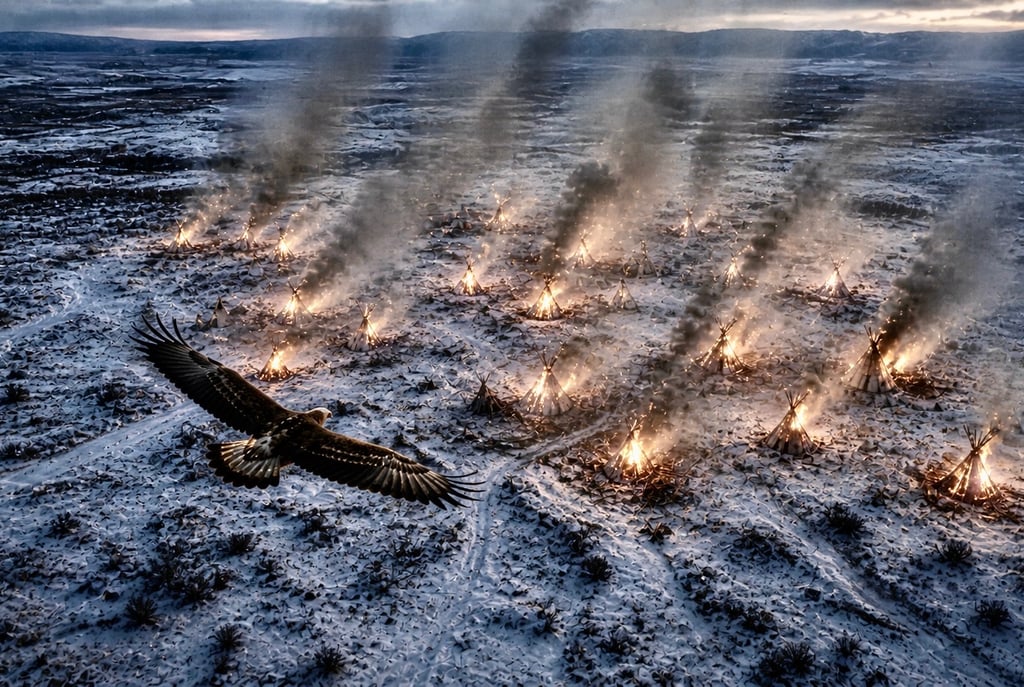
The soldiers rode their horses fast
Toward the reservation
The braves had gone to hunt for food
The soldiers were ‘advanc’n’
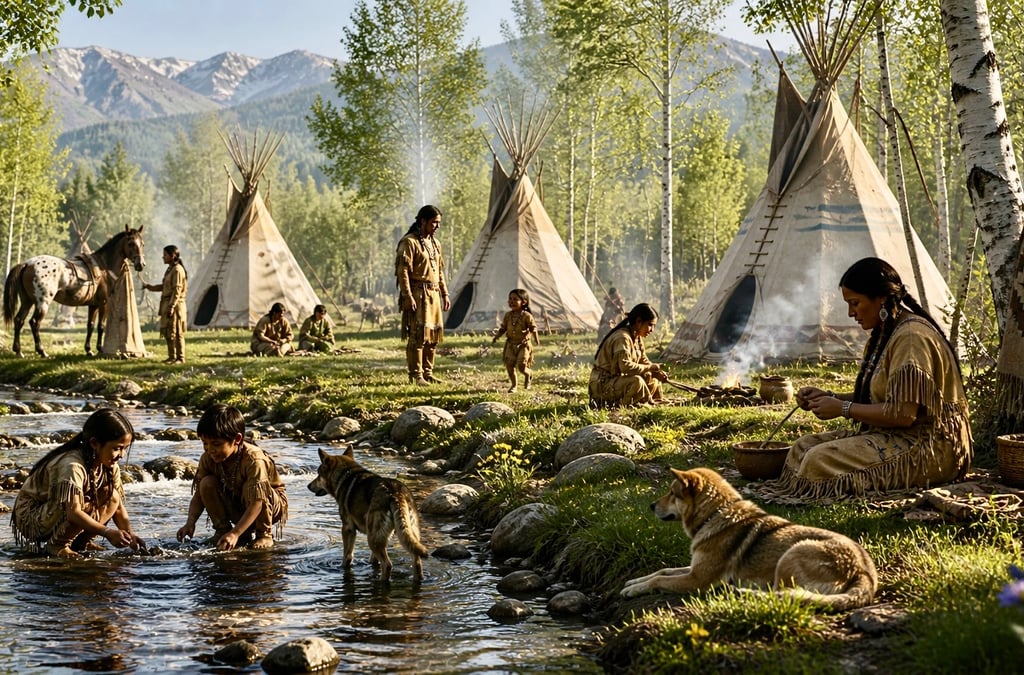
The tepees stood tall each eye-to-eye
The Northern Star was in the sky
All the children fast asleep
Their mothers weary no food to eat
The braves had gone to hunt for food
The soldiers knew just what to do
They aimed their cannon from the hills
The fuses were lit – the earth she stood still
The children they cried
Their mothers they died
The generals were ‘a-pranc’n’
Now the chief’s young son
He was just barely two
My Lord, oh God, what could he do?
The braves had gone to hunt for food
The soldiers knew just what to do
When the chief came home
He found his young wife
She’d been raped and stabbed
By a soldier’s knife
High in the sky an eagle did fly
Looking down he asked himself, why?
All they wanted was to be left alone
To hunt and fish – to keep their tepees warm
Their land was sacred
and the air was clean
But the white-man’s greed
destroyed their dreams
The braves had gone to hunt for food
The soldiers knew just what to do
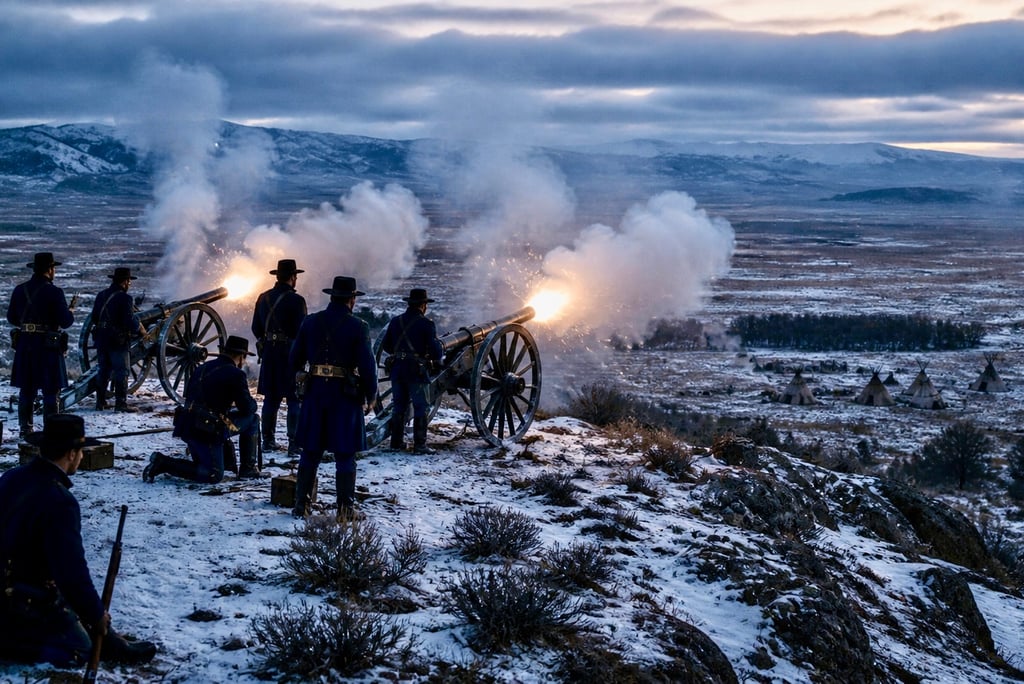
Later that evening I sank inside my sleeping bag with my thoughts on the verge of despair. Staring at the dancing flames in the fireplace, I felt that if I could just look deeply enough at what was right in front of me, possibly, then, I’d discover the right solutions. But, how is that done?
Making sure that my sleeping bag wasn’t getting hit by flying sparks, at least I could appreciate how after living in the forest I had a greater respect for Mother Nature. I was thankful and I really enjoyed my new home—the way things around me were so beautiful, peaceful, and sane.
I recalled how earlier that day, trying to find some music on my transistor radio. Inadvertently, news of the Vietnam War had come on. Even though we had signed a peace treaty there was still fighting going on. Still trying to find something to listen to, I had looked out the window. The cabin had a lot of windows and no matter where I looked I was totally enveloped by trees—a complete world unto itself.
The stark contrast between where I was living and what I was hearing over the radio had suddenly given me the eeriest sensation that I was actually living on some other planet, tuning-in to a distant world and their desperate cries for help. Come to think of it, I wonder how the earth would look if there were no human beings on it?
Now, finally, that was a very interesting question! Somehow I had stumbled onto something that suddenly filled me with a deep sense of anticipation, and even hope for what I was looking for. Curious, I adjusted my pillow, closed my eyes, and with my imagination, began to envision what the Earth would look like, never having been walked on by a single human being.
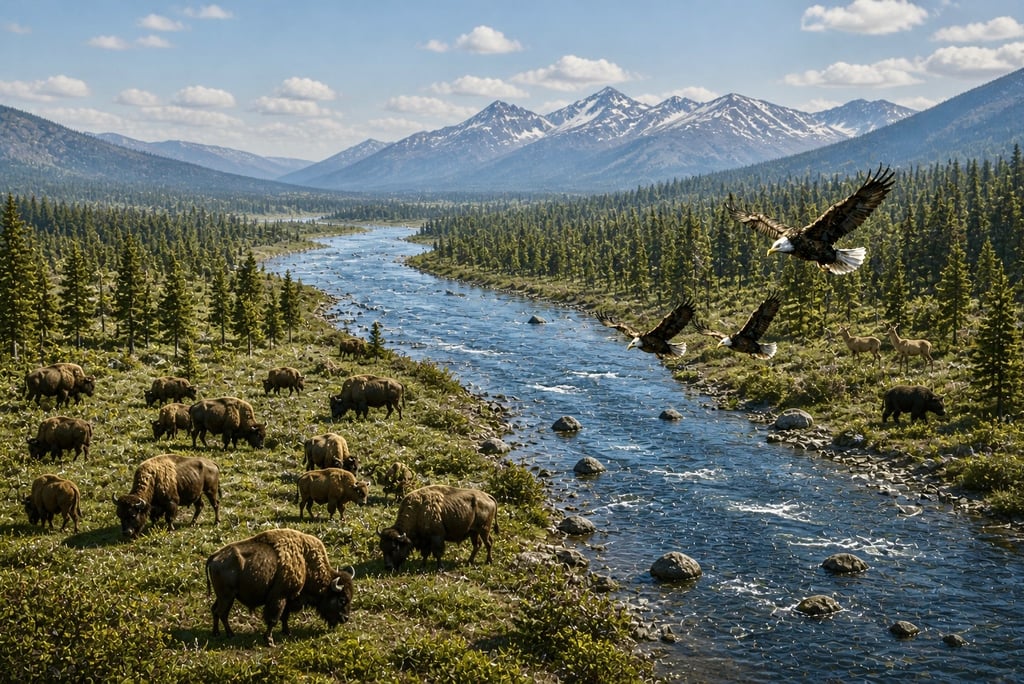
With my curiosity rising, I used my imagination again, but this time I put back all the human beings I had just removed. Within a split second there were visions of rotting garbage; ambulances screaming their way to the twisted remains of a bloody pileup; an ugly slum; the horrors of rape; cities ravaged by war filled my sight. Litter was everywhere and children with sad faces looked up at me from a dump in Mexico City. Like a pesticide, acid rain filled the air. In South America I could see huge portions of the earth naked, her land set ablaze, leaving the air full of thick smoke. The ground oozed with brown mud, smeared on the face of a little girl, her tears making little white lines down her soft cheeks.


Reeling at this appalling sight, again I took away all the human beings and sighed with relief as I gazed upon the earth I truly loved. How beautiful she looked with her splendid snow-capped mountains and emerald forests, filled with hemlock and blue spruce and singing birds. I could even smell her fresh aroma and feel her dark soil—warm, full of life, and eager to give.
Finally I felt I was addressing the right issue and each night, for the next several evenings I eagerly replayed these two scenarios over and over again in my mind. First I looked at the earth without any humans and then I put them back. Suddenly the questions appeared. Why the difference? What makes one world so vastly different from the other? Aren’t they both created by the same Almighty God? Why is there such a tremendous difference? Did God make a mistake? That last question felt especially difficult to ask. Placing another log on the fire I just knew I was at the threshold of something very meaningful, if not at the very core of the problems I wanted to solve.
Early the next morning I grabbed an apple and took a long walk, still heavy with the questions from the previous night. At least certain things were seemed clearer. In the world without humans on it, Mother Nature reigns supreme. Every blade of grass—everything—acts in total unison with her will—each, in its own unique way, busy with its particular task—each an integral part of Mother Nature’s master plan.
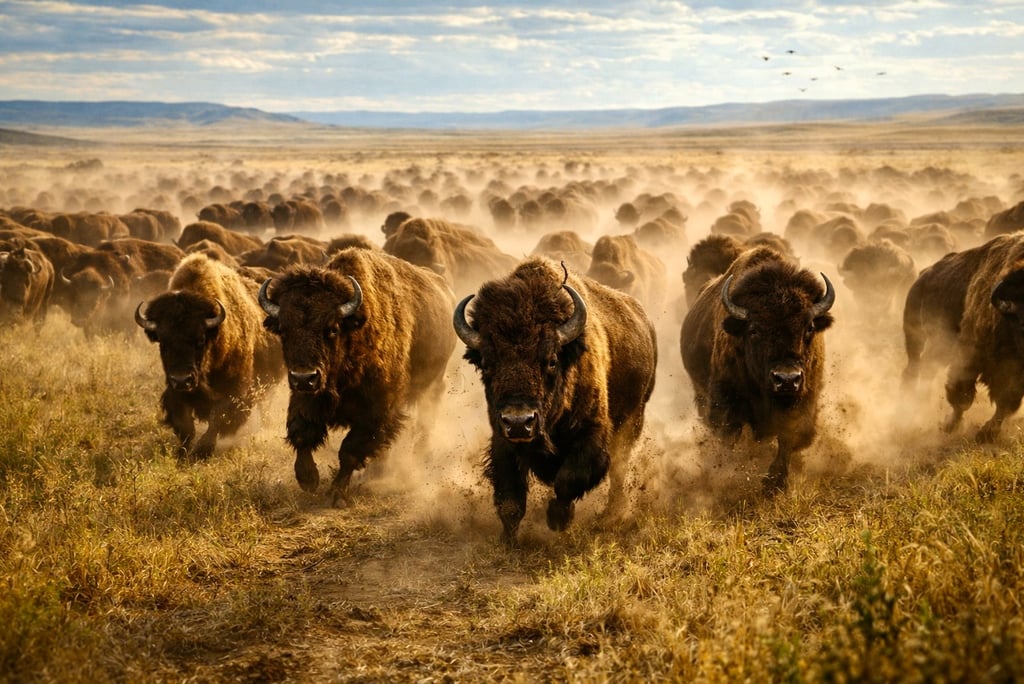
Snapping off a dead tree limb, I watched a formation of Canadian geese fly overhead. I thought how the earth had flourished under Mother Nature’s care for millions upon millions of years. It seems to have been just these recent thousand years or so (not even a second ago compared to the actual age of our planet), that Mother Earth has become threatened with total destruction. Even here in America, not so long ago, the ground in Wyoming and Colorado rumbled from the wild buffalo charging across her great plains. But why the instant change? What went wrong? Again it appeared. Did God make a mistake?
This is what contemplation means—becoming totally absorbed in thought, like a large cloud slowly growing more ominous, until suddenly its charge becomes so great that it explodes with a tremendous light—BANG. My questions seemed more defined, for sure, and I was even playing along the edges of the answer, but I still hadn’t come to the “banging part.” Something was still missing, but what?
Catching a glimpse of the cabin through the trees, I couldn’t contain my thoughts any longer. I couldn’t. I had the lion by its tail. Sitting down on a log I thought again about the earth without any humans on it and once more the same simple truth struck me—everything was behaving in total cooperation with her. But when man is allowed to enter upon the scene, it is his will that wants to prevail, replacing Mother Nature’s with his own desires—to conquer over all that he surveys, no matter what the price.
In other words, man insists on doing his own thing, and to make matters worse there are so many people on our planet, each with his own aggressive viewpoint, selfishly pushing it on others. Our history books and newspapers are full of the horrors of war, and as far as the religions of the world, which are supposed to teach man to live in harmony, they have hardly helped at all. Come to think of it, some of the bloodiest wars are fought over religion.
The sun was bright and I could feel its soothing warmth penetrate through my Woolrich jacket. I loosened a few buttons. The soft snow even began to twinkle. As I glanced around, I realized that a planet without any human beings on it would look a lot like the forest where I was now standing—peaceful, beautiful, and obedient. Actually, I didn’t have to imagine the earth without any humans on it because looking around, besides myself, there were no other human beings.
Beginning to feel the thunder of exhilaration race through my soul, all of a sudden I actually transcended my make-believe planets. Without the slightest effort I took a step right into the very world I had been creating over and over the past several nights, and then BANG—everything connected to Mother Nature—the flying geese, the busy beaver, the changing seasons, the melting snow, the chirping birds; every last thing around me connected.
My mind took me back in time. I was looking at a large spider’s web behind the cabin, each strand sprinkled wet with dew. It was so delicate and yet so strong and intricately woven. Where in the world does a spider get the knowledge to make such an incredible thing?


How do any of the creatures of the forest know what to do? Doesn’t it all come from Mother Nature? The geese that I had just seen flying overhead had received their message from her: “Now it’s time to fly south.” In between two fence posts she tells the spider: “Weave your web like this... and this is how to do it.” In the winter she tells the black bear: “OK, now it’s time to sleep.” And gazing upon a great herd of caribou she speaks the words that spark a great migration. Even the autumn leaf knows which way to fall, and the babbling brook which way to flow.
I stood still—almost spellbound—rooted to the earth, looking around me in wonder—99% forest and 1% me. Everything getting their messages from Mother Nature, and me, an insignificant one percent, not having the foggiest idea as to what I was supposed to do. Even more bewildered, I had always been told that I the superior species? Or was I? It felt unfair. I yelled out, “I’m created too, so what is my message? What am I supposed to do with my life? I want to be part of your kingdom and behave properly like everything else.”
Living in that small cabin definitely brought me in contact with the essential idea of serving God, or loving devotional service, but to save myself, I couldn’t say for sure what it was that I was supposed to do. In the first place, it wasn’t up to me to decide and furthermore, how could I? Instead, what I was trying to come in touch with, was, by its very nature, something beyond me. Its entire content, I felt, would originate from God and then come down to me. It would be exactly like the message that originates independent of the bear, but then comes down to him: “OK, now it’s time to wake up!” I also needed to wake up, but how?
Asking basic questions doesn’t necessarily mean quick answers. After all, certain answers can be beyond man’s ability to reach by himself and requires someone very special to help him. For example, a person who doesn’t know the identity of his actual father might look into thousands of faces, asking, “Is he my father?” Or, “is he my father?” Even if he searched like this for years, this approach would never provide a satisfactory answer. However, if he were to simply ask his mother, who his father is, he would instantly know the answer.
Unquestionably, it is a mistake to avoid or sidestep the spiritual master. (JOHN 15:5)—”Without me you can do nothing.” (SHRI SHRI GURU-ASHTAKA)—”Without the grace of the spiritual master, one cannot make any advancement.”
This is one of the essential numbers to the combination, so you can’t get any more important than that. One of the greatest stumbling blocks to spiritual life is having the attitude that, "Nobody can tell me how to worship God!” But, you see, this isn’t what God has to say. Actually, God has a lot to say on this matter and basically, the system He has established is that on His behalf, the saints represent Him. These great men and women have sacrificed everything to carry out this holy task, resulting at times in great persecution, suffering, and loss of life.
Therefore, out of our Lord’s deep love for His devotees, He asks us to approach him—through them. This only makes sense; if you owned a large company and had a devoted staff working for you, wouldn’t you ask that the public approach you through them? Even God has a “spiritual etiquette” that He follows.
In the Bhagavad-gita As It Is there are four pertinent verses spoken by Lord Krishna about the affection He has for His devotees, all with the same message: God wants us to approach His dear servants and learn from them.
BHAGAVAD-GITA: (4.34)—”Just try to learn the truth by approaching a spiritual master. Inquire from him submissively and render service unto him. The self-realized souls can impart knowledge unto you because they have seen the truth.”
BHAGAVAD-GITA (12.20)—”Those who follow this imperishable path of devotional service and who completely engage themselves with faith, making me the supreme goal, are very dear to me.”
BHAGAVAD-GITA (18.68-69)—”For one who explains this supreme secret to the devotees, pure devotional service is guaranteed, and at the end he will come back to me. There is no servant in this world more dear to me than he, nor will there ever be one more dear.”
Approaching a spiritual master is the same idea that Jesus spoke when he said, "I am the way, the truth, and the life: no man can cometh unto the Father, but by me." (JOHN 14:6)
One of the most vivid images I took with me after giving up my forest cabin in search of my message was that of a falling leaf. It represented how I wanted to be. The reason this impressed me so was that a falling leaf, caught by the wind, never resists its destiny—blown to the right, or blown to the left. Although I wasn’t sure what I was supposed to do, at least I had determined that this was how I wanted to act: obedient like a falling leaf.


And as far as discovering what my message might be, there was at least one good lead that immediately came to mind.
As I have already mentioned, during a lecture that I heard Charles Berner give years earlier, he told us about a very spiritual person who once lived in ancient India. Although Charles never elaborated, I did remember that this person had an amazing sounding name: Krishna (Krsna). I had been deeply moved when I heard it, so one of the first things I wanted to do after I got settled down in Saratoga Springs was to find some information on who Krishna was. "Perhaps," I thought, "He might have said something about my message."
Sharing an apartment with a friend, I had only been in town a couple of months when I noticed an ugly, trash-strewn parking lot, down at the end of Caroline Street, between Sperry’s and Saratoga Traders. The owner of Saratoga Traders was a friend of mine and had hired me to help him run the kitchen. These were two of the most popular bars in town. Shamefully, college students had littered the parking lot with thousands of flattened out beer cans, broken bottles, pull tabs, cigarette butts, pieces of paper, and all kinds of trash. What a contrast compared to the tidy footprints left by my furry little friends back at my cabin.


I was shocked at what I saw. "Perhaps I should go over to Mike’s, borrow his rake and pick up that mess." This made perfect sense, perfectly in line with my new values. Plus, I had just read a book from India and the holy man who wrote it (although vague on details), spoke about the general concept of devotional service to God. Actually, the more I thought about cleaning the place up, the more enlivened I became, confirming in my heart all the more that this was indeed the very thing that I should do. Even though I wasn’t sure who or what God was, or my message, I was certainly eager to serve Him.
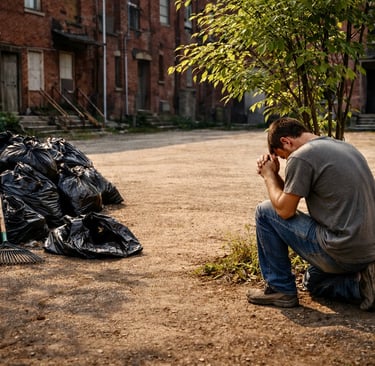
With rake in hand, I happily spent the better part of three days gathering up every piece of trash I could find. Eventually I stacked over forty sacks to be taken to the dump. In a very satisfying way, the parking lot began to look beautiful.
I even discovered a small trees that had somehow managed to avoid all the drunk drivers. At last finished, I took a few extra minutes to carefully groom the dirt under her branches. Then, making sure that no one was watching me, I got down on my knee, bowing my head to Mother Nature, God, and the Earth, asking that my small effort might somehow be pleasing to them. I asked God to forgive me for all the pain I had once inflicted upon His children (animals). This was the first time in my entire life that I had purposely tried to please Him. This was also the first time I had ever said a prayer on my own.

One morning, while having breakfast with Cathy over at the Four Sons’ Cafe, one of my friends came over and asked if I would be interested in sharing a workshop with him and several other people. I was told that the rent was extremely reasonable and that he was handling all the details. When I mentioned this to Mike Eagan, he thought he’d be interested, too, because he needed some extra room to work on his arts and crafts. As for myself, I thought that perhaps I could start my own business.
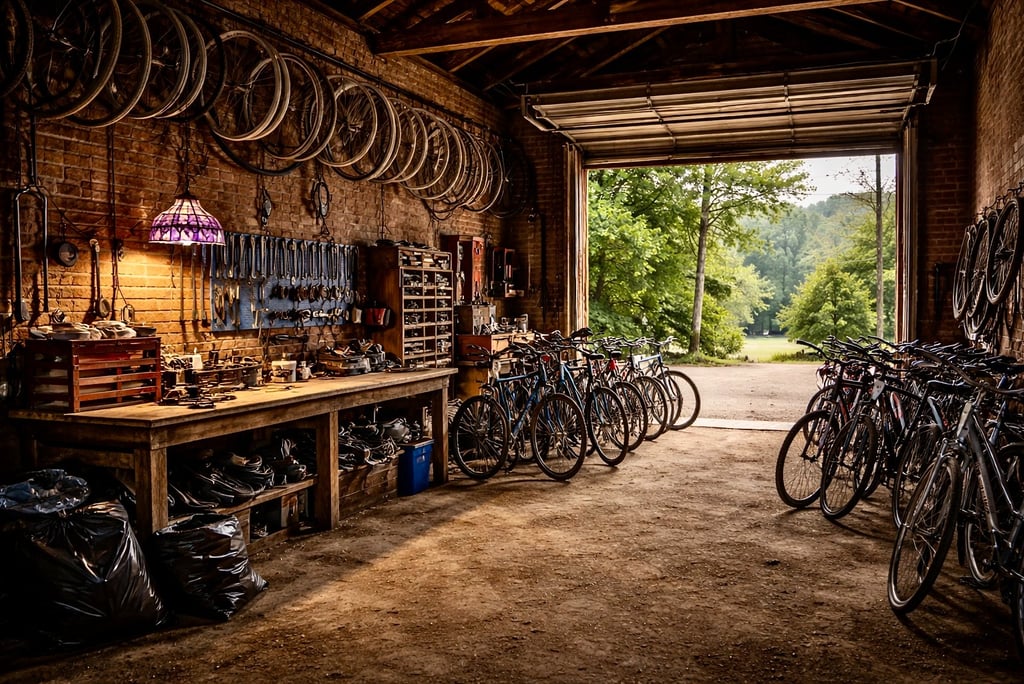
Checking it out, I was more than pleasantly surprised. The large workshop turned out to be an old, ivy-covered garage, hidden from public view and overlooking the city park. Without a doubt there was a certain charm about the place and I knew that if I decided to go for it, I would really enjoy being there.
The only anomaly that occurred is that after I said I would, for various reasons everyone decided to pull out of the deal, leaving me as the only tenant. Even this became quite vague because as far as who I was to pay, no one ever told me. If there was a landlord, he certainly never showed up while I was there. The rumor going around, however, was that the businessmen in the area greatly appreciated my presence, because previously kids had been damaging property, which they immediately stopped once I opened for business.
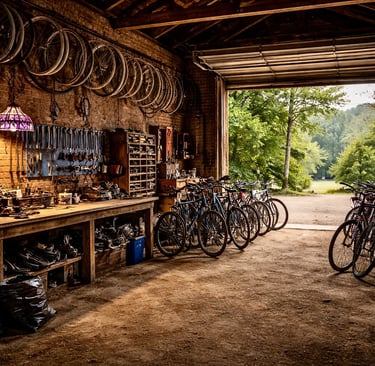
Since college towns are bicycle oriented, I figured I would do well opening a bicycle shop. I liked to work with my hands and all the tools I would need could be purchased for under a hundred dollars. Best of all, I now had the perfect place to work out of.
Setting my mind on this approach to resolve my financial woes, I opened, the Adirondack Wheel Works—a repair shop specializing in buying, selling, and restoring used bikes. Even though my spiritual questions temporarily found themselves on “the back burner,” I had the potential for a rewarding business, hardly any overhead, a town full of good friends, a much better understanding of life, and best of all, my wonderful girlfriend, Cathy Moore, who I loved very much.
---🔧---
Now sixteen years later, the morning sun over Fischer, Texas, was slowly making its presence felt, giving warmth and light to a new day along Cranes Mill Road. Orders for my barn-wood frames had picked up and having been up late trying to get everything ready, I was planning to sleep until at least nine. When the weather was hot like it had been, I would often work at night and spend the day taking care of less strenuous things, such as buying supplies or getting together with my friends at the Shanty. Mostly we’d raid Joe’s inner tubes so we could cool off floating “the loop” on the Guadalupe River.
Over the past year the children and I had gradually made friends with the cows. At the farm & ranch store in Wimberley we even found some special biscuits that they simply loved. I opened the paper sack and let Julia toss a handful over the fence and with much delight we’d watch the cows come running, madly shoving their big round noses into the leaves, searching desperately with their long tongues for a little morsel.
Frankly, I had never lived with cows before and I definitely felt blessed to wake up every morning and see all our gentle neighbors. I couldn’t help being touched by the loving gestures between the calves and their mothers.
The nicest thing I found about living in the country was that I got to think certain things that as a city dweller I just never had the chance to contemplate. For instance, one thing I got to ponder and later build was a compost bin, using 2x4s for the framework and chicken wire for the sides. To make the compost I used a layering method consisting of alternating amounts of soil, dry leaves, green-grass clippings, and manure. This was all outlined in an old issue of Mother Earth News and quickly produced plenty of rich compost for all my gardening needs. Behind the house was a beautiful garden full of deep soil and over the years, previous tenants had removed all the rocks.
When I got to the manure part, this is when I’d get Julia and together we’d climb the fence where the cows drank water. With our shovel we’d then fill our buckets to the top with as much as we wanted. Julia was always eager to help me but poor little Patrick, being far too small, could only stand on his tippy-toes, making sure to see every move we made from his playpen. But those were much happier times.
Now all alone in the empty house, I was awakened by the distant sound of a mooing cow. At first I didn’t think much of it but after hearing her for a steady fifteen minutes I could tell that something was definitely wrong. I thought that maybe her calf has its head stuck in a fence, or worse yet, one of the cows is having a hard time giving birth. I had heard unpleasant stories about that and the more I listened to her cries, the more I became concerned. I knew I could always call my landlord if there was a serious problem. Getting dressed as fast as I could, I ran outside to see what was wrong.
Looking at the far end of their pasture I could make out several cows standing together—one of them doing all the mooing. I went closer but other than her peculiar behavior, everything seemed to be in order. I finally concluded that she had to be calling for her missing calf and with hundreds of acres to get lost in, this was all that was wrong. I was sure that every now and then, with kids being kids, her calf had not paid close enough attention to which way she had gone. Soon, I thought, with all that power behind her bellowing, her calf would show up. Then realizing I had to drive into San Marcos to deliver an order to the Paper Bear, I loaded my truck and put on some decent clothes.
As was often the case, I didn’t get home until five. After parking under the trees, I went inside to check my answering machine. The only call I had was from “Preecher.” He wanted to let me know that he was back in Canyon Lake, having just completed a three week tour with his boss, country singer, George Strait.
Having forgotten to check the mailbox, I stepped back outsid,e when I heard more mooing. Again I said to myself, "what in the world is wrong with that poor cow?" Then I heard the phone ring. It was Joe wanting to know if I could play racquetball with him at seven. He said I had better get my gym clothes together quickly if we were going to grab a bite to eat before driving into New Braunfels for our court appointment. By the time I got home it was well after midnight. I was so exhausted all I could manage was to take off my clothes and fall into bed.
The next morning, just like the day before, again I was stirred by the sound of that poor mother’s mooing. Still puzzled, I thought to myself how she had been bellowing for at least two days, if not longer. Something must have dreadfully happened to her little calf. That had to be the answer. I was fairly certain that she was the cow with the spotted calf but it was difficult to say for sure because they all kind of looked the same. Besides, I don’t think I ever saw the entire herd together at one time. But this was certain—something had happened to her youngster. Why else would she be mooing like that?
Getting out of bed and wondering if I should call my landlord and tell him about his cow, I began to recall how a couple of days earlier, John and his father had been out back with their stock trailer while I had been busy in my shop. Every now and then they’d drive up in their pickup and tend to their herd. But come to think of it, because of the stock trailer, what must have happened is that they took her calf from her—taking it to the slaughterhouse. No wonder she had been crying for such a long time. Her heart was broken.
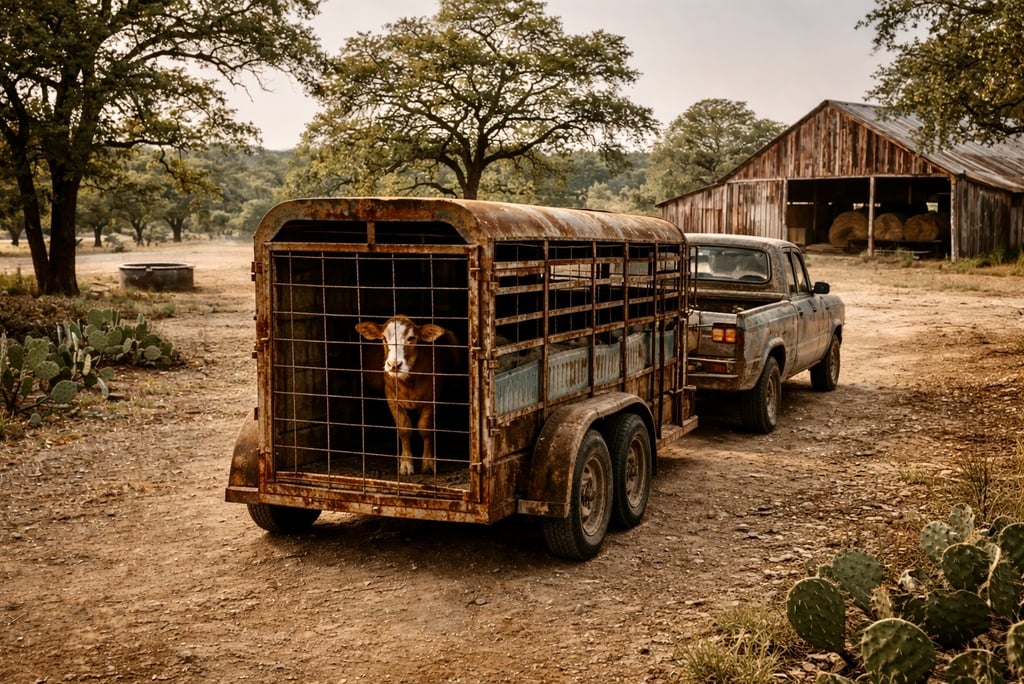
Even though I knew that this was the fate awaiting all the cows, the reality of it had never fully struck me. After getting dressed, I walked outside and stood by the fence, watching her quietly nibble on some grass.
Alone, my heart went out to her. Having had children of my own, I know that nothing in this world is more precious.
Later, sitting in my small reading room, I felt a heaviness I could not shake. The cruelty that had fallen upon this cow and her calf lingered in my mind. I began thinking about my Christian landlord and his family. I remembered the day we moved in—how we opened the back door and found four neatly wrapped Christmas presents waiting for us. We were strangers, yet they had shown us such kindness.
And yet, I was troubled. They had shown us love—but what about that calf? What would Jesus do? As I see it, the failure to honestly answer that question reveals what I call, "The Great Christian Thorn." With all sincerity, I hope the remainder of this chapter can help to pull it out.
I am not a Christian scholar but over the years I have spent time studying the Bible and it has been a deeply rewarding experience. I began with Pearl S. Buck’s renditions of the Old and New Testaments; later reading the Reader’s Digest Bible, The Living Bible, and The Greatest Story Ever Told by Fulton Oursler. I have also studied the King James Bible, cover to cover.
Beyond these, I have read books by Rev. Kenneth Hagin, Smith Wigglesworth, F. F. Bosworth’s Christ the Healer, and some of E. W. Kenyon’s teachings, along with many books on the lives of Christian saints.
From all of this, one truth stands out clearly: the Bible carries a powerful and consistent message of love.
When asked which commandment was the greatest, Jesus replied:
"Thou shalt love the Lord thy God with all thy heart, and with all thy soul, and with all thy mind. This is the first and great commandment. And the second is like unto it, Thou shalt love thy neighbor as thyself." (Matthew 22:37–39)
These verses are among the most familiar in the Bible. Yet there is another teaching—less emphasized—that, in my view, reveals the "Great Christian Thorn."
Simply stated, it is this: We are called to live as Jesus lived. His disciples made this unmistakably clear:
“Whatever you do or say, let it be as a representative of the Lord Jesus.” (Colossians 3:17)
“Be holy in everything you do, just as He is holy.” (1 Peter 1:15–16)
“Anyone who says he abides in Him, ought himself also to walk just as He walked.” (1 John 2:6)
“Christ also suffered for us, leaving us an example, that you should follow His steps.” (1 Peter 2:21)
“Become more and more like Him.” (Ephesians 4:15)
“Live with the attitude of Christ Jesus.” (Romans 15:5)
“Walk in love, as Christ also has loved us.” (Ephesians 5:2)
“Let this mind be in you, which was also in Christ Jesus.” (Philippians 2:5)
And as Rev. Smith Wigglesworth once said, “God wants us to let the mind that was in Jesus—that pure, holy, humble mind—be in us.”
---🔧---
In my imagined world—the one without human beings—there is no rebellion. Everything moves in perfect harmony with the will of Mother Nature, who herself is a faithful servant of God. As Lord Krishna explains in the Bhagavad-gita: "This material nature, which is one of My energies, is working under My direction, O son of Kunti, producing all moving and non-moving beings." (9.10)
Behavior, then, is fundamental to life. From birth to death we are constantly instructed, encouraged, persuaded, and taught how to act. What separates us from the rest of God’s creation is our free will: our freedom of behavior.
Everything else in this world may be viewed as part of the stage—governed by Mother Nature—providing the setting in which we live out our lives. Yet among us, throughout history, have walked the Lord’s humble servants, each carrying the same essential message: how we should live.
Listen to Jesus Christ: "Come unto Me, all ye that labor and are heavy laden, and I will give you rest. Take My yoke upon you, and learn of Me; for I am meek and lowly in heart: and ye shall find rest unto your souls. For My yoke is easy, and My burden is light." (Matthew 11:28–30)
But what is this “yoke” that Jesus speaks of? Here lies a profound and universal truth—the divine song echoed throughout both the Bible and the Bhagavad-gita—we are meant to live in loving-devoted service to God.
This is the "yoke"—the gentle discipline placed upon the restless heart, guiding the soul into peace. It is not a burden, but a path. A way of living. A transformation of behavior. This is where Krishna Consciousness and Christianity meet at their highest expression.
As the Bhagavad-gita teaches:
"Those who follow this imperishable path of devotional service, making Me their supreme goal, are very dear to Me." (12.20)
"Having come into this temporary and troubled world, engage in loving service unto Me."(9.33)
"The one who is always engaged in pure devotional service is the best, for he is very dear to Me, and I am very dear to him." (7.17)
"One who follows the path of devotional service gains the results of all other paths and ultimately reaches the supreme eternal abode." (8.28)


Besides the Bhagavad-Gita there are other books from the Vedas of ancient India that have helped me to understand both myself and God—"Since time immemorial, all transcendentalists have rendered devotional service to Lord Krishna, the Personality of Godhead, with great delight, for such service enlivens the self." (SHRIMAD-BHAGAVATAM 1.2.22) Note: The Shrimad-Bhagavatam is known as the ripened fruit of the tree of Vedic knowledge. I was introduced to it as, The Beautiful Stories of the Lord.)
More than once I found this same message inside the Bible, in other Christian books, and spoken by their saints.
“Our aim is to please Him in everything we do.” (2 Corinthians 5:9)
“I always do those things that are pleasing to Him.” (John 8:29)
“My only purpose in life is to serve Him.” (2 Timothy 1:3)
“In all your ways acknowledge Him, and He shall direct your paths.” (Proverbs 3:6)
Preserved by the Holy Fathers are these words of St. John of the Cross: "I drank deep within the hidden cellar of my Beloved… My soul is content to serve Him with all its strength. I have finished all other work except that love—in that is all my delight."
As I have said, this Third Commandment calls us to become like Jesus—to think as He thinks and to live as He lived. And so we must ask: What kind of person is Jesus Christ?
Does He not encourage us to ask, when He says, "Learn of Me?" (Matthew 11:28–30)
And does it not follow that He shares the very mind of His Father? "My prayer is that they may be one, just as You and I are one." (John 17:21)
With this in mind, while reading the Old Testament, one of the most revealing passages in the entire Bible appears on its very first page. There, in the story of creation, God gives life not only to man, but to all living beings—and then does something remarkable: He gives them all a vegetarian diet.
"Behold, I have given you every herb bearing seed… and every tree… to you it shall be for food. And to every beast of the earth… I have given every green herb for food: and it was so."
(Genesis 1:29–30)
It is right here that we see the character of God. This was His original design—gentle, harmonious, and without violence. And upon seeing it, He declared it: “very good.”
But it is in Isaiah that this vision becomes even clearer: "I create new heavens and a new earth… The wolf and the lamb shall feed together, and the lion shall eat straw like the ox… They shall not hurt nor destroy in all My holy mountain." (Isaiah 65:17–25)
What kind of God desires such a world—where nothing harms, nothing destroys, and no creature suffers? And what kind of person, then, is Jesus?
The Bible tells us plainly the answer: "He is meek and lowly in heart—soft; gentle; kind; unimposing—exactly like His Father." (Matthew 11:28–30)
---🔧---
With one final attempt to call her calf, a deep, anguished bellow echoed along Cranes Mill Road—one of the most pitiful sounds I have ever heard.
Again I thought: What would Jesus do?
I have never been able to understand how so many Christians remain unaware of the suffering inflicted upon animals—especially when the Bible clearly teaches us not to kill and to live as Christ lived.
“These things doth the Lord hate… hands that shed innocent blood.” (Proverbs 6:16–17)
“Whoever claims to abide in Him must walk as Jesus did.” (1 John 2:6)
Surely, Jesus would not cause any creature to suffer. And yet, after church, many will gather at the local steakhouse without a second thought. Would Jesus be there?
Does not God love all His creation—both human and animal? If so, then no unnecessary killing could ever be pleasing to Him. By the way, it is not necessary to eat meat in order to live a long and healthy life.
As I reflected on my Christian landlord—the same man who had welcomed us with gifts—I was troubled by this contradiction. How can such genuine kindness coexist with a way of life that causes such suffering?
Would Jesus terrify that calf? Would He separate it from his mother? Would He drive the calf down the highway, force him into confinement, and lead him to slaughter? Would Jesus do that?
This is not a casual question. It is a necessary one. A person’s spiritual life depends on how honestly it is answered. Too often, instead of searching the heart, we turn to arguments—verses debated; interpretations defended; scholars disagreeing. One says this, another says that. Did Jesus eat meat? Or, did He not? Sadly, these debates can go on endlessly.
At some point, a deeper honesty is required. “Let a man examine himself.” (1 Corinthians 11:28) Because in the end, the question is not merely theological—it is personal.
Consider again that calf—crying out for his mother, held in fear, led toward suffering. And then consider these words of Jesus: “Not everyone who says to Me, ‘Lord, Lord,’ shall enter the kingdom of heaven, but he who does the will of My Father... and then will I profess unto them, I never knew you: depart from me, ye that work iniquity.” (Matthew 7:21–23)
What does it mean, “ye that work iniquity”? It is to act against divine love—to cause harm, to bring suffering, to harden the heart.
Our human life is a rare and precious gift. It calls for reflection. Heaven is a place for the merciful. The saints have always taught kindness, gentleness, and compassion toward all living beings. Mercy is not optional—it is foundational. Jesus Himself was the very embodiment of mercy, reflecting perfectly the heart of His Father.
It is written: “Thou shalt not kill.” (Exodus 20:13) ... and Jesus made clear that He came not to abolish this law, but to fulfill it: “Whoever practices and teaches these commandments shall be called great in the kingdom of heaven.” (Matthew 5:17–19)
So we must be careful—not to twist divine teachings to suit our habits or appetites. Rather, the commandment is clear... no, the confusion lies within us. We ask God for mercy—yet hesitate to give it. Is it reasonable to expect what we are unwilling to offer?
Again the saints have always encouraged us to live a life of compassion, kindness, and respect for all living beings. This is the gentle way. This is how we are meant to live.
---🔧---
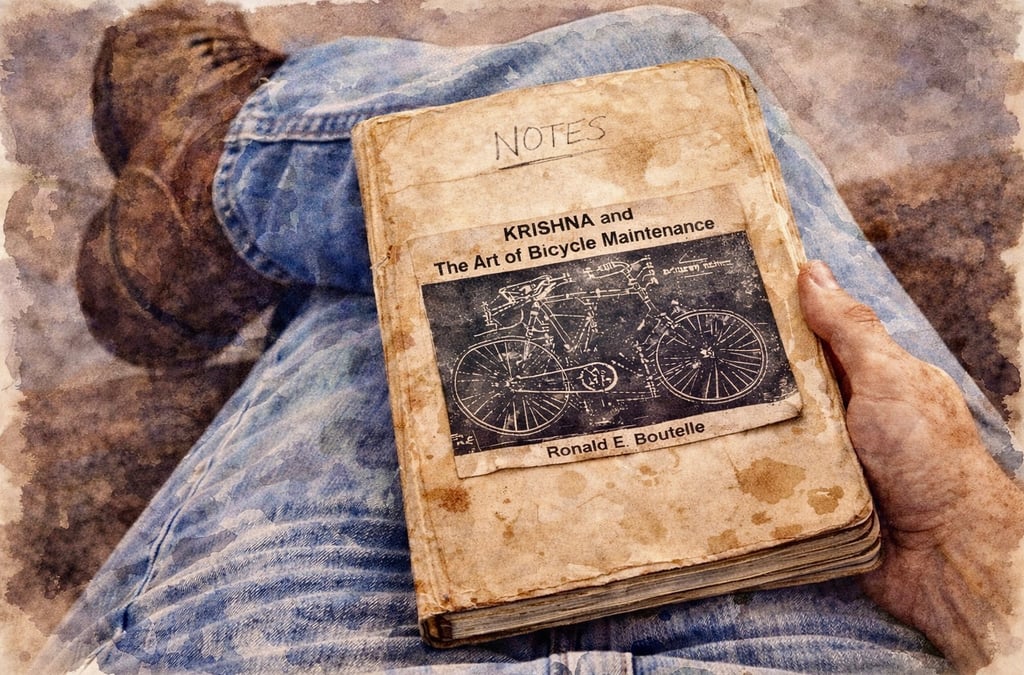
Feeling the hot Texas air begin its ritual climb to the ninety-degree mark, I went back into the house to make myself more comfortable. Turning on the window air conditioner and fetching my old notebook, I sat down with it on my lap. On the cover I had glued an old design I had made years ago for Krishna and the Art of Bicycle Maintenance. Looking at it I thought, "Oh yes, that book I’m going to start writing someday.”
Taking a sip of water, I turned to my last entry.
1. MATTHEW 11:29—”I am meek and lowly in heart.” (Meek: gentle and kind. Gentle: not harsh, soft and soothing. Kind: good-will, loving kindness, sympathy, kindheartedness, well-wisher, benevolent, merciful, tender, considerate, soft-hearted, full of natural affection. Lowly means humble & unimposing.)
2. MATTHEW 5:5,7—”Blessed are the meek. Blessed are the merciful.”
3. JAMES 2:22—”His faith was made complete by what he did, by his actions, his good deeds.”
4. MATTHEW 12:20—Concerning Jesus Christ fulfilling the prophecy of Isaiah: “He does not crush the weak, or quench the smallest hope.”
5. ROMANS 13:10—“Love does no wrong to anyone.” (My note: Isn’t taking an animal’s life wronging the animal?)
6.. PHILIPPIANS 4:8—“Finally, brethren, whatsoever things are true, whatsoever things are honest, whatsoever things are just, whatsoever things are pure, whatsoever things are lovely, whatsoever things are of good report, if there be any virtue, if there be any praise, think on these things.”
Feeling the need to consider what I had just read, I put my notebook down, struck by the implications of that final verse—“whatsoever things are lovely, whatsoever things are of good report.”
The Holy Bible is a wonderful book, filled with a message of love: “Let love be your greatest aim.” (1 Corinthians 14:1)
Saint Paul tells us to fix our minds on what is, “of good report.” ...And what does “lovely” mean?
That word "lovely" stayed with me and I looked it up in my dictionary. When we begin to understand what lovely means—what is gentle, what is pure, and what ispleasing to the heart—What would Jesus do? ...begins to answer itself.
There is also something else to consider, because there is such a thing as being implicated in what we would never do with our own hands. If two men rob a bank, and one takes a life while the other waits outside in the "get-away car," are they not both involved?
In much the same way, many have begun to question the use of fur, leather, and other products that depend upon suffering. Though they may not cause it directly, they understand that these things could not exist without it.
I once knew a trapper who, despite the law requiring regular checks, would sometimes leave his traps unattended.
I remember coming across a small raccoon caught in one that had gone unchecked for days. It was trembling—clearly in enormous distress—and the image stayed with me.
Another time I found a trap where very little remained—only a trace that told its own story of struggle and escape.
Moments like these are not uncommon, but they leave a deep impression. They have a way of making a person stop and think.
And so I found myself returning again and again to that word, "lovely." I felt the need to consider the things that I permit and support in my life, and examine them under the microscope of love. Was my bill of health good? If not, what does that say aboutr the way I choose to live?
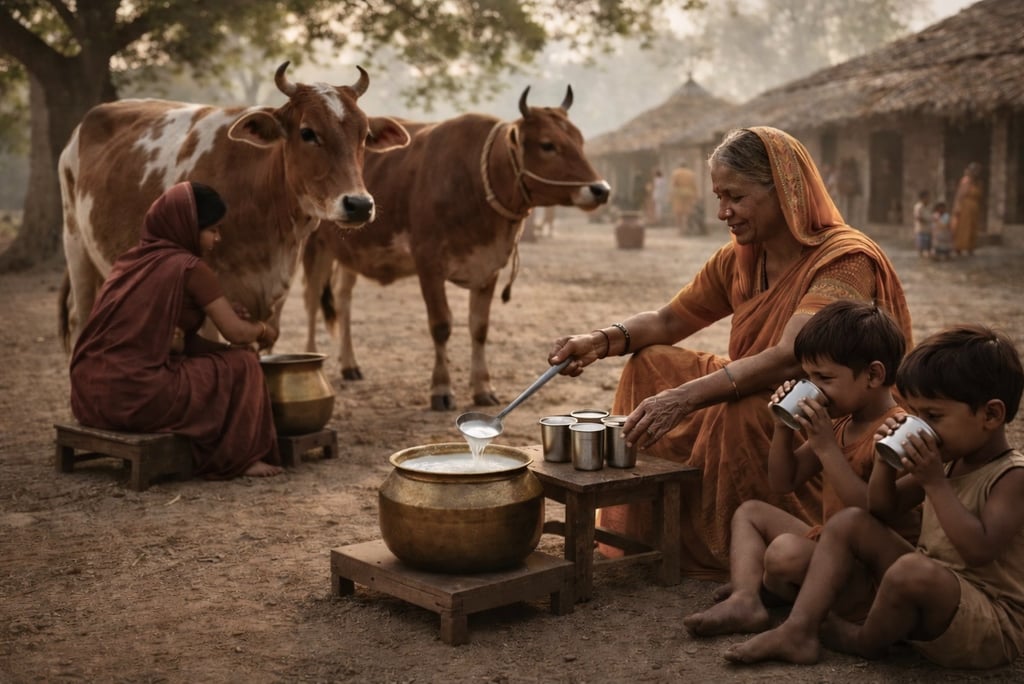
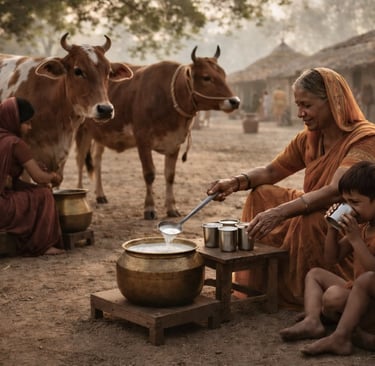
A.C. Bhaktivedanta often spoke on this subject, especially regarding the treatment of cows—who, according to the Vedic tradition are to be honored as one's own mother.
The reasoning is simple and beautiful. The cow eats what others do not—grass—and by the grace of God transforms it into something nourishing, especially for children. From cows milk—yogurt, butter, and other products are produced (cheese, sour cream, etc.)—that are combined with other wholesome ingredients that have sustained mankind for countless ages.
It was in one of his books that Shrila Prabhupada asked the question: "What do we call one who gives milk to children?"
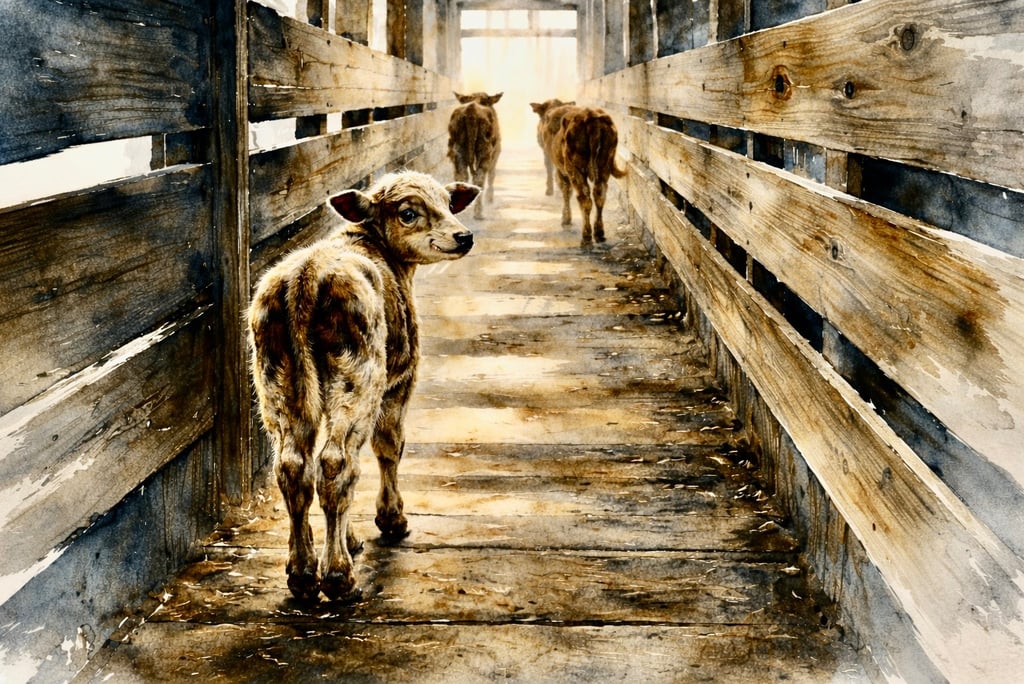
If you want to understand, just visit a slaughterhouse. Watch a young calf take its final steps.
Just days before it stood beside its mother—nourished; then running freely through the meadows with the other calves. That was a simple life. However, now the calf is pushed forward with the other calves. The place is unfamiliar. The air is heavy. Something is wrong, though it cannot understand what. The calves keeps moving forward.
And then, in a moment, the calf is gone. Days later, the same life appears again—this time arranged on a plate, carefully prepared and served in a comfortable setting. Conversation flows easily. No one stops to consider what came before.
We call this normal, but if we look closely—if we are willing to see—we may begin to question what we have accepted without thought.


Just as harm has come to the spotted calf, there is another, quieter way in which we take part. Each time we reach into our wallet, we may be supporting something that we would never do with our own hands. It is an uncomfortable thought—one that many of us would rather not consider.
This is, perhaps, a kind of “thorn” we carry without noticing. Why do we so easily distance ourselves from what lies behind our choices? Why does it feel so natural that even within our churches, these things pass without question?
We like to think of ourselves as kind and compassionate, as He was. And when we look closely at the life of Jesus, we see a consistency that is impossible to miss.
Wherever He went, He walked in love. Not only in the temple, but everywhere. Not only at chosen moments, but always. His life left behind a trail of tenderness—care, compassion, sympathy, and peace. There is no contradiction in Him, no separation between belief and action, no distance between what He taught and how He lived.
The Holy Scriptures, the life of Jesus, and the history of countless Christian saints all invite us to look again at our own lives—not with harsh judgment, but with honest reflection.
If we are to follow Him, then we must ask: what does it truly mean to walk in that same spirit of love?
---🔧---
Broadcast loudly across America on Christian radio stations, the Word is preached: “Walk in love, brethren. Let the holy mind of our Lord Jesus Christ fill your soul. Walk in love, brethren.”
But come late October, a different tune is heard as the brave Christian soldiers prepare to arm themselves. Ammunition is purchased. Knives are sharpened, rifles are sighted in... “Excuse me Reverend Edwards, how about joining Tom and brother James and myself after church next Sunday? Deer season opens then and we’re planning to go on over to Molly’s Garden and kill us that fat doe that Jimmy’s been seeing. And besides, this will give you a chance to try out your new rifle.”
What about this? Is this the spirit of the Holy Bible and the teachings of our Lord and His beloved son?
During the summer of 1989, I noticed a large tent pitched in a vacant lot in Denver, Colorado.
Asking, I discovered that an old-fashioned tent revival was going to be held and that the public was invited.
Just a year prior to this I had visited Tulsa, Oklahoma and Oral Robert’s, City of Faith. One of the little books I picked up in his gift shop was titled, "Best Loved Tent Sermons." I was deeply impressed with the pictures in it, showing thousands of people gathered together, eager to hear the word of God. So having the opportunity to attend a tent revival, myself, was simply too inviting to pass up.
For two nights in a row I attended, sincerely appreciating the dedicated efforts by the churches involved. On the second night I met a very nice pastor from Missouri, having made the long drive to Denver with his lovely wife and their two teenage boys.
Over the next few nights we spoke about Jesus. Somehow, one of our conversations got onto the subject about how, back in Missouri, he and his sons had recently shot and killed a couple of large bucks while deer hunting.
As you can imagine, this really pushed a few buttons inside me, and for the remainder of our conversation I tried to introduce my perspective on the matter. There’s just something about a group of armed ministers traipsing through the woods looking to kill something that I find a bit odd—to say the least.
Again, Jesus Christ said: "Love the Lord thy God with all your heart." It’s that word, “all” that speaks the loudest to me. Yes, we need to love God with every part of our heart. The heart is where our love dwells, but if part of it has hardened to the point that allows us to act differently than Jesus, then how will we ever grow spiritually? Rather, we want to keep our hearts pure and simple—capable of loving all of God’s creation.
Please don’t misread me. I’m not saying that this Missouri minister was a bad person. Rather, he is one of those kind Christians you meet everywhere, who would eagerly give a person in need the shirt off his back. But stop killing deer? Well, that’s a W-H-O-L-E different story.
After he presented his arguments why killing deer was approved in the Bible, as kindly as I could I asked him the question: "But what would Jesus do?" Oddly, at first he didn’t understand what I was asking, so to make myself clear I said, "the next time you are out in the woods and spot a small doe down the barrel of your rifle—just before you squeeze the trigger—please ask yourself, what Jesus would do?"
The dozen or so Christians who were still in the tent slowly gathered in close to hear his answer. He took a few moments to gather his thoughts—looking at his wife and sons—gazing at the hushed crowd—and then at me.
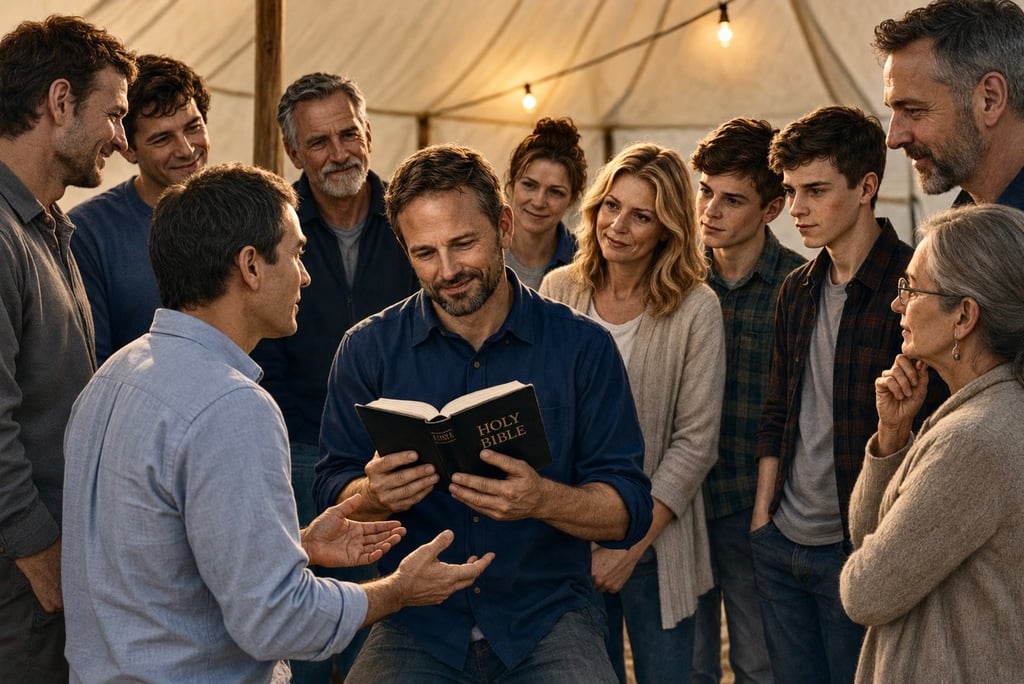
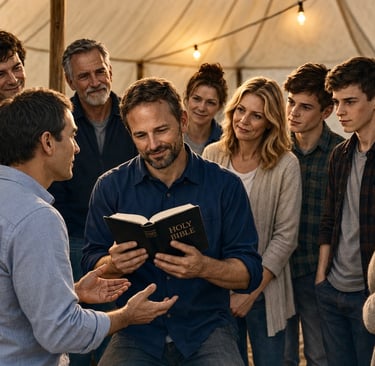
He then stood a little straighter, knowing that what he would now say would be the perfect reply. He looked at me and said, "Well—Jesus—He wouldn’t shoot that small doe at all. He’d wait for a big buck to come by!"
A noticeable ripple of approval moved through the small crowd. Heads nodded. Most everyone smiled and many laughed. It seemed that the matter had been settled. To this day I still wonder if he still goes deer hunting.
I wish I could say that this was an isolated exchange, but it wasn’t. Over the years I’ve known other pastors—good men—who spoke easily about deer hunting. One even showed me his rifle with a kind of quiet pride. Another, in the middle of a sermon, casually mentioned spending time inside a tent with some other men in Rifle, Colorado, the deer hunting capital of that great state. I was listening to him in his church in San Antonio and I doubt that anyone, besides me, understood what he was really saying.
Is deer hunting lovely? I know because I have carried a rifle just like all these preachers, and have seen what happens. I have watched as the shots land—often wounding but not killing. I have seen animal's desperately struggle; I have witnessed their fear—their effort to escape; their body failing; their last breaths. I have seen grown men approach their fallen prey, their voices excited; pulling out their razor-sharp knives; applying the final touches.
And I've also seen something else: young men—boys, really—on their first hunt. At first, eager to belong and prove themselves, but then suddenly, quiet. One turns away. Another grows pale. Some say green. I have seen them step back, overcome, not by weakness, but by something they were not prepared for. Not a lovely sight, at all. No one speaks of that part. Is this a good report?
It's during October and November that men go deer hunting. On Sunday morning they speak of Jesus who teaches mercy, who walked in compassion, who sees value in every living being.
But then, after church, many from the congregation gather together in the woods—quietly, carefully, resting their fingers on the trigger—waiting and watching and praying for a big buck.
I do not ask this in anger. I ask it as plainly as I can: What would Jesus do?
---🔧---
With less than an hour left before having to go out into my shop, I picked up my notebook and began to read where I had left off.
As I sat there another thought began to take hold—another question—but not one only meant for Christians. After all, voices of compassion rise from many traditions, saints, sages, and thoughtful men and women from across the world. They speak with one tongue, one heart, and one message. They tell us that to take the life of the most vulnerable is to move away from our divine nature. In the end, how we treat the most vulnerable reveals who we truly are.
Mahatma Gandhi once wrote: "The greatness of a nation and its moral progress can be measured by the way in which its animals are treated.”
And long before him, Pythagoras observed: “As long as men massacre animals, they will kill each other. He who sows the seed of violence cannot reap joy and love."
A similar spirit is found in the ancient teachings of the East: "Because he has pity on every living creature, therefore a man is called holy." (Dhammapada, verse 270)
Checking my watch, I put my notebook on the table next to me and closed my eyes. Orders were waiting for me to fill out in my workshop, but an even greater challenge was wondering how I was ever going to include this chapter in, Krishna and the Art of Bicycle Maintenance?
Remembering something I had forgotten to read, I picked up my notebook and there it was. It was kind of silly but if I was going to include it, this was the only place where it would make any sense.

---🔧---
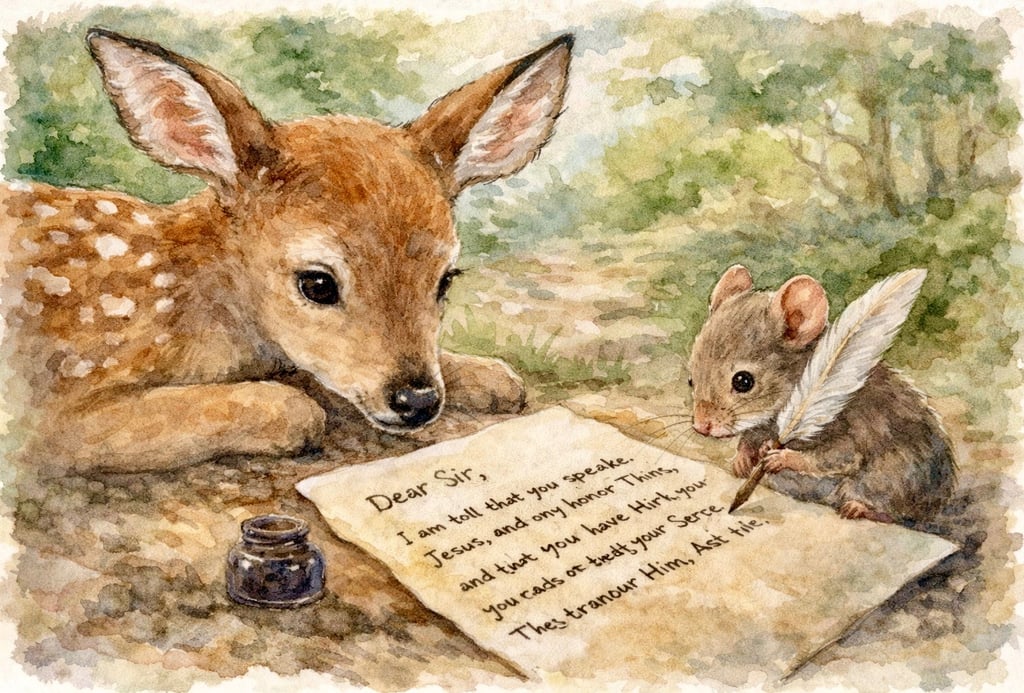

Once upon a time, a little fawn asked her friend, the mouse, to help her write a letter. It was meant for the hunter.
“Dear Sir,” she began, “I am told that you speak of Jesus, and that you honor Him. A small bird once heard you and your friends talking about Him beneath a tree.
"I do not understand something. Why do you come into our home in a way that brings us such fear? At night, my little brother trembles, and my mother no longer moves as she once did. Something has changed, and we do not know why.”
The mouse paused, then continued to write as the fawn softly dictated:
“We have heard stories passed down from long ago—that when Jesus went into the mountains, the animals were not afraid of Him. They came near. They trusted Him. They found peace in His presence.
"If you follow Him, then why do we run from you, instead of toward you?
"I wonder, if you follow Him, is it possible that one day will you come to us in the same way? If you truly walk with Him, why does your presence bring fear where His brought peace? Not as someone we fear, but as someone we could trust.
"Wouldn’t that be a more beautiful meeting?”
---🔧---
Realizing that it was getting late, I put my notebook down and headed to the workshop to put an order I had finished in my truck, but the image of that small calf stayed with me. It wasn’t going away.
Then as I was driving, my thought were drawn to something else—something I had once done. I had also been in my truck when I noticed a family pulled over along the edge of the road. It looked like they needed help but I kept driving, telling myself that I had an appointment and that someone else would be stopping. Later, I realized how little that appointment had mattered compared to what I had ignored.
The thought stayed with me because deep down inside I knew that I had missed something important: "Thou shalt love thy neighbor as thyself.” Of course I had heard those words all my life, but what did they really mean?
I asked myself a simple question, if that had been my wife… my children… someone I loved—would I have stopped? Of course I would have—without hesitation—and in that moment, I understood. This is what Christ is asking of us: not a limited love. Not a selective love, but a love that recognizes others—not as strangers but as part of my family.
And if that is true, then the question becomes unavoidable. Where does that love stop? Does it end with human beings, or does it extend further—to include all the life that God has created?
I thought of the animals and how easily we love some—our pets—and yet, ignoring the suffering of others. I have seen it. I have felt it. I have been there... and so the question remains: If we are called to love… then how far are we willing to let our love reach out?
I had my answer. But it was not an easy one.
So this is what Christ is asking of us—how He wants us to live. To walk in a love without boundaries, an unconditional love that recognizes everyone we meet—man and animal alike—as part of one family. Even the mountains and lakes, and the ocean, the air we breath and the earth, itself, are included.
The path leading to heaven is not easy to find. But there are lights along the way—lanterns that guide us.
The first, called “the greatest,” teaches us to love God with all our heart.
The second, “like unto the first,” calls us to love one another. It is this love that draws us into the arms of our merciful Lord. As Saint Thérèse of Lisieux once wrote, “I long for no other treasure but love, for it alone can make us pleasing to God.”
And then, slowly, another light began to appear—something more personal, something meant for me, something I had been searching for all along; another part of my message: to love others as I love myself. But who are these others?
I have watched my wife cry over the loss of her parakeet. I wept over my dog as Coco took her last breath, and I know we are not alone in this. People everywhere love their animals deeply.
So if God has given us the capacity to love them, how can they be excluded from that commandment? Not every animal is part of our home, just as not every person is part of our family. But still, we are called to grow in love—to widen the circle, not shrink it—to make room in our hearts for all of God’s creation.
As my destination grew closer I began to understand. This was not just an idea. It was a way of life. A way that had been shown to me, again and again—through Christ, through Krishna, and through the quiet voice that has followed me all the way from that little cabin.
- End of Chapter Three -
Chapter Four