

- Chapter Five -
The Good News of the Vaishnava Gospel
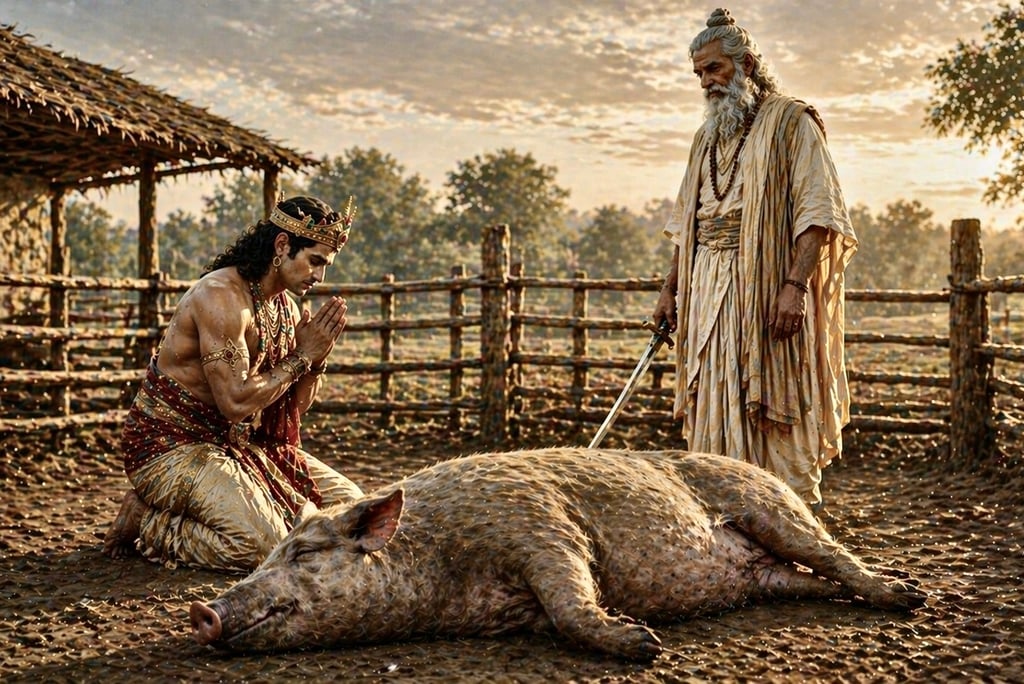
Long ago, the demigod in charge of rainfall, King Indra, fell from his heavenly position and took birth in the body of a pig. Because of his offensive behavior, his spiritual master, Brihaspati, had cursed him into this condition.
Living among the other pigs, Indra became completely absorbed in that life. He relished eating the rotting garbage thrown over the fence by the farmer. He enjoyed rolling in thick mud, grunting loudly, and never complained about the flies that covered his body.
In time, he became attached to a large sow, and soon he was surrounded by many piglets. To him, life could not have been better. He had his mate, his family, and more than enough to eat. He was fully satisfied.
When Lord Brahma heard of his condition, he came at once, filled with compassion for his fallen friend.
“My dear King Indra,” Brahma said, “what has happened to you? Why are you living like this? Do you not remember your heavenly kingdom, your palace, and your friends who are waiting for you? This life is not meant for you.”
But Indra replied, “I do not understand what you are saying. I am very happy here. I have everything I need—my beautiful she-pig, dozens of little piglets to play in the mud with, and plenty to eat. Please leave me alone.”
Seeing how deeply his friend had fallen under illusion, Lord Brahma acted at once. With a single stroke, he ended the pig’s life—and in that instant, King Indra was freed.
Awakened to his true identity, Indra stood before Brahma, humbled and ashamed, offering his deepest respects.
---🔧---
The events that led me into full-time participation in the Hare Krishna Movement came upon me suddenly, each one unexpected in its own way.
First, the relationship I had cherished with my girlfriend came to a sudden and heartbreaking end. From that moment on, everything in Saratoga Springs lost its sparkle. I wanted to be happy, but without her, my life felt ruined.
Then came something I never could have anticipated—a letter from Charles Berner. I didn’t even think he knew where I was living, yet there it was in my hand: an invitation to rejoin his staff at his newly opened ashram (spiritual school) near San Francisco.
That letter stirred something in me. It brought back the questions I had once wrestled with while living in my forest cabin: What is my message? What does God want me to do?
I decided to accept his offer and in doing so I sold or gave away nearly everything I owned and made plans to leave.
At last, the day arrived—early August, 1976. My bus to California was preparing to depart.
As I stood there, the weight of the past few years pressed heavily on me: my wife leaving me to join some cult out in Texas, falling in love with Cathy, the forest cabin, moments of awakening, the Adirondack Wheel Works, the chocolate chip cookies, and my growing fascination with Lord Krishna.
I checked my watch. On a long shot, I decided to take one last walk downtown. Perhaps—just perhaps—I might see Cathy.
It had been months since I had last seen her. I had no idea where to look. It was like searching for a needle in a haystack. Still, I was in love with her, and in my heart I wanted to say goodbye.
With less than an hour before boarding the bus, hoping for a miracle, I started walking.
Then, to my astonishment, I saw her—standing near the post office.
At that moment, being able to spend even a few minutes with her meant everything and Cathy was kind enough to talk with me. Yet behind our final words was something even more striking—the improbable way I had found her, at all.
It felt like one last gigantic coincidence—and somehow it fit. Saratoga had always carried a quiet sense of the unexpected.
We said goodbye and this time, I was ready to leave.
About thirty minutes before the large Greyhound bus pulled into New York City’s Port Authority Bus Terminal, I sat quietly, staring out the dirty window beside me.
Determined not to box myself in, I hadn’t even bothered to buy a ticket all the way to California. What I really wanted was to embrace a new way of living—to drift like a falling leaf, going wherever God chose to take me. For now, I just needed to reach New York City. After that, I would figure out how to get to California—or so I thought.
Tired and hungry, I briefly considered spending the night in the city, but as the jagged skyline rose into view I was reminded of the harsh cities I had once imagined—places filled with people, yet somehow empty. It was not a place I wanted to stay. No, I needed to get my next ticket and leave as quickly as possible.
Still, as I gathered my things, a thought crossed my mind: It would be nice to sit in a quiet vegetarian restaurant, listen to Indian music, and meet some spiritual people.
Just wishful thinking. Certainly not something I would find in a bus terminal. I needed to focus on finding the ticket window.
About the fifteenth person to step off the bus, I held tightly to my tenor guitar as the weight of my pack pressed down on my shoulders. And just a few steps later—no more than fifteen—I was stopped by a rather odd looking man.
He asked if I would like to take a book.
Without waiting for an answer, he placed it in my hand.
I glanced down and immediately recognized it—the Bhagavad-gītā As It Is. I told him I already had that exact book in my backpack—which was true, though I had not read it.
Then he showed me another book—one of the seventeen volumes of the Chaitanya-charitāmṛta.
I had never heard of it before, and I certainly couldn’t pronounce it (chay-ton-ya—cha-ree-TOM-ree-ta). But the moment I looked at it, I was captivated. The cover drew me in completely.
There, seated on a slightly elevated cushion and surrounded by His loving disciples, I saw, for the first time in my life, a picture of Lord Chaitanya.
Even now, it remains one of the most beautiful images I have ever seen.
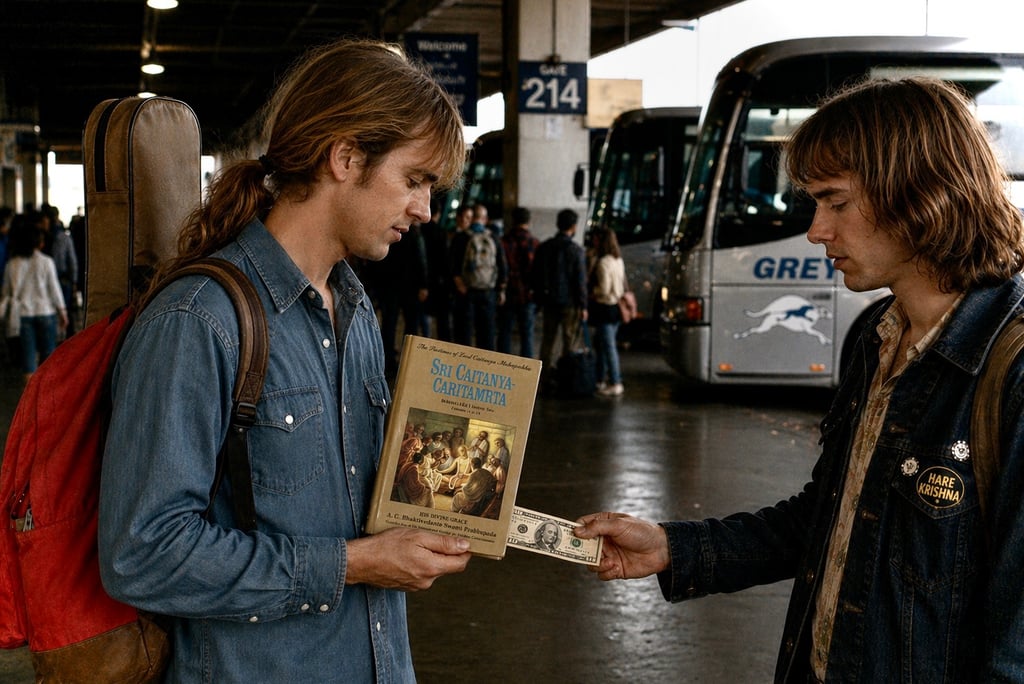
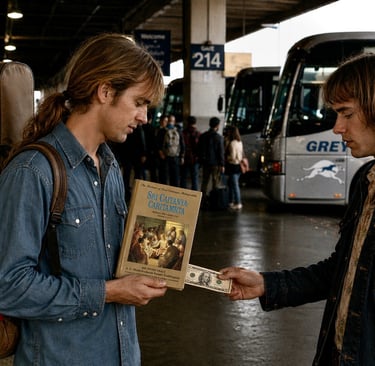
Definitely wanting to read the book on my journey, I unsnapped my shirt pocket and gladly handed the man (Gopal Acharya dasa) a ten-dollar bill. We said our goodbyes and I turned to leave.
But after only three steps, I stopped and turned around. I couldn’t ignore what had just happened. Only minutes before stepping off the bus, I had been thinking about meeting someone spiritual—and now, here he was.
Twice in one day, against all odds, something had found me. First Cathy… and now this. I could feel it. Something unseen was moving. A wind—quiet, but unmistakable.
What I didn’t know was that this was no gentle breeze. A hurricane was already on its way to knock me off my feet.
I walked back and asked the young man if he knew of any vegetarian restaurants nearby—somewhere I could get a meal, maybe listen to Indian music, and meet some nice people.
He smiled and told me that his temple operated a very popular restaurant. He said I would enjoy the atmosphere—the décor, the music, and the people.
I didn’t know what kind of temple he was talking about but if I could get there without too much trouble, I was willing to go.
And just as he said, for only a few dollars a taxi brought me directly to the front door—a modest skyscraper near Central Park on West 55th Street.
What began as nothing more than a simple meal became a lifetime—a lifetime dedicated to Lord Krishna and Śrīla Prabhupāda.
---🔧---
Jayananda (Ji-YA-nun-dah) was one of the older devotees in the Hare Krishna Movement, and Śrīla Prabhupāda was especially fond of him. After I entered the building, I was told that he would show me the way to Govinda’s—their vegetarian restaurant.
In spite of his bald head and unusual clothes, it was impossible not to like him. He had an easygoing manner, a broad smile, and a warm, friendly voice. Before I knew it, I had accepted his invitation to spend the night at the temple. He even offered me a place in his room.
I personally saw another side of him, as well.
From time to time, he would bring up a large, gated, flatbed truck—decorated with flowers—and carefully help the mothers and children climb aboard. Once everyone was settled, he would drive them to Central Park where they would spend a few hours together, singing the holy names of God.
What stayed with me was not just the effort—but his concern that they, too, should have some service to do—that they should feel included. He made sure they had a place.
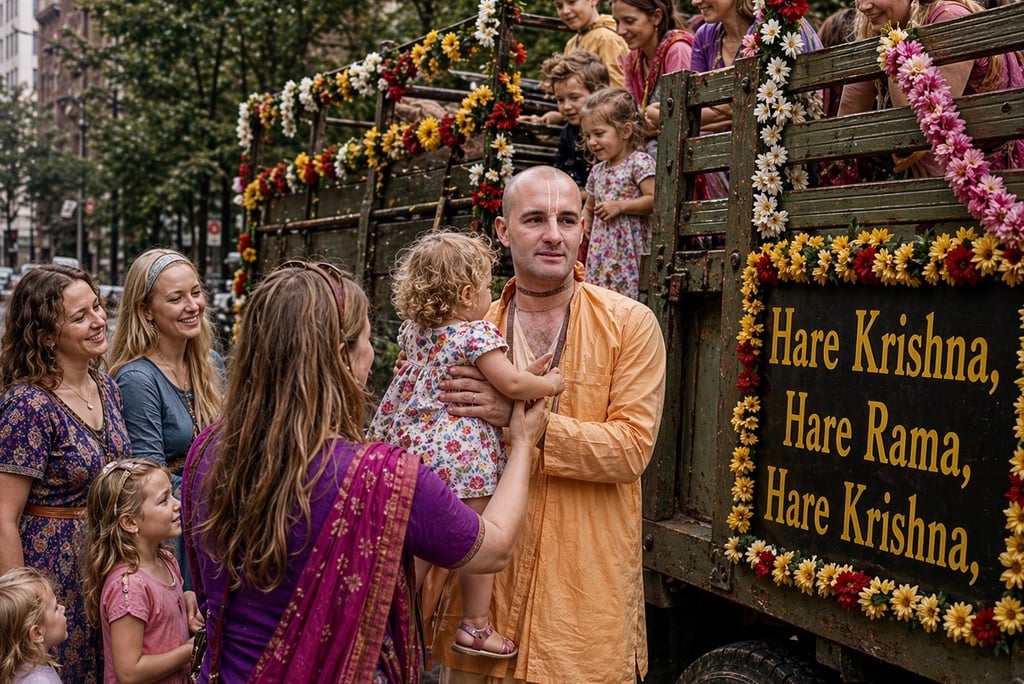
Although I only slept a few hours that first night, it was surprisingly easy to wake when Jayananda called my name at three-thirty in the morning. I was excited—everything was new. Even the ice-cold shower didn’t bother me.
Soon, he led me downstairs into a large temple room. Nearly fifty devotees—men, women, and children—stood waiting before a set of massive, ornately carved teak doors.
Then, with the trumpet-like sound of a white conch shell being blown and the ringing of bells, the doors swung open. Inside was a magnificent altar, surrounded by fragrant incense and glowing with beauty. Marble forms—what I had thought of as statues—stood there, including one of Lord Krishna, radiant and serene.
Another ceremony followed about four hours later. This time, everyone took a handful of fresh rose petals from a large wicker basket. When the doors opened again, the devotees tossed their petals toward the altar, creating a shower that seemed to cover everything in flowers.
At that exact moment, a song arranged by George Harrison began to play. I remember thinking that even though I had no idea what these people were all about, one thing was certain—if there was such a thing as worshiping God, then this had to be it.
Because of the gentle way Jayananda asked, I kept accepting his invitation to stay “just one more night.” After all, I wasn’t in a hurry to get to California. But sooner or later, I knew I would have to leave.
In my shirt pocket I had over a thousand dollars in cash. Concerned about losing it, I told Jayananda. He led me to a small office, where I was given a receipt. By showing it, I could get my money back at any time.
The next day, after the morning ceremonies, Jayananda walked over to me and, in a childlike way, asked if I had seen my money—“all around Lord Krishna’s lotus feet.”
At the time, I didn’t understand what he was doing. Now, I’m pretty sure it was a kind of transcendental bluff—or was it?
But in that moment, the idea that my entire savings had been offered to God—without my permission—was overwhelming. I was speechless. My thoughts began racing. Something inside me knew that a decision—one I had not planned for—was already taking shape.
If my money had been given to God—how could I ask for it back, even if I hadn’t agreed to it?
Trying to understand what was happening, my mind returned to what mattered most—how I wanted to live: like a falling leaf.
If this was the Lord’s arrangement, I would accept it. I then asked Jayananda to help me become a novice priest in the Hare Krishna Movement. This is how I joined and became a bhakta (bock-ta).
Later that day, Jayananda cut off all my hair. It had been over sixteen inches long. In a single moment, I looked—and felt—ten years younger.
To be perfectly honest, I would not trade what I have learned about Lord Krishna for all the money in the world. And like Lord Brahmā, Jayananda carried a sword—though I did not see it at the time.
But when it fell, I felt it. For a brief instant I experienced the sharpness that comes when illusion is cut away—the same shock, perhaps that all conditioned souls feel when they come into contact with a true devotee.
I can only say now—thank you, to this great soul who helped save my life.


This is the nature of divine love. It is ever fresh, ever increasing, never ending—and with each passing day this truth becomes more evident.
Jayananda was under no illusion. He had discovered something real—an extraordinary gift: the Good News of the Vaishnava Gospel.
When a person sincerely turns toward Lord Krishna for help, something unexpected begins to happen. The Lord, with great kindness, starts to remove the very material attachments that once seemed essential.
As stated in the Vedas: “Krishna, the Personality of Godhead, who is the Paramatma (Supersoul) in everyone’s heart, and the benefactor of the truthful devotee, cleanses the desire for material enjoyment from the heart of the devotee who has developed the urge to hear His messages.” (Srimad-Bhagavatam 1.2.17)
A. C. Bhaktivedanta Swami Prabhupada comments: “The Lord is reciprocally responsive to His devotees. When He sees that a devotee is sincere in seeking Him, the Lord acts from within the heart so that the devotee may return to Him. In truth, the Lord is more eager to bring us back to His kingdom than we are to go.”
This same principle appears in other traditions as well. Many years ago, Thérèse of Lisieux expressed it in her own way: “He knows well that if He gave me even a shadow of happiness, I would cling to it with all my strength. I believe His work has been to detach me from all that is not Himself.”
Across traditions, the pattern is the same: divine love does not merely comfort—it refines, redirects, and ultimately frees. In light of this, we must be careful when making exclusive claims about spiritual truth.
It is often said—sometimes quite forcefully—that Christianity alone holds the “good news,” unmatched by any other path. While the message of the Holy Bible is indeed profound and transformative, it is not accurate to say that divine truth has been revealed in only one tradition.
Such claims, however well-intentioned, can unintentionally narrow the heart and discourage sincere seekers from recognizing truth when it appears outside familiar boundaries.
I recall hearing a minister once declare that Christianity stands alone on four unshakable claims:
That its founder is God
That it alone offers forgiveness of sins
That it alone assures eternal life
That its founder, alone, rose from the dead
My purpose here is not to diminish Christianity, but to broaden the lens—to offer insight into what may be called the Good News of the Vaishnava Gospel.
Religious leaders carry a great responsibility. When they speak in ways that dismiss other traditions, outright, they can unknowingly create a mindset that resists truth simply because it arrives in an unfamiliar form.
But even within the Christian tradition itself, there are reminders of humility and openness:
“For now we see in a mirror dimly.” (1 Corinthians 13:12)
“I have much more to say to you, more than you can now bear.” (John 16:12)
“The time is coming when I will speak plainly of the Father.” (John 16:25)
These verses suggest something important. Our understanding of God is ever unfolding; not over; not complete; and as Swami Padmanabha writes in his book (Evolution of Divine Love), divine love is an eternal, ever-evolving dance between us and God.
The good news of the Vaishnava tradition draws its strength from the ancient Vedic texts of India, from the teachings of A.C. Bhaktivedanta, and especially from the Bhagavad-gita.
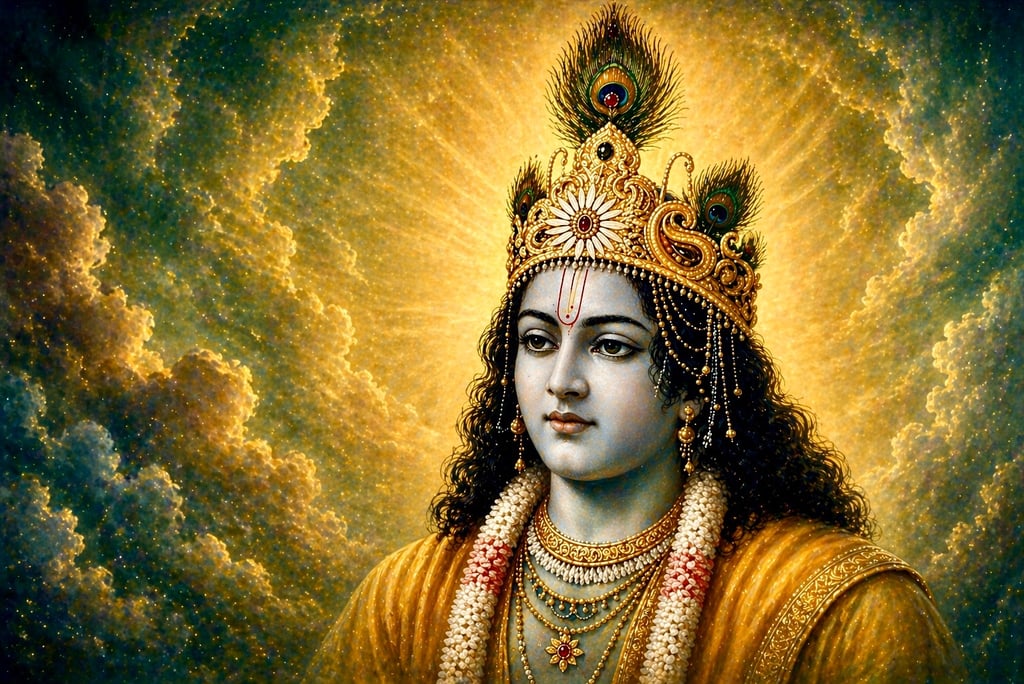
In that work, one central truth is emphasized again and again: Krishna is not merely a teacher or prophet—rather we read that the speaker of Bhagavad-gita is Lord Krishna—who is God Almighty. He is mentioned on every page of Bhagavad-gita as the Supreme Personality of Godhead.
“Fools deride Me when I descend in human form. They do not know My transcendental nature as the Supreme Lord of all that be.” (BHAGAVAD-GITA-9.11)
"Lord Krishna, the Supreme Personality of Godhead, along with Balarama (His brother), played like a human being, and so masked, He performed many superhuman acts.” (SHRIMAD-BHAGAVATAM -1.1.20)
Because of these scriptural references—and many others like them—the Good News of the Vaishnava Gospel is that its historical foundation rests directly upon God Himself, the Supreme Personality of Godhead.
In more recent times, many have pointed to Chaitanya Mahaprabhu as the great architect of the Hare Krishna movement. Yet here again, we encounter the same conclusion.
As discussed in the previous chapter, Lord Chaitanya is understood not merely as a teacher or reformer, but as a direct manifestation of the Divine. So whether we look to the ancient past or to more recent history, the conclusion remains unchanged—the fountainhead of the Vaishnava tradition is none other than the Blessed and Almighty Lord Himself.
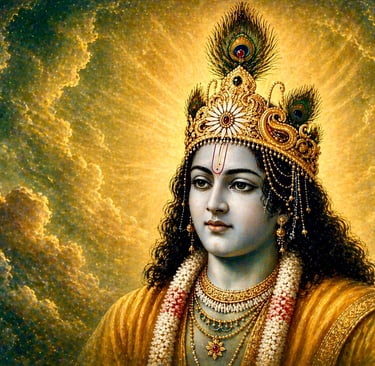
Two of the central pillars of the Christian gospel are the forgiveness of sins and the promise of eternal life. We read about this in the Bible.
“Through this man is preached unto you the forgiveness of sins.” (Acts 13:38)
“Repentance and remission of sins should be preached in His name.” (Luke 24:47)
“Whoever believes in Him shall not perish but have everlasting life.” (John 3:16)
There is no question that these are beautiful and powerful assurances. All glories to Lord Jesus Christ. But we may ask, with sincerity and respect: Is this promise found only in one tradition? Or, has God revealed this same mercy in other venues?
"What does the Good News of the Vaishnava Gospel say about these same truths?
What does Lord Krishna declare?" Let us turn to the Bhagavad-gita to answer these questions.
“He who knows Me as the unborn, the beginningless, the Supreme Lord of all worlds—he is freed from all sins.” (10.3)
“Abandon all varieties of religion and just surrender unto Me. I shall deliver you from all sinful reactions. Do not fear.” (18.66)
And from the Srimad-Bhagavatam: “Glorification, remembrance, hearing, and worship of Lord Krishna can at once cleanse one of all sinful reactions.” (2.4.15)
Here we find the same essential promise—that by turning toward the Divine with sincerity, one is freed from sin and restored to a life of eternal relationship with God.
This is not a contradiction of the Christian message—but a confirmation of a deeper principle—that God’s mercy is not limited, nor confined to a single expression.
As we can see, the Good News of the Vaishnava Gospel also offers a complete and profound assurance of purification and spiritual freedom—just as we find in the Holy Bible.
---🔧---
The question of “eternal life,” however, requires a deeper look.
Throughout the Bhagavad-gita, the Lord repeatedly establishes the eternal nature of the soul:
• “The living entities in this conditioned world are My eternal fragmental parts.” (15.7)
• “Never was there a time when I did not exist, nor you… nor in the future shall any of us cease to be.” (2.12)
• “For the soul there is neither birth nor death. He is unborn, eternal, ever-existing.” (2.20)
Even within the Bible, we find the same understanding: “Do not fear those who kill the body but cannot kill the soul.” (Matthew 10:28)
So in one sense, eternal life is already established within our spiritual blueprint. We do not become eternal—we already are. The real question, then, is not whether we live forever, but our eternal condition; our happiness; our manifestation; our actives.
It is here that the true value of the "good news” begins to unfold. What is being offered is not mere existence—but a return to an eternal and active loving relationship with the Divine.
Does the Good News of the Vaishnava Gospel really promise such a blessing? Again, the Bhagavad-gita answers clearly:
• “One who is fully absorbed in Krishna consciousness is sure to attain the spiritual kingdom.” (4.24)
• “My devotees ultimately reach My supreme abode.” (7.23)
• “By devotional service, one reaches the supreme eternal abode.” (8.28)
• “In full consciousness of Me, one can enter into the kingdom of God.” (18.55)
So this is the true promise: not simply eternal life—but eternal life in the presence of God.
As Śrīla Prabhupāda explains, even simple appreciation of the Supreme is the beginning of spiritual relationship: “Simple appreciation of the Supreme is called śānta-rasa.” From that first appreciation, the soul may gradually awaken to deeper service and love.
Such statements reveal something profound: that the mercy of God is not distant or difficult to access. Rather, it begins even with a sincere inclination of the heart.
---🔧---
Now let us consider the fourth point often presented as unique to Christianity: "that only their founder appeared again after death."
This claim is frequently offered as evidence of exclusivity. But we may ask: "Is the Holy Bible the only sacred record that describes such a reappearance?"
From the Bible: “...That same evening, while the disciples were gathered behind locked doors… Jesus came and stood among them.” (John 20:19)
This is a profound and deeply meaningful event in the Christian tradition. Yet, within the Vaishnava tradition, we also find accounts of divine reappearance.
After the departure of Lord Krishna from this world—approximately five thousand years ago—He is understood (as described by Krishnadasa Kaviraja) to have appeared again as Chaitanya Mahaprabhu.
And even after Lord Chaitanya’s disappearance in 1534, there are recorded instances in which He again appeared before His devotees.
One such event took place at a place called, Kheturi-grāma, in ancient Bengal and the birthplace of Śrīla Narottama Dāsa Ṭhākura. During a grand festival celebrating Lord Chaitanya’s appearance day. Thousands had gathered, absorbed in kirtan—the congregational chanting of the Holy Names.
As described in Lives of the Vaishnava Saints: “The sweet kirtan filled the four directions… men and women wept in divine love. At that time, Lord Chaitanya, along with His associates, appeared there and joined the sankirtan. Who can describe the happiness of the devotees when, in their midst, the Lord Himself appeared? Like a flash of lightning within a mass of clouds, He manifested among them.”
These accounts reveal something important: That the phenomenon of divine reappearance is not confined to a single tradition.
Rather than diminishing the Christian account, this broader view suggests that God’s presence is not limited, nor bound by one historical moment or cultural setting.
The Divine, being absolute, is fully capable of revealing Himself again—whenever and wherever He chooses.
---🔧---
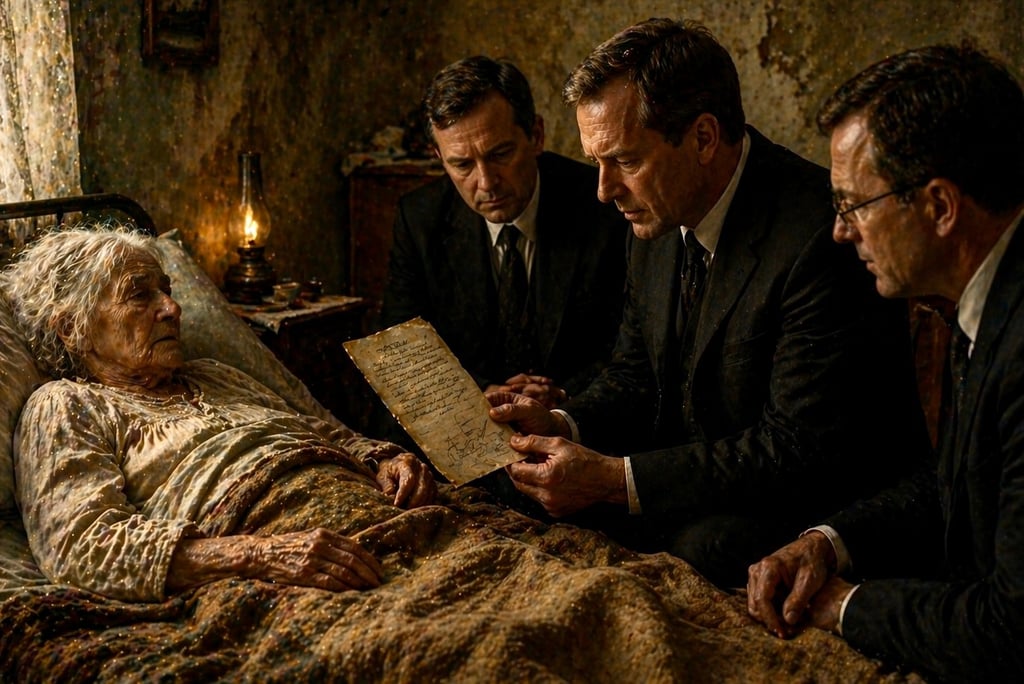
Another way to understand the importance of hearing the word of God is to compare it to a seed. Like any seed, if it is not planted, how can it grow and produce fruit? A seed cannot act on its own—it must first be received, planted, and nurtured.
But this process does not even begin until the farmer hears about the seed, accepts it—and trusts that it will produce what it promises. If we do not trust the seed, why would we take the time and effort to plant it?
In the same way, if we do not trust God, we will not give attention to His words. We will not be interested in His gifts. Therefore, it is the words, themselves, that awaken faith—introducing us to the Good News of the Vaishnava Gospel.
I certainly would not have spent so many years in what many consider a most peculiar religion if I did not trust the words of Lord Krishna and A.C. Bhaktivedanta Swami Prabhupada. As mentioned earlier, while living in my bicycle shop in Saratoga Springs, I read Krishna: The Supreme Personality of Godhead. At the end of certain chapters it stated that simply by hearing these pastimes, I would be blessed.
This struck me deeply. I had never encountered anything like that before. "Could this really be true?" Looking back now, from that moment onward, my life has never been the same. For me, the Good News of the Vaishnava Gospel is that Lord Krishna has touched my life in many different ways—often in simple, practical, and deeply personal ways. He understands my nature and knows exactly how to guide and encourage me. Today, I consider Lord Krishna to be my very best friend.
This realization has shaped my prayer life and my devotional service in a profound way. There have also been moments in my life that I can only describe as mysterious—perhaps even mystical. These experiences have made my spiritual life deeply personal. Often, they appear as what we might call, coincidences—yet, in those moments I strongly sense the presence of the Lord near me. I once read a sign in front of a church that said, "A coincident is God's way of remaining anonymous."
Before leaving Colorado, I had been feeding the homeless on the streets of Denver. Then, in 1990 a tornado struck Limon, Colorado. This was my first experience responding to a disaster and it revealed to me the enormous potential of this kind of service. That same year, I founded Krishna Disaster Relief, that is now officially a 501(c)(3) nonprofit charity.
About a year later I decided to move to Potomac, Maryland, hoping to establish Krishna Disaster Relief in Washington, D.C. Without a car, I arranged to take a “drive-away vehicle" to the East Coast—cars that need to be delivered long distances to their owners. Out of five available cars heading east, I narrowed my choice down to two.
One would take me about a hundred miles from Washington. The other was to be delivered to a place called Great Falls, Virginia. Curiously, I could not find Great Falls on my map. Even the drive-away company could only vaguely suggest that it was somewhere near Baltimore—which made little sense. With a deadline approaching, I chose the car going to Great Falls.
While completing the paperwork, my friend noticed something unusual: The delivery address was on Peacock Street. Lord Krishna is always depicted with a peacock feather. We both paused. It felt significant.
After several days of driving I arrived early and decided to first go to the Potomac temple. From there, I called the car’s owner and to my astonishment, he told me that Great Falls was less than three miles away. And yes—he lived on Peacock Street.
Out of all the cars, out of all the destinations, I had chosen the one that brought me exactly where I needed to be.
For various reasons, however, I was unable to establish Krishna Disaster Relief in Washington. After months of effort, I became discouraged. One rainy Tuesday morning in March, with only a few hundred dollars left, I made a final decision: "I would give up and go back to work."
Within minutes—literally minutes—I received a phone call. It was the Food for Life director in Philadelphia. He offered me a position as kitchen manager at a large shelter he ran, cooking vegetarian meals for homeless veterans. I had not applied. I had not inquired. I didn’t even know the position was available, and yet, the moment I let go—five minutes later the opportunity appeared.
I share these experiences not to impress, but to explain something very simple:
These kinds of events have continued to occur throughout my life, and when they are viewed alongside the teachings of the Vaishnava tradition, they strengthen my faith in the words—and the presence of Lord Krishna.
This, too, is part of the Good News of the Vaishnava Gospel.
---🔧---
Not long after I began working in Philadelphia, I went to the public library to look for a copy of The Story of a Soul by Thérèse of Lisieux. I was in the middle of writing this book and was searching for additional insight.
The day before, I had called several bookstores, but no one seemed to have it.
At the library I discovered that their copy could not be checked out, so I sat down in the reference section and read for nearly three hours. By the time I had to leave I knew I wanted a copy of my own, but once again, I had no success finding one. Amazon didn't even exits back then.
The following Sunday I went downtown to watch a movie. At one point, having become turned around, I stopped to ask for directions. After a stranger pointed the way, I found myself walking down a side street, surrounded by tall buildings and unfamiliar noise. I felt out of place.
Standing at a stoplight, I quietly offered two short prayers—one to Shrila Prabhupada and one to Jesus—"Lord Jesus Christ, have mercy on me a sinner."
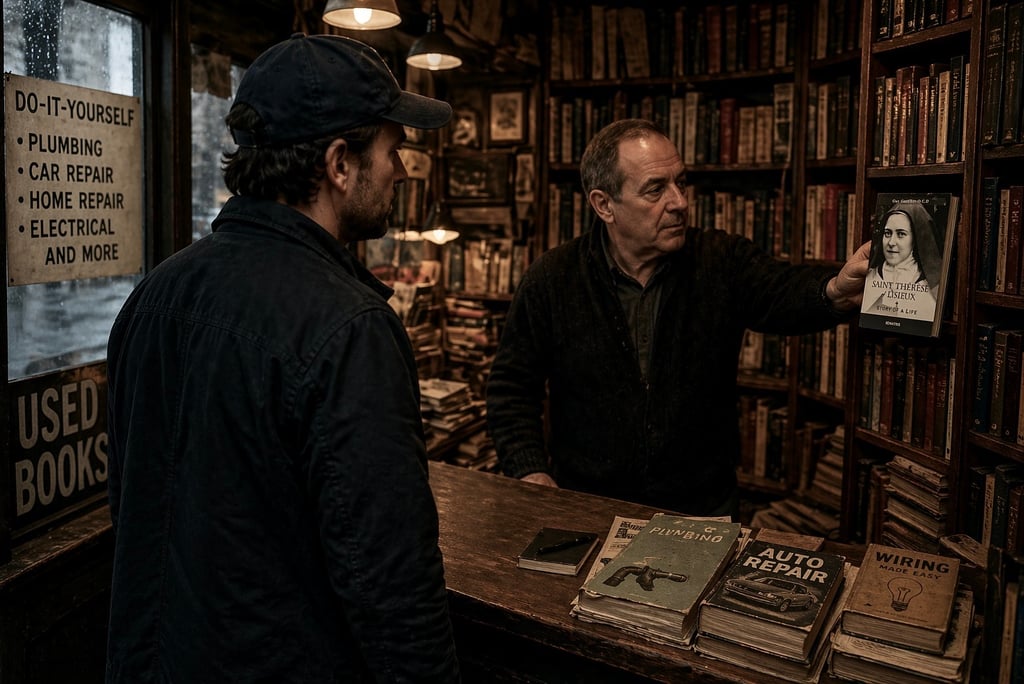
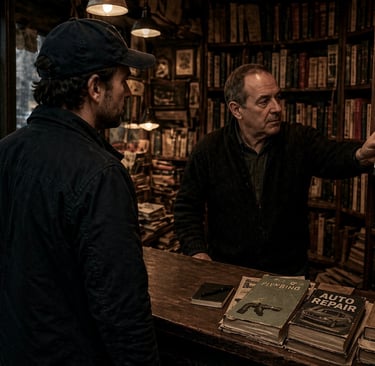
Then less than sixty steps later, I noticed a used bookstore on my right. “Perhaps,” I thought, “they might have it.”
I opened the door. Immediately to my left stood a man behind the counter. “Can I help you?” he asked.
“Yes,” I said. “I’m looking for a book—The Story of a Soul.”
He didn’t walk. He didn't talk. He didn’t search. He simply turned, extended his arm out—no more than 16 inches, and pulled the book from a shelf. “This is my personal copy,” he said. “But I’ll sell it to you for ten dollars.”
Then, after a brief pause, he added: “If you really want it, I’ll give it to you for five.”
I took out a five-dollar bill and walked out into the street—completely stunned. Just a few minutes had passed since those two prayers, and yet, out of the countless books in the world—out of all the books that could have been in that store—out of all the books that could have been within arm’s reach—it was there.
About a month later, I discovered something even more surprising: That bookstore specialized exclusively in do-it-yourself manuals—plumbing, car repair, and similar subjects. Nothing else. There had even been a sign on the storefront stating this—but I had never noticed it.
So how was this possible? As I continued my journey home, I thanked Shrila Prabhupada and Lord Krishna. Besides ending up with the book that I wanted, this wonderful aspect of the Vaishnava Gospel again flooded my soul with faith. This says to me that my religion is real and that it’s not just something in my head. “The Good News of the Vaishnava Gospel” isn’t just a bunch of lofty words in a book, but rather has entered my life in a most wonderful way, just as it can enter yours.


Like many others, I have always appreciated deep and meaningful thoughts. Over time, the wisdom found in the Bhagavad-gita opened before me a world of understanding that felt both vast and extraordinary.
The Vedic scriptures are immensely powerful—breathtakingly beautiful, highly detailed, and deeply engaging. Their sheer scope is almost beyond comprehension. Devotees such as Steven Rosen and Swami Padmanabha continue to delve into the history of India’s ancient Vedas and share their findings and insights, further illuminating this rich tradition.
When I first became a novice priest, I was told about many of the great souls who had helped Lord Chaitanya establish His great movement, but at that time there was little written about their lives—not in English. Today, this has greatly changed.
There are now many books describing these remarkable souls—individuals who have fully embraced the Good News of the Vaishnava Gospel.
Reading about their lives—their virtues, their sacrifices, and their unwavering faith in Lord Krishna has deeply strengthened my own faith. It has given me confidence, not only in their teachings, but in the reality of God Himself.
Another aspect of this “good news” is the clarity brought by A.C. Bhaktivedanta Swami Prabhupada. He leaves very little room for self-deception. He speaks plainly about discipline, and about proper conduct. I truly appreciate this, and yet, when I examine myself in that light, I cannot help but feel how far I fall from the mark. But here is where the good news becomes deeply personal, because it must contain something for people like me—otherwise, why would I so often experience Lord Krishna dealing with me with such patience and kindness?
What I am speaking about is God’s mercy. If I had to express in a single word what the Good News of the Vaishnava Gospel means to me, it would be, blessings; freely given; readily available; and offered to everyone.
A number of years ago, I attended a three-day Enlightenment Intensive in a redwood forest above Santa Cruz, California. During one of the exercises, the person sitting across from me looked at me and said, “Tell me what you are.”
Suddenly, it was as if a veil had lifted. Without planning it, I heard myself say, “I am my blessings.”
That moment became important to me because it touched something I had been searching for over many years. It also became part of the message I hope to share in this book.
In truth, I am no more special than anyone else. If I were able to know you personally—the reader of this book—I suspect I would be the one asking God for some of your virtues. For many years, I had little interest in God, and I carry no illusions about myself. As Śrīla Prabhupāda has said, the heart can sometimes be like a lump of coal.
I may say that I try, that I am sincere, or that I care. But when I honestly look within, I often question the depth of those qualities. And yet, I cannot ignore the mercy I have received.
Again and again, I have seen how patiently Lord Krishna—and His devotees—have guided me. For this reason, I offer my allegiance to Lord Krishna and to Śrīla Prabhupāda. Not perfectly, because I cannot do so perfectly. But sincerely, as best I am able.
---🔧---
There is something else I feel I should share—because it has deeply shaped my understanding of divine mercy.
Years ago, I experienced a period in my life that brought great personal suffering.
I loved my family deeply and gave everything I could as a husband and father. But circumstances unfolded in a way I could not have imagined. One day, my wife left, and I found myself raising our young children alone. Patrick was still crawling at the time.
Those months were some of the most difficult I have ever faced. With winter approaching and my work suffering, I struggled just to keep things together. Still, my children were everything to me. They were my closest companions, and I gave them all the love and attention I had.
Eventually, out of necessity, I agreed to let their mother care for them temporarily while I tried to stabilize our situation.
But soon after, they were gone—taken thousands of miles away without warning. That loss has never left me. Even now, I still think of them often, and looking back over my life I can see that suffering has been a constant teacher.
And yet, it is here—within that suffering—that the Good News of the Vaishnava Gospel has meant the most to me, because it speaks of a place where there is no suffering—no anxiety—no separation.
A place of eternal peace, and this gives me hope. Lord Krishna assures us: “By devotional service, one reaches the supreme eternal abode.” (Bhagavad-gita 8.28)
There is also this: ...that the Lord extends His protection not only to the devotee, but "The Lord gives special protection to the family members of a devotee. The Lord is so kind that He gives all protection to them." (Shrimad-Bhagavatam: 1.19.35)
This has given me the strength to continue forward—even without knowing where my children are, because I trust that they, too, are under His care.
I share this not to dwell on pain—but to show how real and necessary God’s mercy has been in my life.
(Note: The events described above were written in the early 1990s. Many years later, in 2001, I was blessed to reconnect with my children.)


---🔧---
- End of Chapter Five -